THE CLASSIC COLLECTION✦A dead man’s diaryCLASSIC FREE BOOKS
A dead man’s diary
Coulson Kernahan
THE CLASSIC COLLECTION · 1915
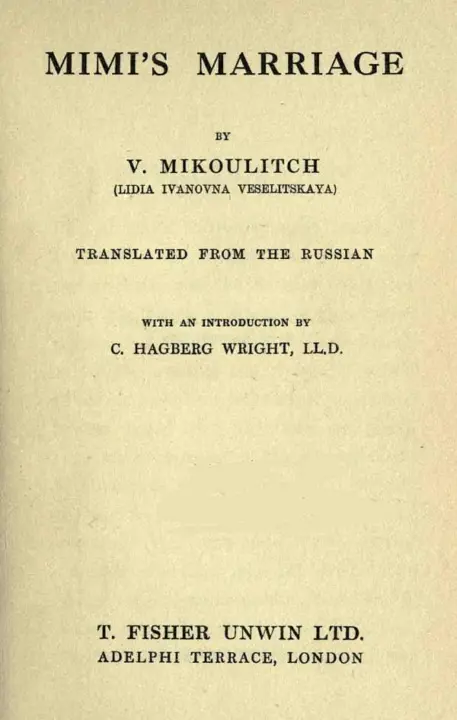
"Mimi's Marriage" by Lidiia Ivanovna Veselitskaia is a novel written in the early 20th century. The story revolves around the life of Mimi, a young woman navigating her engagement and the expectations placed upon her by society and her family. With a focus on the dynamics of relationships and the societal pressures of marriage, the narrative explores themes of love, social status, and personal happiness. The opening of "Mimi's Marriage" introduces us to the titular character, Mimotchka, who has just become engaged. The initial excitement surrounding her engagement is illustrated through the reactions of her family, particularly the delight of her aunts. Despite their enthusiasm, it is clear that Mimotchka is unsure of her own feelings towards her fiancé, Spiridon Ivanovitch. As she reflects on her past relationships, including a previous, more charming engagement that ended abruptly, the complexities of her emotions begin to emerge. This opening sets the stage for a deeper exploration of her character's internal conflicts and the societal expectations that she must navigate.
Introduction adapted from the source catalogue; source summaries may be automatically generated.
Free to read · English · 44,841 words · No account needed
MAKE TIME FOR A GOOD BOOK
On by default. Untick to stop anonymous reading totals. Each page counts after 10 seconds in view. How this works.
Anonymous counting is on unless you have switched it off.
And really everything was for the best. Mimotchka's first fiancé was a brilliant young guardsman, with beautiful shiny boots, black moustaches, curly chestnut hair, and a gold-mounted pince-nez. Mimotchka met him for the first time at an evening party, where he led the dancing,[2] clinking his spurs, facetiously fanning himself with the fans and scented hand-kerchiefs of the ladies he danced with, smiling gaily to show his brilliantly white teeth, and with diabolical entrain calling out: "Ser-r-r-r-rez le rond!... Chaîne!" ... He took a few turns with Mimotchka, admired her while she was waltzing with some one else, and, having ascertained what was the social position of her parents, asked to be presented to her.
[2] At dances in Russia a leader or conductor is generally chosen, who directs and calls out the figures in the cotillion, mazourka, and quadrilles, which are more complicated than in England.
Then he took to calling, then he began to pay her attention, and
finally made her an offer.
The brilliant guardsman and adroit dancer passed for a dangerous lady-killer. He flirted with all the pretty girls, widows, and married women that he was acquainted with, and was said to be the object of the affections of many of them. So that to carry him off from them all must have been very flattering to the vanity of both Mimotchka and her mamma.
Mimotchka accepted his offer, and was announced to be "fiancée."
On this occasion Aunt Sophy gave a dance, Aunt Mary a dinner with champagne, and Aunt Julia a folle-journée with dancing, champagne, and a sleigh drive out of town.
The young man was respectful, attentive, and amiable to his fiancées relations, and pleased them all.
"Do you know, Mimotchka," said Aunt Mary to her, "he is so nice, so very nice, that if I were only a little younger, on my word of honour, I should try and cut you out."
"Yes, you will make a handsome couple," confirmed Aunt Sophy.
"And you were quite right, my dear, to accept his offer," concluded Aunt Julia. "Such a fiancé is not met with every day. He's on the right road, and is sure to advance a great deal in the service."
The fiancé was not only "on the right road," but he was a "prince" besides, of a somewhat decayed family, certainly, but still he was a prince, and not an Eastern one. And, in addition to this, he was, he said, the nephew and sole heir of a rich, childless uncle, who owned land in the south, fifteen thousand dessiatines,[3] and coal mines as well.
[3] 40,500 acres.
Your reading position is saved on this browser. Take it to another device with a library code. Reading pages adapt to text, rather than matching a printed edition.
BEHIND THE BOOK
This eBook is for the use of anyone anywhere in the United States and most other parts of the world at no cost and with almost no restrictions whatsoever. You may copy it, give it away or re-use it under the terms of the Project Gutenberg License included with this eBook or online at www.gutenberg.org. If you are not located in the United States, you will have to check the laws of the country where you are located before using this eBook. Read the source licence.
The original source file, including credits and licence, is retained by this library. Request an original-format copy at no charge. Please include the book title and Project Gutenberg identifier #56719.
KEEP YOUR CURIOSITY GOING
Coulson Kernahan

Maurice Baring
Frances Wright
Cécile Tormay

Frederic Jesup Stimson

W. H. P. (William Henry Pope) Jarvis