THE CLASSIC COLLECTION✦Moving Pictures: How They Are Made and WorkedCLASSIC FREE BOOKS
Moving Pictures: How They Are Made and Worked
Frederick Arthur Ambrose Talbot
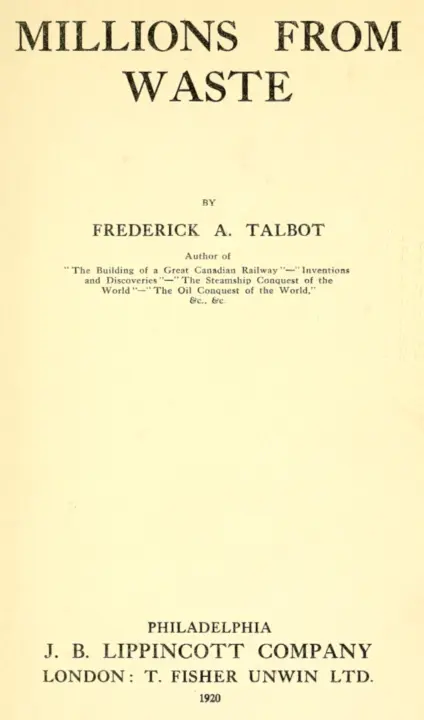
THE CLASSIC COLLECTION · 1920
"Millions from Waste" by Frederick A. Talbot is a non-fiction publication written in the early 20th century. The book explores the reclamation and exploitation of waste products in industry, highlighting how these often-overlooked resources can be transformed into significant economic assets. Talbot aims to raise awareness about the potential wealth embedded in waste and to promote methods of thrift and effective resource management to benefit both individuals and the broader community. The opening of the book introduces the pressing issue of industrial waste, linking it to economic extravagance and environmental impact. Talbot sets the context by explaining how a lack of awareness leads to wastefulness, especially in domestic settings. He discusses the relationship between waste and economic efficiency, asserting that even minor actions to reclaim and repurpose waste can lead to substantial benefits. Through specific examples, he emphasizes the need for society to embrace a more conscientious approach to waste management, ultimately arguing that understanding and utilizing waste is crucial for sustainable development and economic growth.
Introduction adapted from the source catalogue; source summaries may be automatically generated.
Free to read · English · 109,276 words · No account needed
MAKE TIME FOR A GOOD BOOK
On by default. Untick to stop anonymous reading totals. Each page counts after 10 seconds in view. How this works.
Anonymous counting is on unless you have switched it off.
When necessity, which knows no law, compelled us to economize in every direction, and particularly in connection with food, we found it expedient to turn round to ascertain whether or not we might be able to effect tangible savings to minimize the disconcerting influences of stringency. The domestic dust-bin was the first factor in the domestic circle to undergo sensational overhaul. Material which had hitherto been consigned to this dead end only too freely and perfunctorily, was more closely scrutinized to see if it could not be induced to yield further useful service before suffering complete abandonment by the housewife. Contemporaneously with this manifestation of individual private effort the civic and municipal authorities were compelled to display unwonted activity. The whole problem of refuse disposal had to be viewed from quite a new angle.
Upon investigating the issue of household refuse at close quarters, and under the microscope of concentrated interest, the country’s wastage in this direction was found to exceed the wildest speculations of the critics. For the first time illuminating statistics became available. According to the National Salvage Council, the official department created to stimulate the public mind in matters pertaining to this question, the quantity of refuse “made” by householders throughout the country during the year may be set down at 9,450,000 tons.
At first sight this figure seems so startling as to be received with incredulity, but analysis suffices to demonstrate that it does not err upon the side of exaggeration. Rather is it conservative. It is based upon an allowance of 1,680 lb. a day for each 1,000 members of the total population during 300 days of the year. An allowance of 1·68 lb. per head per day wastage cannot be construed as excessive. How many households of six persons can show a weekly dust-bin collection weighing less than 60 lb. especially when the extremely varied contents of the receptacle are born in mind?
Now, of what is the heterogeneous collection of the dust-bin composed, and what is the proportion of each to the aggregate? The following table, based upon the data collected by the official department already mentioned, shows--
Material. | Average |Total per | Estimated Value. |Percentage.| Year. | --------------------------|-----------|----------|--------------------- | | Tons. | £ | $ Fine dust | 50·98 | 4,800,000| 240,000| 1,200,000 Cinders | 39·63 | 3,700,000| 1,850,000| 9,250,000 Bricks, pots, shales, etc.| 5·35 | 500,000| 25,000| 125,000 Tins | 0·98 | 90,000| 360,000| 1,800,000 Rags | 0·40 | 37,000| 555,000| 2,775,000 Glass | 0·61 | 50,000| 100,000| 500,000 Bones | 0·05 | 4,000| -- | -- Vegetable matter | 0·72 | 68,000| -- | -- Scrap iron | 0·06 | 5,000| 15,000| 75,000 Shells (oyster, etc.) | 0·08 | 7,000| -- | -- Paper | 0·62 | 58,000| 400,000| 2,000,000
From these figures it is evident that the dust-bin is a veritable treasure ground. Of course the values are subject to market fluctuations, but it is apparent that a round £3,000,000--$15,000,000--more or less, a year, is being allowed to fly up the chimney to vanish in smoke and gases, and to extend very meagre return for its combustion.
Your reading position is saved on this browser. Take it to another device with a library code. Reading pages adapt to text, rather than matching a printed edition.
Frederick Arthur Ambrose Talbot
Frederick Arthur Ambrose Talbot
Frederick Arthur Ambrose Talbot
Frederick Arthur Ambrose Talbot
BEHIND THE BOOK
This eBook is for the use of anyone anywhere in the United States and most other parts of the world at no cost and with almost no restrictions whatsoever. You may copy it, give it away or re-use it under the terms of the Project Gutenberg License included with this eBook or online at www.gutenberg.org. If you are not located in the United States, you will have to check the laws of the country where you are located before using this eBook. Read the source licence.
The original source file, including credits and licence, is retained by this library. Request an original-format copy at no charge. Please include the book title and Project Gutenberg identifier #67837.
KEEP YOUR CURIOSITY GOING

Charles G. (Charles Griffith) Ross
Hannah Webster Foster

Emily Lawless
Edwin Hamlin Carr

Charles De Lano Hine
Andrew Ure