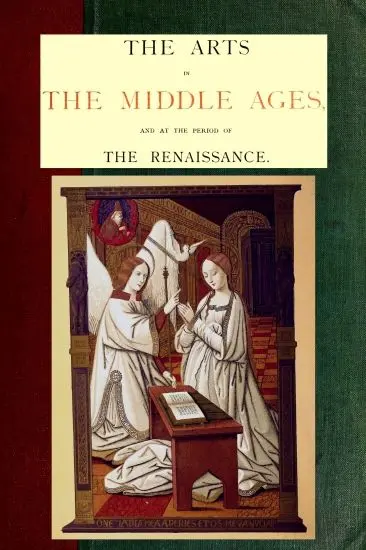
The Arts in the Middle Ages and at the Period of the Renaissance
P. L. Jacob
THE CLASSIC COLLECTION · 1874
"Military and Religious Life in the Middle Ages and at the Period of the Renaissance" by Paul Lacroix is a historical account likely written in the late 19th century. The work explores the intertwined roles of military and religious life that shaped medieval society, delving into concepts such as feudalism, the power dynamics between nobles and the church, and the transformations culminating in the Renaissance. The narrative outlines how these forces influenced the customs, laws, and architecture of the time. The opening of the book introduces the foundational themes regarding the impact of Christianity on medieval European society and the formation of its social structures. Lacroix emphasizes how the church acted as a unifying force among the barbaric tribes post-Roman Empire, aiding in the establishment of societal cohesion and moral principles. He discusses the significant roles played by notable figures, such as Charlemagne, and outlines the gradual changes in military power, feudal obligations, and the eventual rise of the bourgeoisie, setting the stage for the evolution of European civilization and its complex dynamics between various societal classes.
Introduction adapted from the source catalogue; source summaries may be automatically generated.
Free to read · English · 146,615 words · No account needed
MAKE TIME FOR A GOOD BOOK
On by default. Untick to stop anonymous reading totals. Each page counts after 10 seconds in view. How this works.
Anonymous counting is on unless you have switched it off.
In the ordinary arrangement, at this period, of any army giving battle in the open field, the free archers, the men-at-arms, and the knights were posted either in the centre or at the wings, while the infantry, properly so called, divided into little groups of five, termed cinquains, was either thrown forward to skirmish, or sent behind to cover the rearguard, or detached at intervals on the flanks in order to harass the enemy and to protect the baggage. During the engagement, all the knights, clad entirely in armour, dismounted in order to fight, and left their horses to the care of the infantry. In these days horses were only used to carry their riders on the march, which the weight of their armour would not have allowed them to perform on foot.
A horseman, when disabled by long service or by age, was no longer employed in the cavalry, but retired into the infantry, where he enjoyed, under the title of anspessade (from the Italian spezzate, broken), the privileges that were at a later period granted to veterans.
No troops, until the time of the Crusades, had any distinguishing mark among themselves, except the difference of their arms, and the idea of a military uniform had not then arisen. But with the emblazoned arms, the standards, and the pennants, there came into use scarves, worn as baldricks or sashes, over the cuirass, and of which the colour, which generally matched that of the standard of the feudal seignior of the wearer, became as much a rallying signal as the standards themselves (Fig. 51). The necessity of distinguishing friends from foes at a distance naturally also brought about more or less marked distinctions of dress.
The administration and inner regulation of an army, which had been one of the principal cares of the Gothic and earlier Frankish kings, were entirely neglected, like everything pertaining to the art of war, for many centuries. For instance, at the beginning of the fourteenth century, the captains of the different companies were allowed to distribute the pay to their men as they pleased after each muster, and were solely and entirely entrusted with the administration of their companies. They were thus entirely irresponsible, and did not concern themselves to see that the regulations, prescribed by superior authority, concerning the general discipline of the army, were carried into effect. In 1355, daring the captivity of King John in England, special commissioners were appointed, with the title of controllers, whose duty it was to superintend the internal economy of the army generally, with a view to put a stop to the numerous abuses that existed; but the disturbed and unfortunate period at which this attempt was made rendered it almost necessarily a barren one. When the dauphin came to the throne as Charles V., he returned to this project, which he had indeed himself originated, but at his death anarchy again reigned for more than a century. Civil and foreign wars laid waste and exhausted France, without bringing to the surface one single creative mind, with the exception perhaps of Jean Bureau, the grand master of artillery under Charles VIII. It is by no means going beyond the mark to state that the reverses sustained in Italy, in the reigns of Charles VIII. and Louis XII., were owing less to the chivalrous recklessness of the nobility and their ignorance of the first principles of warfare, than to the gross faults of the military administration of the country. Even in Francis I.’s time, the public service was in such a miserable condition that he was never really properly informed of the actual effective strength of his army, for his captains, whose interest it was to exaggerate the number of the rank and file under their standards (Figs. 52 and 53), habitually deceived the generals and their superiors. To such a degree was this carried that, on the eve of the battle of Pavia, Francis I. was led to believe that his army was a third stronger than it really was. At last, however, in 1517, there issued from this chaotic confusion the first germ of a proper system of supervision and control of all matters relating to war.
Your reading position is saved on this browser. Take it to another device with a library code. Reading pages adapt to text, rather than matching a printed edition.
P. L. Jacob
P. L. Jacob
BEHIND THE BOOK
This eBook is for the use of anyone anywhere in the United States and most other parts of the world at no cost and with almost no restrictions whatsoever. You may copy it, give it away or re-use it under the terms of the Project Gutenberg License included with this eBook or online at www.gutenberg.org. If you are not located in the United States, you will have to check the laws of the country where you are located before using this eBook. Read the source licence.
The original source file, including credits and licence, is retained by this library. Request an original-format copy at no charge. Please include the book title and Project Gutenberg identifier #73559.
KEEP YOUR CURIOSITY GOING
Cécile Tormay

Moritz Busch
John L. Ransom
Frances Wright
Cécile Tormay

Mabel Potter Daggett