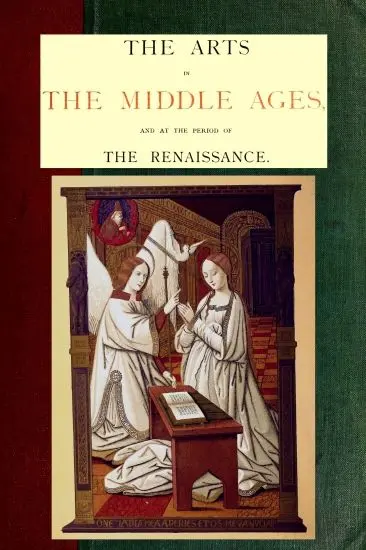
The Arts in the Middle Ages and at the Period of the Renaissance
P. L. Jacob
THE CLASSIC COLLECTION · 1874
"Military and Religious Life in the Middle Ages and at the Period of the Renaissance" by Paul Lacroix is a historical account likely written in the late 19th century. The work explores the intertwined roles of military and religious life that shaped medieval society, delving into concepts such as feudalism, the power dynamics between nobles and the church, and the transformations culminating in the Renaissance. The narrative outlines how these forces influenced the customs, laws, and architecture of the time. The opening of the book introduces the foundational themes regarding the impact of Christianity on medieval European society and the formation of its social structures. Lacroix emphasizes how the church acted as a unifying force among the barbaric tribes post-Roman Empire, aiding in the establishment of societal cohesion and moral principles. He discusses the significant roles played by notable figures, such as Charlemagne, and outlines the gradual changes in military power, feudal obligations, and the eventual rise of the bourgeoisie, setting the stage for the evolution of European civilization and its complex dynamics between various societal classes.
Introduction adapted from the source catalogue; source summaries may be automatically generated.
Free to read · English · 146,615 words · No account needed
MAKE TIME FOR A GOOD BOOK
On by default. Untick to stop anonymous reading totals. Each page counts after 10 seconds in view. How this works.
Anonymous counting is on unless you have switched it off.
In Germany and in Italy the emperor, in France and England the king, as the highest representatives of feudalism, possessed in every large city--notably in the cities termed imperial or royal--an official delegate, called burgrave, count, or viscount, who, originally at the head of the army, the magistracy, and the finances, gradually lost his prerogatives till, in the thirteenth century, he was scarcely more than a mere dignitary, without either power or credit. Many bishops, authorised by the lay sovereign, took the title of count, without, however, adding in any material degree to their influence. Besides, whatever may have been the nature and extent of the functions of a count, it does not appear that the free towns paid any more heed to them than to the pre-eminence of the bishop in all that appertained to the administration and government of the commune. In many places, especially in Italy and upon the banks of the Moselle and the Rhine, the bourgeoisie possessed councils invested both with the judicial and executive power, also a senate and a parliament, which was summoned by the ringing of a bell, and to which the lords inhabiting the adjacent castles were admitted, but only as ordinary citizens; without, however, losing any of their domainial privileges.
Though feudalism possessed nearly the same generic type in all European countries, it presented here and there varying shades of nationality, due to the dissimilarity of race, to the habits of the people, to the different modes in which it had been introduced, and to the diverse phases of its struggle and growth.
The illustrious house of Franconia, alarmed at the incessant progress of high German feudalism, and anxious to check it, created, in the midst of the duchies by which it was threatened, a number of immediate lordships, owing fealty only to the emperor, and having an hereditary right over the fiefs of chivalry. This step met with an obstinate resistance from the great vassals who possessed this hereditary right, which the elected monarch did not enjoy of himself. On the other hand, the palatine lords, agents of the emperor, and empowered to represent him in the great fiefs or in his domains, and the burgraves of the towns, impatient to free themselves from the imperial suzerainty, displayed at the same time the insubordination which the leudes had practised in the Carlovingian epoch, and endeavoured to establish for themselves an independence transmissible to their heirs. While this movement was going on, the Pope was lowering the status of the empire; Innocent II. compelled the Emperor Lothair II. to receive in fee from him Tuscany, the Duchy of Spoleta, the Marches of Ancona, Bologna, Parma, Placenza, &c., forming part of the legacy bequeathed to the Holy See by the Countess Matilda. From this flagrant humiliation, submitted to by Conrad of Hohenstaufen, the successor of Lothair, and haughtily rejected by Henry the Haughty when he refused to render feudal homage to the Pope, arose the celebrated quarrel of the Guelphs and the Ghibellines, which, from the banks of the Rhine, spread beyond the Alps, and implanted itself in the very heart of Italy. Henry the Haughty, chief of the Guelphs, independent and royal, was proscribed and stripped of his duchies, while Conrad, chief of the Ghibellines, inaugurated the brilliant dynasty of the Hohenstaufens. Thirty years of bitter warfare, during which the alliance of the papacy with the national party was cemented, seconded by the efforts of petty feudalism, led up to the treaty of Constance, which brought to a definite close the struggle of the feudal empire against the popular independence of the cities of Italy. The Pope had recovered the freeholds left him by the Countess Matilda; the towns preserved their regal prerogatives, entire liberty to raise armies, to surround themselves with walls (Fig. 29), to exercise criminal and civil jurisdiction, and to form confederations with other towns, &c. The emperor was left with no other privileges than those of confirming, through his ambassadors, the consular elections, and of appointing in each town a judge of appeal in his name. It was in vain that the Emperor Henry VI. endeavoured to re-establish high feudalism; he died in the attempt (1199), and Innocent III., who considered himself to be the natural defender of all the rights and the supreme judge in all the monarchies in Europe, resisted every effort made by Henry VI. Several Crusades, moreover, which occurred at about this period, created a modification in the warlike sentiments of the feudal nobility, until, thanks to the policy of the illustrious pontiffs who had occupied the chair of St. Peter, and to the efforts of the Italian free towns, backed up by the petty feudal nobility, the independence of Italy rose triumphant from the tomb which opened for the Emperor Frederick II. on December 13th, 1250.
Your reading position is saved on this browser. Take it to another device with a library code. Reading pages adapt to text, rather than matching a printed edition.
P. L. Jacob
P. L. Jacob
BEHIND THE BOOK
This eBook is for the use of anyone anywhere in the United States and most other parts of the world at no cost and with almost no restrictions whatsoever. You may copy it, give it away or re-use it under the terms of the Project Gutenberg License included with this eBook or online at www.gutenberg.org. If you are not located in the United States, you will have to check the laws of the country where you are located before using this eBook. Read the source licence.
The original source file, including credits and licence, is retained by this library. Request an original-format copy at no charge. Please include the book title and Project Gutenberg identifier #73559.
KEEP YOUR CURIOSITY GOING
Cécile Tormay

Moritz Busch
John L. Ransom
Frances Wright
Cécile Tormay

Mabel Potter Daggett