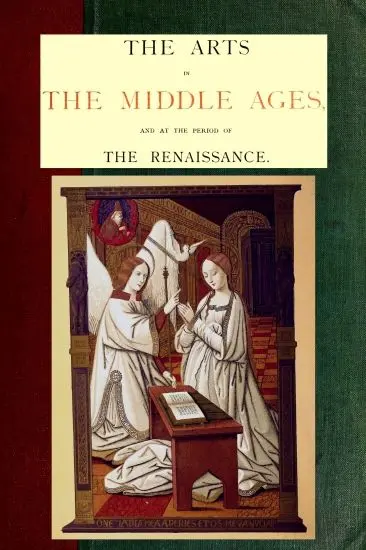
The Arts in the Middle Ages and at the Period of the Renaissance
P. L. Jacob
THE CLASSIC COLLECTION · 1874
"Military and Religious Life in the Middle Ages and at the Period of the Renaissance" by Paul Lacroix is a historical account likely written in the late 19th century. The work explores the intertwined roles of military and religious life that shaped medieval society, delving into concepts such as feudalism, the power dynamics between nobles and the church, and the transformations culminating in the Renaissance. The narrative outlines how these forces influenced the customs, laws, and architecture of the time. The opening of the book introduces the foundational themes regarding the impact of Christianity on medieval European society and the formation of its social structures. Lacroix emphasizes how the church acted as a unifying force among the barbaric tribes post-Roman Empire, aiding in the establishment of societal cohesion and moral principles. He discusses the significant roles played by notable figures, such as Charlemagne, and outlines the gradual changes in military power, feudal obligations, and the eventual rise of the bourgeoisie, setting the stage for the evolution of European civilization and its complex dynamics between various societal classes.
Introduction adapted from the source catalogue; source summaries may be automatically generated.
Free to read · English · 146,615 words · No account needed
MAKE TIME FOR A GOOD BOOK
On by default. Untick to stop anonymous reading totals. Each page counts after 10 seconds in view. How this works.
Anonymous counting is on unless you have switched it off.
Henry VIII., from the very fact of his having broken with the principle of authority in religious matters, found himself driven to an excess of severity, feeling that it was by terror alone that he could put down resistance; and, as the example of those who are placed high in authority exercises a decisive influence upon the masses, the king singled out for attack those who stood highest on the roll of magistrates and bishops--the Chancellor, Thomas More, and his illustrious friend Fisher, Bishop of Rochester (Fig. 341). They were both cited to appear before the King’s Council, and the Chancellor was condemned to die. More was passionately attached to his daughter Margaret, who, when the trial was over, threw herself upon her father’s neck, exclaiming, amidst her sobs, “My father, are you who are innocent to die?” To which, embracing her for the last time, and giving her his blessing, he replied, “Would you have me die guilty?” When he reached the foot of the scaffold he called upon the populace to witness that he died in the faith of the Catholic, Apostolic, and Roman Church. The executioner asked for his forgiveness, and More, embracing him, rejoined, “You are rendering me the greatest service that can be done to a Christian!” He met his death with joy, and his head was exposed for a fortnight upon London Bridge. His friend, the Bishop of Rochester, had been sent to the block a few weeks before (Fig. 341).
Switzerland suffered as much as England, for the Inquisition set up by Calvin at Geneva defied all description. While Calvin, as it is reported, was allowed to stigmatize those who differed from him as rogues, dogs, and scoundrels, their emperor vermin, and their fathers and mothers imps of Satan, the peasants who used rough language to their cattle were thrown into prison. Three children were publicly whipped because they had stolen away from the meeting-house to go and eat cakes. The registers of the town record that in the course of sixty years one hundred and fifty persons were burnt alive as sorcerers. Another crime punishable with death was “to speak ill of Calvin,” who made no secret of his feelings upon this point, as may be gathered from the following sentence in a letter he sent to one of his partisans: “Do not fail to purge the country of the fanatic scoundrels who go about exhorting the people to withstand us, who blacken our conduct, and who try to depict our creed as an empty dream. Such monsters ought to be put down.” On these grounds, the poet Gruet was put to the torture and beheaded “for having spoken ill of Calvin.” Michael Servetus, who practised medicine, astrology, and theology, ventured to contradict the teaching of the Reformer, especially in reference to the doctrine of the Trinity. Calvin wrote to Farel, under date of February 13th, 1546, the following letter, the original of which may still be seen in the National Library of Paris: “Servetus wrote to me the other day, and sent with his letter a large book filled with his vain and arrogant reveries, saying that I should find it full of wonderful and hitherto unknown subjects. He promises to come and meet me here, if I wish, but I do not care to enter into any arrangement, for, if he comes and I have my own way, I shall not let him escape with his life.” The unfortunate Servetus was obliged to repair thither under the following circumstances. He had clandestinely published at Vienne (Dauphiny) his book entitled “Christianismi Restitutio” (“The Restoration of Christianity”). Of this book Calvin procured a copy, which, he forwarded to the Cardinal-Archbishop of Lyons. Servetus, thanks to Calvin’s denunciations, was arrested and thrown into the ecclesiastical prison of Vienne, as this book contained many obnoxious statements tainted with heresy. It happened that the prisoner, a better doctor than he was theologian, had formerly saved the life of the only daughter of the bailiff of that town, and the gaoler received orders to favour his escape, which was effected without difficulty. Servetus unfortunately took refuge at Geneva. Calvin’s spies discovered him there; he was imprisoned on the 13th of August, 1553, and on the 26th of October, after a lengthened examination, during which he defended himself energetically against the accusations of impiety and atheism, he was condemned to be burnt alive. The sentence was carried out on the following day (Fig. 342). Calvin witnessed the execution from his window, and was soon after congratulated on what he had done by the Cantons of Zurich, Schaffhausen, Basle, and Berne. The learned Melancthon wrote to him, “Your magistrates have acted in accordance with right and justice in having this blasphemer put to death.” These acts of cruelty and vengeance, nevertheless, have excited the just indignation of several Protestant historians, who deplore the loss to Geneva of her ancient liberties and franchises. “For more than eight hundred years,” says Fazy, “the harmony between the cause of the people and that of religion had placed Geneva in the van of civilisation. Its laws were mild, acts of violence were rare, confiscation was unknown, and nowhere do we find any traces of people being persecuted for their opinions.”
Your reading position is saved on this browser. Take it to another device with a library code. Reading pages adapt to text, rather than matching a printed edition.
P. L. Jacob
P. L. Jacob
BEHIND THE BOOK
This eBook is for the use of anyone anywhere in the United States and most other parts of the world at no cost and with almost no restrictions whatsoever. You may copy it, give it away or re-use it under the terms of the Project Gutenberg License included with this eBook or online at www.gutenberg.org. If you are not located in the United States, you will have to check the laws of the country where you are located before using this eBook. Read the source licence.
The original source file, including credits and licence, is retained by this library. Request an original-format copy at no charge. Please include the book title and Project Gutenberg identifier #73559.
KEEP YOUR CURIOSITY GOING
Cécile Tormay

Moritz Busch
John L. Ransom
Frances Wright
Cécile Tormay

Mabel Potter Daggett