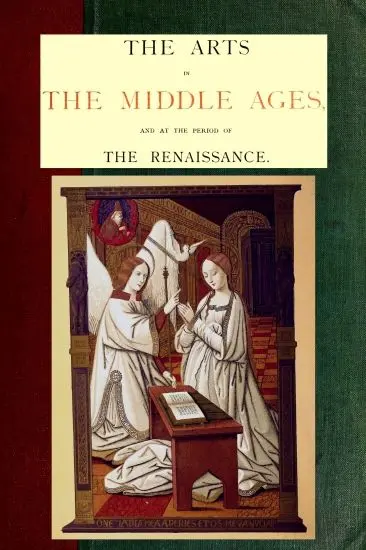
The Arts in the Middle Ages and at the Period of the Renaissance
P. L. Jacob
THE CLASSIC COLLECTION · 1874
"Military and Religious Life in the Middle Ages and at the Period of the Renaissance" by Paul Lacroix is a historical account likely written in the late 19th century. The work explores the intertwined roles of military and religious life that shaped medieval society, delving into concepts such as feudalism, the power dynamics between nobles and the church, and the transformations culminating in the Renaissance. The narrative outlines how these forces influenced the customs, laws, and architecture of the time. The opening of the book introduces the foundational themes regarding the impact of Christianity on medieval European society and the formation of its social structures. Lacroix emphasizes how the church acted as a unifying force among the barbaric tribes post-Roman Empire, aiding in the establishment of societal cohesion and moral principles. He discusses the significant roles played by notable figures, such as Charlemagne, and outlines the gradual changes in military power, feudal obligations, and the eventual rise of the bourgeoisie, setting the stage for the evolution of European civilization and its complex dynamics between various societal classes.
Introduction adapted from the source catalogue; source summaries may be automatically generated.
Free to read · English · 146,615 words · No account needed
MAKE TIME FOR A GOOD BOOK
On by default. Untick to stop anonymous reading totals. Each page counts after 10 seconds in view. How this works.
Anonymous counting is on unless you have switched it off.
Christian Rome, bedewed with the martyrs’ blood and enriched with their relics, has since the first ages of Christianity been the central object of the great majority of pilgrimages. Her three hundred churches have one after another been visited by a host of believers drawn thither by pious recollections, by all kinds of effectual acts of grace or indulgences, by an abundant hospitality, by a pompous ceremonial, and, above all, by the ardour of their faith. On great anniversaries, at jubilees and at the Inventions of the bodies of saints, the number of pilgrims multiplied indefinitely. As many as twelve hundred thousand have been known to have arrived in the course of a single day, from different parts of the world--pious bands which encamped around the walls of the Eternal City, their ranks being constantly added to by fresh arrivals during several consecutive months. Besides the basilica of St. Peter, Rome possessed several privileged sanctuaries which were at all periods the chief haunts of the pilgrims: these were the Church of Sta. Maria Maggiore, where the manger in which our Lord was born was seen; San Praxeas, the basilica which contained two thousand five hundred martyrs; San Giovanni Laterano, in which are the scala santa, the same steps blessed by the blood of Jesus Christ when He was wearing the crown of thorns, and which are only ascended by people upon their knees; San Pietro-in-Montorio, the crypt of which stands upon the spot where that apostle was crucified; San Sebastiano-fuor-gli-Muri, famous for its catacombs; San Paolo da Tre Fontane--miraculous springs which gushed from the ground with three leaps, just as St. Paul’s head rebounded three times from the ground when he was executed; San Paolo-fuori-le-Muri, where is preserved the crucifix which spoke to St. Bridget; San Lorenzo-fuori-le-Muri, where are interred the bodies of St. Stephen and St. Lawrence; Santa Croce di Gerusalemme (Fig. 293), a basilica founded by the august mother of St. Constantine on her return from a pilgrimage to Palestine; St. Cecilia, a church built upon the site of the house in which that saint lived, and containing the bath-room in which she suffered martyrdom; as well as twenty other churches which have been the cradles of the Christian religion, and which, by their origin, tradition, and relics, command the pious respect of those who visit them. No matter by what road the pilgrims travelled, they passed on their way to Rome a vast number of sanctuaries and stations which were dedicated either to the Virgin Mary or to illustrious saints (Fig. 294). Upon the sea-coast, the church of Our Guardian Lady and of Our Lady of Genesta, the tutelary guardians of the Gulf of Lyons and the Gulf of Genoa; and with them St. Martha and St. Magdalene; St. George, the legend of whose warlike exploit is reproduced in so many pictures; at Lucca, Our Lady of the Rose; in the Neapolitan States, Our Lady of the Commencement, Our Lady of the Conception, Our Lady of the Assumption, Our Lady of Naples, Our Lady of Mount St. Januarius; in Sicily, Our Lady of the Crown, St. Restituta, St. Agatha, but particularly St. Rosalie; towards the eastern shores of the Ionian Sea, several virgins of Byzantine origin, who were worshipped conjointly with St. Nicholas and St. Spiridion; along the Adriatic other Madonnas and other saints, conspicuous among whom, like a precious pearl, shines the celebrated image known as Our Lady of Victory. It was in her honour that an Eastern emperor caused a triumphal car to be constructed, in order that she might be drawn through the streets of Constantinople whenever the empire was threatened with danger. Brought to Venice and deposited in the Church of St. Mark, she was looked upon as the safe-guard of the republic, and, in place of the triumphal car, a magnificent gondola was specially reserved for this image. From the days of Godfroy de Bouillon, who, with a part of the Crusaders, made a pilgrimage to Bari, on the “soil of Monseigneur St. Nicholas,” before pursuing his journey to Jerusalem, this august sanctuary became the scene of continuous devotions. Joinville, Froissart, Philippe Giraud de Vigneulles, and other chroniclers speak of the number of pilgrims who visited Bari to do honour to the relics of St. Nicholas. The miracles accomplished there through the intercession of the blessed Bishop of Myra, form a rich volume of legends dating from the eleventh century, when forty burghers of the town of Bari went into Asia Minor to rescue his precious body from the violence of the Saracens.
Your reading position is saved on this browser. Take it to another device with a library code. Reading pages adapt to text, rather than matching a printed edition.
P. L. Jacob
P. L. Jacob
BEHIND THE BOOK
This eBook is for the use of anyone anywhere in the United States and most other parts of the world at no cost and with almost no restrictions whatsoever. You may copy it, give it away or re-use it under the terms of the Project Gutenberg License included with this eBook or online at www.gutenberg.org. If you are not located in the United States, you will have to check the laws of the country where you are located before using this eBook. Read the source licence.
The original source file, including credits and licence, is retained by this library. Request an original-format copy at no charge. Please include the book title and Project Gutenberg identifier #73559.
KEEP YOUR CURIOSITY GOING
Cécile Tormay

Moritz Busch
John L. Ransom
Frances Wright
Cécile Tormay

Mabel Potter Daggett