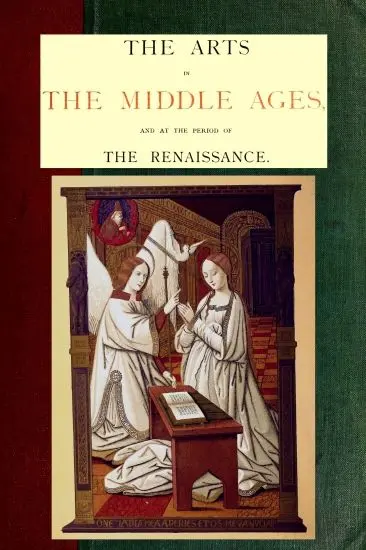
The Arts in the Middle Ages and at the Period of the Renaissance
P. L. Jacob
THE CLASSIC COLLECTION · 1874
"Military and Religious Life in the Middle Ages and at the Period of the Renaissance" by Paul Lacroix is a historical account likely written in the late 19th century. The work explores the intertwined roles of military and religious life that shaped medieval society, delving into concepts such as feudalism, the power dynamics between nobles and the church, and the transformations culminating in the Renaissance. The narrative outlines how these forces influenced the customs, laws, and architecture of the time. The opening of the book introduces the foundational themes regarding the impact of Christianity on medieval European society and the formation of its social structures. Lacroix emphasizes how the church acted as a unifying force among the barbaric tribes post-Roman Empire, aiding in the establishment of societal cohesion and moral principles. He discusses the significant roles played by notable figures, such as Charlemagne, and outlines the gradual changes in military power, feudal obligations, and the eventual rise of the bourgeoisie, setting the stage for the evolution of European civilization and its complex dynamics between various societal classes.
Introduction adapted from the source catalogue; source summaries may be automatically generated.
Free to read · English · 146,615 words · No account needed
MAKE TIME FOR A GOOD BOOK
On by default. Untick to stop anonymous reading totals. Each page counts after 10 seconds in view. How this works.
Anonymous counting is on unless you have switched it off.
Most of the churches and abbeys, such as those of Saint-Denis, of Saint-Martin des Champs, and of Saint-Germain des Prés (Fig. 16), which proudly reared their towers and spires opposite the Louvre of the kings of France, exercised on their own account all the feudal rights which they had acquired by reason of the territorial possessions as well as by the concessions lavishly ceded to them by their sovereigns. The archbishops, the bishops, and the abbots thus became temporal lords, and were consequently forced to have vassals for military service, to keep up a court of justice, and to support a mint, thus uniting--in the case of bishops who enjoyed the temporal rank of count--spiritual with political authority.
This twofold power made the prelate the suzerain of all the seigniors in his diocese. Towards the end of the tenth century the feudal ecclesiastics, by reason of the permission granted to laymen to bequeath their property to the Church, as well as of the strictness of the laws which forbade the alienation of ecclesiastical property, possessed a fifth part of all French and English soil, and nearly a third of Germany; whilst the last surviving Carlovingian could only claim the town of Laon, where he resided, to such an extent had his predecessors despoiled themselves of their lands in favour of their great vassals, who still, however, recognised him as their suzerain. In the eleventh century Europe was divided into a multitude of fiefs, each having its own mode of life, its own laws, its own customs, and its ecclesiastical or lay head, who was as independent as he well could be. Around these, but under certain conditions of dependence and of subordination, was developed the much more numerous class of freedmen. Gradually manual labour and the efforts of a growing intelligence led to the political existence of the bourgeois, those worthy representatives of the labouring portion of society. The part which was taken by the latter was not always of a passive character. As early as the year 987 the villains of Normandy rebelled and leagued themselves against their feudal lords, claiming the right of fishing and of the chase, and the privilege of having an administration and a magistracy of their own; it was thus that the innate power of the people revealed itself: the towns and the boroughs were peopled with inhabitants who held their homes in tenure from the seigniors--who were the proprietors of the soil--under certain servile obligations as to the payment of taxes. As soon as the establishment of the hierarchy of fiefs had put an end to discord and anarchy, the germs of the Great Revolution--destined to restore civil liberty to the heirs of the countless inhabitants whom the misfortunes of Gaul and the tyranny of the emperors had reduced to servitude--began to show themselves. It was in this wise that the communal movement originated, and the town of Mans is generally credited with having been the first to set the example of having, through the agency of the working classes, conspired against the seignior. We find in the annals of Metz, about the year 1098, record of the election for life of a maître-échevin (high-sheriff), named Millon, in place of one, by name Hennolu-Bertin, who had been elected for one year, but who, doubtless, was not the first in his office. And we find an echevinal council, termed the council of the twelve, enjoying functions at once magisterial, administrative, and military. Metz possessed at the same time, by the side of their communal organization, a count of the name of Gerald, who was succeeded in 1063 by another count named Folmar. It had also a bishop, rich, powerful, firm, full of learning, named Adalbéron, a favourite both with the Pope and with the Emperor, influential enough to obtain anything, but never asking anything but what was just. It was, therefore, under the protection of the sword of the count and of the crozier of the bishop that the municipal liberties of Metz began to grow--liberties that became within a single century so developed and powerful that Bertram, another bishop of Saxon origin, undertook the task of restricting them, and endeavoured to regulate them by a charter which restored to the Church its electoral but not its governmental influence. This first communal organization, a type of many other municipalities in France and in Germany, was inaugurated without bloodshed. But this was not everywhere the case; at Cambrai, for instance, the commune was only established after a century of open warfare between the inhabitants and the bishop, their suzerain. At Laon--that ancient feudal city where the nobility and the burgesses engaged in all kinds of brigandage, where the bishop, who was a famous warrior and huntsman, was in the habit of sharing with the dignitaries of his cathedral and with the aristocracy of the town the fruit of his exactions--the commune inaugurated itself with the blood of their bishop, who was assassinated in the midst of a terrible insurrection. The towns of Amiens, of Beauvais, of Noyon, of Saint-Quentin, of Sens, of Soissons (Fig. 17), and of Vézelay, underwent nearly the same vicissitudes that Cambrai and Laon had experienced, and finally attained, after similar trials, a similar position. Perhaps Cambrai, of all the French communes, was the most exacting towards the feudal power that it was trampling under foot. “Ni l’évêque, ni l’Empereur, ne peuvent mia asseoir ne taxe, ne tribut, et n’en peult issir la malice, fors que pour la bonne garde et défense de la ville, et ce depuis coq chantant jusques à la nuit.”[1] No vassal had ever claimed or obtained more in the exercise of his feudal rights (Fig. 18).
Your reading position is saved on this browser. Take it to another device with a library code. Reading pages adapt to text, rather than matching a printed edition.
P. L. Jacob
P. L. Jacob
BEHIND THE BOOK
This eBook is for the use of anyone anywhere in the United States and most other parts of the world at no cost and with almost no restrictions whatsoever. You may copy it, give it away or re-use it under the terms of the Project Gutenberg License included with this eBook or online at www.gutenberg.org. If you are not located in the United States, you will have to check the laws of the country where you are located before using this eBook. Read the source licence.
The original source file, including credits and licence, is retained by this library. Request an original-format copy at no charge. Please include the book title and Project Gutenberg identifier #73559.
KEEP YOUR CURIOSITY GOING
Cécile Tormay

Moritz Busch
John L. Ransom
Frances Wright
Cécile Tormay

Mabel Potter Daggett