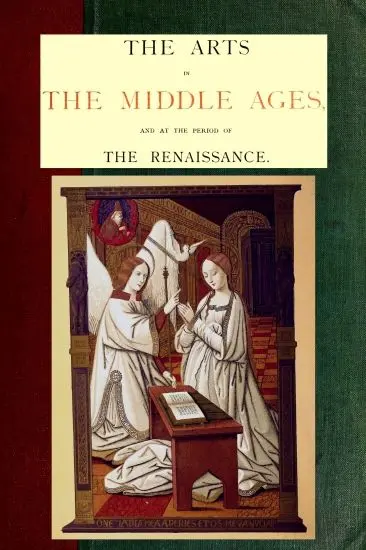
The Arts in the Middle Ages and at the Period of the Renaissance
P. L. Jacob
THE CLASSIC COLLECTION · 1874
"Military and Religious Life in the Middle Ages and at the Period of the Renaissance" by Paul Lacroix is a historical account likely written in the late 19th century. The work explores the intertwined roles of military and religious life that shaped medieval society, delving into concepts such as feudalism, the power dynamics between nobles and the church, and the transformations culminating in the Renaissance. The narrative outlines how these forces influenced the customs, laws, and architecture of the time. The opening of the book introduces the foundational themes regarding the impact of Christianity on medieval European society and the formation of its social structures. Lacroix emphasizes how the church acted as a unifying force among the barbaric tribes post-Roman Empire, aiding in the establishment of societal cohesion and moral principles. He discusses the significant roles played by notable figures, such as Charlemagne, and outlines the gradual changes in military power, feudal obligations, and the eventual rise of the bourgeoisie, setting the stage for the evolution of European civilization and its complex dynamics between various societal classes.
Introduction adapted from the source catalogue; source summaries may be automatically generated.
Free to read · English · 146,615 words · No account needed
MAKE TIME FOR A GOOD BOOK
On by default. Untick to stop anonymous reading totals. Each page counts after 10 seconds in view. How this works.
Anonymous counting is on unless you have switched it off.
Near the close of the ninth century, Anastasius the Librarian wrote, at Rome, an Ecclesiastical History, from which we learn that the hierarchical order of the functionaries in the primitive Church was composed as follows: the doorkeeper (Fig. 220), the reader, the exorcist (Fig. 221), the acolyte, the sub-deacon, the keeper of the confessions of the martyrs, the deacon, the priest, the bishop. To these were afterwards added the chanters or psalmists, entitled confessors, because their function was to confess the name of God by celebrating His praises. The interpreter-linguists, the copyists, and the notaries, who figure in the Greek as well as in the Roman Church down to the fourth or fifth century, ranked with the order of confessors and that of clerks.
In the early days of Christianity the bishop in each diocese consecrated to the service of religion, after the manner of St. Paul, those who were represented to him as being the most worthy, or whom he himself deemed fitting. The aspirant to the major orders sometimes rose very slowly, however meritorious he might be; thus Latinus, Bishop of Brescia, who died towards the close of the third century, had been, as his epitaph recorded, simple exorcist for twelve years, priest for fifteen, and bishop for three years and seven months. There were, however, some rapid and almost immediate promotions, called per saltum, because they jumped, as it were, from one grade to another; but these were made under exceptional circumstances.
At first the Christians had not any clergymen, properly so called; priests, however, ministered in each locality, for we read that St. Paul appointed Titus “to ordain elders in every city” (Titus i. 5). But in most cases, during the first centuries, the bishop alone ministered in his episcopal city, particularly in the East (Fig. 222).
After the fourth century we find that, in the East as at Rome, there were other churches in the large towns besides the cathedral; the functions of the clergymen, or cardinals, who ministered in them were confined to giving the people religious instruction, and to keep the bishop informed of everything relating to the government of the church. Down to the fifth century, the administration of the sacraments and the celebration of the holy communion took place in the cathedral only. Pope St. Marcellus founded, in the fourth century, twenty-five titles or parishes in Rome, in order to afford greater facilities for the preparatory instruction by which the sacraments of baptism and penance were preceded. But in the fifth century, when the cathedrals were found too small to hold all the congregation, it became the custom to distribute, in the titles or parishes of the city, the holy eucharist which the bishop sent by the hands of deacons to the titulary clergy. The bishops also delegated to their clergy the power of receiving the reconciliation of the penitents in cases of necessity, of admitting heretics in danger of death (but only in the bishop’s absence), and of pronouncing excommunications in their parishes, by virtue of a sentence delivered by the bishop. The clergyman also visited the sick, administered the sacrament of extreme unction, blessed the private dwelling-places, and himself selected the staff for his church. At last, in the sixth century, clergymen celebrated, in the quarters or titles wherein they ministered, the entire liturgy of the holy communion, and from the seventh century they were empowered to diminish or to increase, as they thought proper, in accordance with the revenues of the parish, the number of the clerks, choristers, and the various subordinate officers. In compliance with the wishes of the faithful, the bishop would often authorise the clergy to celebrate two masses upon the same day, one to take place of necessity in the parish church, the other perhaps in some oratory attached to the parish (Fig. 223).
Your reading position is saved on this browser. Take it to another device with a library code. Reading pages adapt to text, rather than matching a printed edition.
P. L. Jacob
P. L. Jacob
BEHIND THE BOOK
This eBook is for the use of anyone anywhere in the United States and most other parts of the world at no cost and with almost no restrictions whatsoever. You may copy it, give it away or re-use it under the terms of the Project Gutenberg License included with this eBook or online at www.gutenberg.org. If you are not located in the United States, you will have to check the laws of the country where you are located before using this eBook. Read the source licence.
The original source file, including credits and licence, is retained by this library. Request an original-format copy at no charge. Please include the book title and Project Gutenberg identifier #73559.
KEEP YOUR CURIOSITY GOING
Cécile Tormay

Moritz Busch
John L. Ransom
Frances Wright
Cécile Tormay

Mabel Potter Daggett