
Elsie’s Friends at Woodburn
Martha Finley
THE CLASSIC COLLECTION · 1881
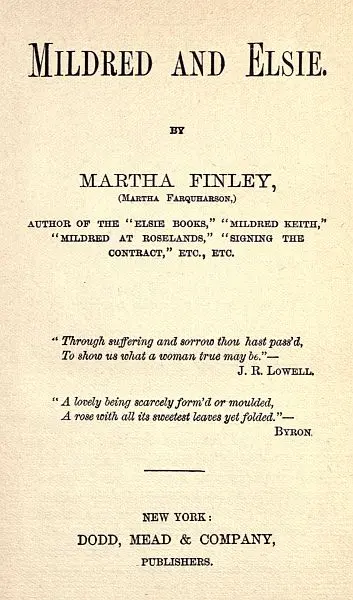
"Mildred and Elsie" by Martha Finley is a novel written in the late 19th century. This narrative primarily revolves around the lives of two young girls, Mildred and her cousin Elsie. The story explores themes of love, family dynamics, and moral dilemmas faced by the characters, particularly focusing on Mildred's emotional struggles as she navigates her affections and sense of duty. The opening of the book introduces readers to Mildred as she awakens to a beautiful morning, reflecting on a significant decision that may impact her future. She desires guidance, particularly from her mother, as she grapples with her feelings for Charlie Landreth and the barriers in their relationship. Upon meeting her cousin Elsie, who is portrayed as a sweet and innocent child, Mildred's nurturing side emerges. The chapter establishes the emotional landscape that will unfold throughout the story, highlighting Mildred's internal conflicts and her relationships with those around her, setting the stage for a rich exploration of love and friendship against the backdrop of societal expectations.
Introduction adapted from the source catalogue; source summaries may be automatically generated.
Free to read · English · 63,215 words · No account needed
MAKE TIME FOR A GOOD BOOK
On by default. Untick to stop anonymous reading totals. Each page counts after 10 seconds in view. How this works.
Anonymous counting is on unless you have switched it off.
In another minute or two bridegroom and bride, with the whole train of attendants, had taken their places in presence of the assembled guests, and the ceremony began, Frank Osborne officiating.
He did not seem at all embarrassed or at a loss for words; his manner was solemn and tender, and when the ceremony was over every one said, "How beautiful it was!"
While the bride and groom were receiving the congratulations of relatives and friends, Mr. Lord, having leisurely finished his tea, sat in the farm-house porch, quietly conversing with his host. But a sudden thought seemed to strike him, and he started up in evident perturbation.
"What is it?" asked Mr. Vail; "anything gone wrong?"
"Rather," groaned the minister, glancing at the face of his watch, which he had just drawn from its fob. "I was to have married Wallace Ormsby and one of Mr. Keith's daughters about fifteen minutes ago."
"Better get back to town, then, as fast as you can," returned the farmer, laughing. "I'll harness up and take you."
"Alas, man, it's already too late!" sighed the minister.
"'Better late than never,' though, and they may be waiting for you
still."
"Why, yes; that's possible, to be sure!"
"Where shall I take you?" Mr. Vail asked, half an hour later, as they
drove into the town.
"Drive right to Mr. Keith's, if you please."
"I thought maybe you'd want to fix up a bit, seeing it's a wedding
you're going to."
"Oh, to be sure! yes, certainly! I'm glad you reminded me. I'll go home
and dress first."
"And while you're at that I'll go round and tell 'em you're coming--just to keep 'em from getting quite out of heart, you know."
He went, and by the time Mr. Lord's toilet was completed, returned with the information, delivered in tones of amusement and with eyes twinkling with fun: "You've lost the job, sir; somebody else has tied the knot; but they've sent word for you to hurry along and you'll be in time for the refreshments. So cheer up, for that's the main thing, after all, ain't it."
"Really I--I'm ashamed to go now," stammered the minister, looking much mortified and embarrassed.
"Tut, tut, man! better treat it as a good joke," returned the farmer
gayly.
"I believe you're right," said Mr. Lord, and proceeded to take the
advice.
His apologies and excuses were received with good-humored raillery, mingled with laughing assurances that he need not disturb himself; as things had turned out 'twas all very well; it seemed a pleasant accident that had left the performing of the ceremony to an old and valued friend of the bride and her family.
Your reading position is saved on this browser. Take it to another device with a library code. Reading pages adapt to text, rather than matching a printed edition.
Martha Finley

Martha Finley

Martha Finley

Martha Finley
BEHIND THE BOOK
This eBook is for the use of anyone anywhere in the United States and most other parts of the world at no cost and with almost no restrictions whatsoever. You may copy it, give it away or re-use it under the terms of the Project Gutenberg License included with this eBook or online at www.gutenberg.org. If you are not located in the United States, you will have to check the laws of the country where you are located before using this eBook. Read the source licence.
The original source file, including credits and licence, is retained by this library. Request an original-format copy at no charge. Please include the book title and Project Gutenberg identifier #45651.
KEEP YOUR CURIOSITY GOING
Coulson Kernahan

Maurice Baring
Frances Wright
Cécile Tormay

Frederic Jesup Stimson

W. H. P. (William Henry Pope) Jarvis