THE CLASSIC COLLECTION✦The Little Vanities of Mrs. Whittaker: A NovelCLASSIC FREE BOOKS
The Little Vanities of Mrs. Whittaker: A Novel
John Strange Winter
THE CLASSIC COLLECTION · 1885
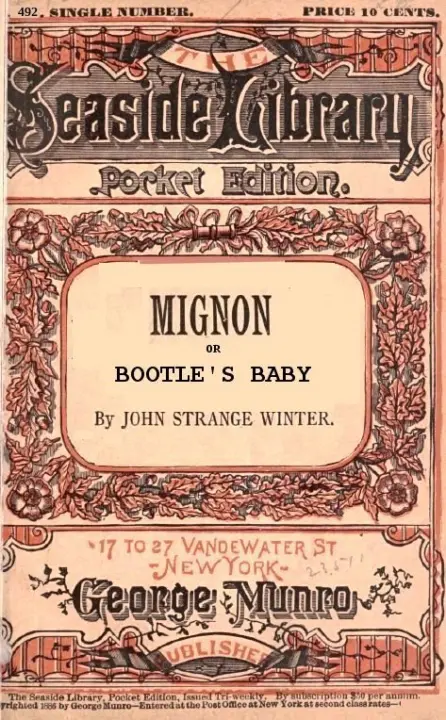
"Mignon; or, Bootles' Baby" by John Strange Winter is a novel written in the late 19th century. The story revolves around Captain Algernon Ferrers, affectionately called "Bootles," who unexpectedly finds himself responsible for a baby girl named Mignon after her mother leaves her in his care, thus triggering a series of humorous and heartfelt events within a military barracks setting. At the start of the narrative, Bootles is introduced during a late-night card game, where he suffers from a headache and seeks solitude, inadvertently discovering a baby in his bed. Confused and surprised, Bootles learns from a letter that the child is his—though he claims no knowledge of her origins despite the implications. A mix of light-hearted banter, camaraderie among officers, and Bootles's growing attachment to Mignon unfolds as his fellow officers tease him about this unexpected turn of events. The opening chapters set the stage for a charming exploration of love, responsibility, and the complexities of life in a military community, while Bootles navigates the challenges of parenthood.
Introduction adapted from the source catalogue; source summaries may be automatically generated.
Free to read · English · 17,429 words · No account needed
MAKE TIME FOR A GOOD BOOK
On by default. Untick to stop anonymous reading totals. Each page counts after 10 seconds in view. How this works.
Anonymous counting is on unless you have switched it off.
The baby, pleased with the glittering toy, set up a cry of delight, and Bootles took the opportunity of slipping out. He entered the anteroom with a very rueful face, finding it pretty much as he had left it. Lacy was the first to catch sight of him.
“Halloo, Bootles, what’s the mat-tah?” he asked. “Is your head worse?”
“My head? Oh, I forgot all about it,” Bootles replied. “But, I say, I’m in a mess. There’s a baby in my room.”
“A WHAT?” they cried, with one voice.
“A baby,” repeated Bootles, dismally.
“Al—ive?” asked Lacy, with his head on one side.
“Alive! Oh, very, very much so, and means to stop, for it has brought its entire wardrobe and a letter of introduction with it,” holding the letter for any one to take who chose. It was Lacy who did so, and he asked if he should read it up.
“Yes, do,” said Bootles, dropping into a chair with a groan. “Perhaps some one else will own to it.”
So Lacy read the letter in his ridiculous drawl of a voice, and ceased amid profound silence—“Fa-ah-well!”
“Well?” said Bootles, finding no one seemed inclined to speak. “Well?”
“Well,” said Preston, solemnly, “if you want my opinion, Bootles, I think you ought to be ashamed of yourself.”
A general laugh followed, but Bootles protested.
“Oh, don’t imagine it’s me. I’ve nothing to do with it. I shouldn’t have come to you fellows if I had.”
“No, no, of course not,” returned Miles, promptly, but with an air which raised another shout.
“Then it’s a plant,” announced Preston, in a tone of conviction.
“Of course it’s a plant,” cried Bootles; “but why in the wide world should it be planted on me?”
“Why, indeed?” echoed Miles, feelingly.
“Besides,” Bootles continued, “some of you know my mother, and that her name was not Mary but Margaret.”
Now as several of those present had known Lady Margaret Ferrers very well, that was a strong point in favor of Preston’s assertion that the affair was a plant. The chief question, however, was what could be done with the little stranger for that night. Some woman, of course, must look after it, but who? It was then after two o’clock, and the lights had been out hours ago in the married people’s quarters. Bootles did not know what to do, and said so.
“Is it in your room now?” Preston asked.
“Yes.”
“Where did you find it?”
“In my cot.”
“The devil you did! I wonder you weren’t frightened out of your very
wits.”
“I nearly was,” Bootles admitted.
Your reading position is saved on this browser. Take it to another device with a library code. Reading pages adapt to text, rather than matching a printed edition.
BEHIND THE BOOK
This eBook is for the use of anyone anywhere in the United States and most other parts of the world at no cost and with almost no restrictions whatsoever. You may copy it, give it away or re-use it under the terms of the Project Gutenberg License included with this eBook or online at www.gutenberg.org. If you are not located in the United States, you will have to check the laws of the country where you are located before using this eBook. Read the source licence.
The original source file, including credits and licence, is retained by this library. Request an original-format copy at no charge. Please include the book title and Project Gutenberg identifier #64603.
KEEP YOUR CURIOSITY GOING
Coulson Kernahan

Maurice Baring
Frances Wright
Cécile Tormay

Frederic Jesup Stimson

W. H. P. (William Henry Pope) Jarvis