THE CLASSIC COLLECTION✦The Little Vanities of Mrs. Whittaker: A NovelCLASSIC FREE BOOKS
The Little Vanities of Mrs. Whittaker: A Novel
John Strange Winter
THE CLASSIC COLLECTION · 1885
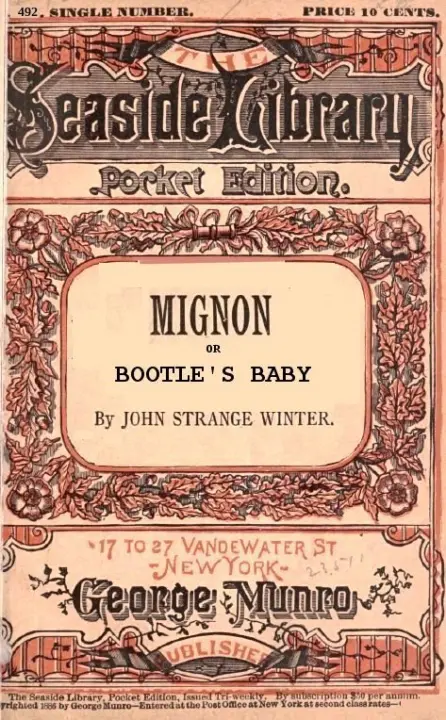
"Mignon; or, Bootles' Baby" by John Strange Winter is a novel written in the late 19th century. The story revolves around Captain Algernon Ferrers, affectionately called "Bootles," who unexpectedly finds himself responsible for a baby girl named Mignon after her mother leaves her in his care, thus triggering a series of humorous and heartfelt events within a military barracks setting. At the start of the narrative, Bootles is introduced during a late-night card game, where he suffers from a headache and seeks solitude, inadvertently discovering a baby in his bed. Confused and surprised, Bootles learns from a letter that the child is his—though he claims no knowledge of her origins despite the implications. A mix of light-hearted banter, camaraderie among officers, and Bootles's growing attachment to Mignon unfolds as his fellow officers tease him about this unexpected turn of events. The opening chapters set the stage for a charming exploration of love, responsibility, and the complexities of life in a military community, while Bootles navigates the challenges of parenthood.
Introduction adapted from the source catalogue; source summaries may be automatically generated.
Free to read · English · 17,429 words · No account needed
MAKE TIME FOR A GOOD BOOK
On by default. Untick to stop anonymous reading totals. Each page counts after 10 seconds in view. How this works.
Anonymous counting is on unless you have switched it off.
So Bootles carried her to the fire in the adjoining room, where the nurse was sewing a fresh frill of lace on the pretty velvet frock, with its braidings of scarlet and gold, which she had worn that day.
“Lal said Mignon wasn’t to go to Bootles,” she said, reproachfully.
“Bootles has been bothered, Mignon,” he answered.
“Poor Bootles!” stroking his cheek with her soft hand. “Bootles was vexed; Lal said so. But not with Mignon. Mignon told Lal so,” confidently.
“Never with Mignon,” answered Bootles, resting his cheek against the tossed golden curls, and feeling as if he had done this faithful baby heart a moral injustice by his hours of anger and doubt.
There was a moment of silence, broken by the nurse. “Have you heard, sir, how Mr. Gilchrist is?” she asked.
Bootles roused himself. “He is dead, nurse. Died half an hour ago.”
“Then, if you please, sir,” she asked, hesitatingly, “might I ask if it is true about Miss Mignon?”
“Yes, it is true,” his face darkening.
“Because, sir, Miss Mignon should have mourning,” she began, when Bootles
cut her short.
“I shall not allow her to wear mourning for Mr. Gilchrist,” he said, curtly; so the nurse dared say no more.
Three days later the funeral took place; and if the facts of the dead man’s having acknowledged Miss Mignon as his child, and having admitted to Bootles that he had transferred her that night from his own quarters to Bootles’s rooms, created a sensation, it was as nothing to the intense surprise caused by the will, which was read, by the dead man’s desire, before all the officers of the regiment.
In it he left his entire property to his daughter, Mary Gilchrist, now in the care of Captain Ferrers, and commonly known as Mignon, on condition that Captain Ferrers consented to be her sole guardian and trustee until she had attained the age of twenty-one, or until her marriage, provided it should be with her guardian’s sanction, and on the express understanding that Captain Ferrers should not give up the care of the child to her mother, even temporarily. To his wife, Helen Gilchrist, a copy of this testament was to be sent forthwith. Should any of the conditions be violated, the whole property of which he died possessed should go to his cousin, Lucian Gavor Gilchrist; but if the conditions be faithfully observed Captain Ferrers should have the power of applying any, or all, of the income arising from the estate for the use and maintenance of the said Mary Gilchrist.
Your reading position is saved on this browser. Take it to another device with a library code. Reading pages adapt to text, rather than matching a printed edition.
BEHIND THE BOOK
This eBook is for the use of anyone anywhere in the United States and most other parts of the world at no cost and with almost no restrictions whatsoever. You may copy it, give it away or re-use it under the terms of the Project Gutenberg License included with this eBook or online at www.gutenberg.org. If you are not located in the United States, you will have to check the laws of the country where you are located before using this eBook. Read the source licence.
The original source file, including credits and licence, is retained by this library. Request an original-format copy at no charge. Please include the book title and Project Gutenberg identifier #64603.
KEEP YOUR CURIOSITY GOING
Coulson Kernahan

Maurice Baring
Frances Wright
Cécile Tormay

Frederic Jesup Stimson

W. H. P. (William Henry Pope) Jarvis