THE CLASSIC COLLECTION✦The Little Vanities of Mrs. Whittaker: A NovelCLASSIC FREE BOOKS
The Little Vanities of Mrs. Whittaker: A Novel
John Strange Winter
THE CLASSIC COLLECTION · 1885
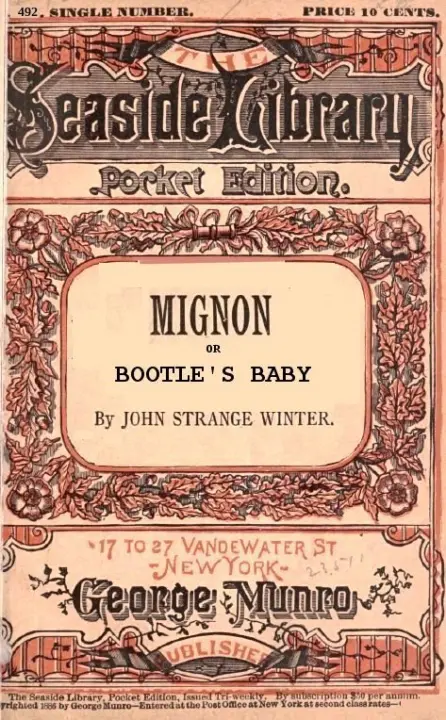
"Mignon; or, Bootles' Baby" by John Strange Winter is a novel written in the late 19th century. The story revolves around Captain Algernon Ferrers, affectionately called "Bootles," who unexpectedly finds himself responsible for a baby girl named Mignon after her mother leaves her in his care, thus triggering a series of humorous and heartfelt events within a military barracks setting. At the start of the narrative, Bootles is introduced during a late-night card game, where he suffers from a headache and seeks solitude, inadvertently discovering a baby in his bed. Confused and surprised, Bootles learns from a letter that the child is his—though he claims no knowledge of her origins despite the implications. A mix of light-hearted banter, camaraderie among officers, and Bootles's growing attachment to Mignon unfolds as his fellow officers tease him about this unexpected turn of events. The opening chapters set the stage for a charming exploration of love, responsibility, and the complexities of life in a military community, while Bootles navigates the challenges of parenthood.
Introduction adapted from the source catalogue; source summaries may be automatically generated.
Free to read · English · 17,429 words · No account needed
MAKE TIME FOR A GOOD BOOK
On by default. Untick to stop anonymous reading totals. Each page counts after 10 seconds in view. How this works.
Anonymous counting is on unless you have switched it off.
After the chief had left the room, Bootles continued his breakfast in silence, considering the two suggestions for the disposal of the child. Now, if the truth be told, Bootles had a horror of workhouses. He had gone deeply into the “Casual” question, and pitied a tramp from the very inmost recesses of his kind heart. It fairly made him sick to think of that bonny golden head growing up among the shorn and unlovely locks of a pauper brood—to think of the little soft fingers that had twined themselves so confidently about his own, and had picked at the embroideries of his mess waistcoat, being slapped by the matron, or set as soon as they should be strong enough to do coarse and hard work, to develop into the unnaturally widened and unkempt hand of a “Marchioness”—to think of that little dainty thing being nourished on skilly, or on whatever hard fare pauper children are fed—to think of that little aristocrat being brought up among the children of thieves and vagabonds!
“Oh, confound it all,” he broke out, “I can’t.”
“I never expected you could,” retorted Miles. “It wouldn’t be natural if
you did.”
This time Bootles did not laugh; on the contrary, he looked up and regarded Miles with a grave and searching gaze, rather disconcerting to that quizzical young gentleman.
“Are you judging me out of your own bushel?” he asked.
“How? What do you mean?” Miles stammered.
“Do you happen to know anything of the matter?” Bootles persisted.
“I? Oh no. On my honor I don’t.”
“Ah! As the colonel said just now, that settles the question. You’re a very witty fellow, Miles, very. I shouldn’t wonder, after a while, if you ain’t quite the sharp man of the regiment. Only your jokes are like the clown’s jokes at the circus—one gets to know them. They’re in this kind of way:
“‘Ever been in Paris, Mr. Lando?’
“‘Yes, of course, Bell.’
“‘Ever been in Vienna, Mr. Lando?’
“‘To be sure, Bell.’
“‘Ever been in Geneva, Mr. Lando?’
“‘Of course I have, Bell.’
“‘Ever been in jail, Mr. Lando?’
“Of course I have, Bell—at least—that’s to say—I mean—no, of course I
haven’t.’
“‘Why, Mr. Lando, I saw you there.’
“‘You saw me in jail, Bell? And what were you doing to see me?’
“Oh!’ grandly, ‘I was staying with the governor for the good of my
’ealth.’
“‘And hadn’t stealing a cow something to do with it, eh, Bell?’
“‘Yah. Who stole a watch?’
“‘A Jersey cow, eh, Bell?’
“Yah. What time is it, Mr. Lando?’
Your reading position is saved on this browser. Take it to another device with a library code. Reading pages adapt to text, rather than matching a printed edition.
BEHIND THE BOOK
This eBook is for the use of anyone anywhere in the United States and most other parts of the world at no cost and with almost no restrictions whatsoever. You may copy it, give it away or re-use it under the terms of the Project Gutenberg License included with this eBook or online at www.gutenberg.org. If you are not located in the United States, you will have to check the laws of the country where you are located before using this eBook. Read the source licence.
The original source file, including credits and licence, is retained by this library. Request an original-format copy at no charge. Please include the book title and Project Gutenberg identifier #64603.
KEEP YOUR CURIOSITY GOING
Coulson Kernahan

Maurice Baring
Frances Wright
Cécile Tormay

Frederic Jesup Stimson

W. H. P. (William Henry Pope) Jarvis