THE CLASSIC COLLECTION✦A dead man’s diaryCLASSIC FREE BOOKS
A dead man’s diary
Coulson Kernahan
THE CLASSIC COLLECTION · 1912
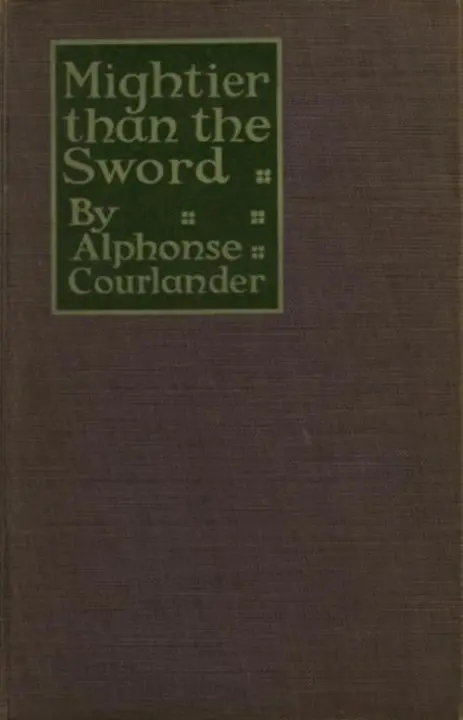
"Mightier than the Sword" by Alphonse Courlander is a novel written in the early 20th century. The story opens with Mr. Pride, a newspaper journalist, who frantically rushes through London to catch the last train home after an evening spent at a high-profile dinner event. It quickly becomes apparent that this work will delve into the life and challenges of journalists, as well as explore the dynamics within the bustling world of Fleet Street, where news and ambition intertwine. The opening of the novel introduces us to Tommy Pride as he navigates the complexities of life as a reporter. After a long day filled with interviews and social engagements, he finds himself in a rush, reflecting on the competitive and often precarious nature of his profession. Through his interactions with fellow journalists in the lift and on the train, we begin to see different attitudes towards their careers, from Pride's determination to succeed to the naivety of younger reporters like Cannock. He is also introduced as a character who finds solace in the familiarity of his routine, underscoring the stark contrast between the romantic notions of journalism and the gritty realities that accompany it. This opening effectively sets the stage for a narrative that promises to unpack the journalism profession during a transformative period in England's history.
Introduction adapted from the source catalogue; source summaries may be automatically generated.
Free to read · English · 97,354 words · No account needed
MAKE TIME FOR A GOOD BOOK
On by default. Untick to stop anonymous reading totals. Each page counts after 10 seconds in view. How this works.
Anonymous counting is on unless you have switched it off.
"Perhaps I do," she said, and Humphrey went into raptures over it. "Isn't it wonderful," he said, "to think that only a few weeks ago we were really strangers, and now you have been in my arms--how can we be strangers, Lilian, and kiss as we do?"
"Have you told your mother yet?" he asked, one day.
"No--not yet," she said.
"Oughtn't I to meet her?"
"I suppose so--wait a little longer," she pleaded. "Have you told your
aunt?"
"You asked me not to. I'd love to take you down to her--she'd like you, I'm certain. It wouldn't matter if she didn't."
They made plans, of course: nothing was settled about the day of their marriage. It was a question whether life was possible for them both on three pounds a week. "I'm sure to get a rise, soon," said Humphrey. "I'll go and ask for one, and tell Ferrol I'm going to be married. We can live splendidly on four pounds a week. Heaps of people live on less."
"I don't know.... It's mother I'm thinking of," she confessed.
"What about mother?" he asked.
"I'm wondering what she'll do without me."
"There are your sisters," he said. "How many are there, let me see"--he ticked them off--"Mabel, Florence and Edith. That's enough for her to go on with."
Her face grew wistful. "Yes--that's enough," she echoed, her eyes not looking at him. "I ought to have told you, Humphrey, long before this, but mother's rather dependent on me and Edith. There's Harry, of course, but he's still at the Technical Institute--he'll be able to help some day. Florence is still at school--and Mabel--Mabel's got something the matter with her hip."
"Well, what about your father?"
She winced. "Father--father doesn't help much. He's--he's an invalid."
Humphrey was young, and this was his first love, and the more obstacles there were to overcome, the greater seemed the prize to him. "We could send your mother a little money each week ..." he said. "It won't cost so much when you're not there."
"Yes, we could do that. And I could still go on with my work."
"What," he cried, horrified, "you go to the Special News Agency after
we're married?"
"Yes, why not?"
"Oh, Lilian dear, I don't want you to do that. I want you to have a home of your own, just to sit there and arrange it as you like, and do nothing but loll in an arm-chair all day until I come home in the evening, and then we'll loll together."
She laughed. "You are a funny boy," she said. "I suppose you think
a house doesn't want looking after. It's much harder work than
typewriting."
Your reading position is saved on this browser. Take it to another device with a library code. Reading pages adapt to text, rather than matching a printed edition.
BEHIND THE BOOK
This eBook is for the use of anyone anywhere in the United States and most other parts of the world at no cost and with almost no restrictions whatsoever. You may copy it, give it away or re-use it under the terms of the Project Gutenberg License included with this eBook or online at www.gutenberg.org. If you are not located in the United States, you will have to check the laws of the country where you are located before using this eBook. Read the source licence.
The original source file, including credits and licence, is retained by this library. Request an original-format copy at no charge. Please include the book title and Project Gutenberg identifier #55535.
KEEP YOUR CURIOSITY GOING
Coulson Kernahan

Maurice Baring
Frances Wright
Cécile Tormay

Frederic Jesup Stimson

W. H. P. (William Henry Pope) Jarvis