THE CLASSIC COLLECTION✦A dead man’s diaryCLASSIC FREE BOOKS
A dead man’s diary
Coulson Kernahan
THE CLASSIC COLLECTION · 1912
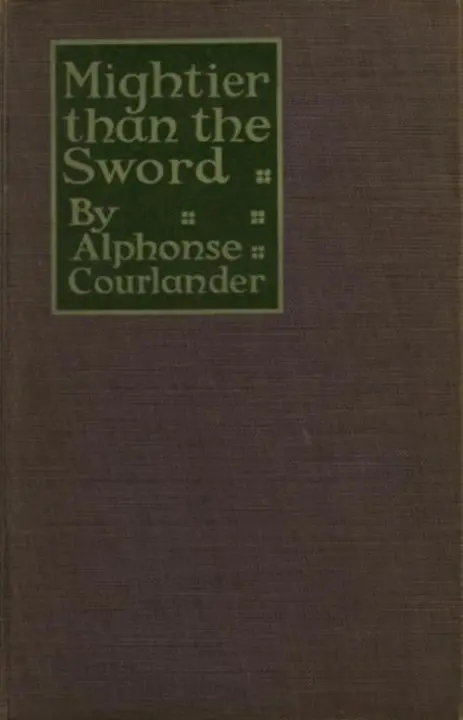
"Mightier than the Sword" by Alphonse Courlander is a novel written in the early 20th century. The story opens with Mr. Pride, a newspaper journalist, who frantically rushes through London to catch the last train home after an evening spent at a high-profile dinner event. It quickly becomes apparent that this work will delve into the life and challenges of journalists, as well as explore the dynamics within the bustling world of Fleet Street, where news and ambition intertwine. The opening of the novel introduces us to Tommy Pride as he navigates the complexities of life as a reporter. After a long day filled with interviews and social engagements, he finds himself in a rush, reflecting on the competitive and often precarious nature of his profession. Through his interactions with fellow journalists in the lift and on the train, we begin to see different attitudes towards their careers, from Pride's determination to succeed to the naivety of younger reporters like Cannock. He is also introduced as a character who finds solace in the familiarity of his routine, underscoring the stark contrast between the romantic notions of journalism and the gritty realities that accompany it. This opening effectively sets the stage for a narrative that promises to unpack the journalism profession during a transformative period in England's history.
Introduction adapted from the source catalogue; source summaries may be automatically generated.
Free to read · English · 97,354 words · No account needed
MAKE TIME FOR A GOOD BOOK
On by default. Untick to stop anonymous reading totals. Each page counts after 10 seconds in view. How this works.
Anonymous counting is on unless you have switched it off.
Mrs Wayzgoose's face fell apart in her welcoming smile--the smile that her lodgers saw only once. It was a wonderful, carefully-studied smile, beginning with the gradual creasing of the mouth, extending earwards, joyfully, and finally spreading until the nose and the eyes were brought into the scheme.
"I hope you find everything you want, Mr Quain," she said.
"Everything's very comfortable," Humphrey answered.
"Do you take tea or coffee with your breakfasts, Mr Quain?"
Humphrey was about to reply coffee, when the guardian Beaver winked enormously at him, and shook his head in a manner that was quite perplexing. He had not a notion of what Beaver was trying to convey--there was evidently something to beware of in the question. Then, he had an inspiration.
"What do I take, Beaver?" he asked.
"Oh, tea--undoubtedly tea," Beaver answered hastily.
"Very good." Mrs Wayzgoose turned to go.
"Oh! by the way, Mrs Wayzgoose," Humphrey said. "These ... these
bulrushes...."
"Bulrushes!" echoed Mrs Wayzgoose, losing her placidity all of a sudden. There was an icy silence. Beaver seemed to be enjoying it.
"Pray, what of my bulrushes?" demanded the masterful Mrs Wayzgoose.
"Don't you think ... I mean ... wouldn't the room be lighter without
them?"
"Without them?" The way she echoed his words, her voice rising in its scale, reminded him of the wolf's replies to Red Riding Hood before making a meal of her. "Are you aware, Mr Quain, that those bulrushes have been there for the last thirty years."
"I was not aware of it, but I am not surprised to hear it," Humphrey
answered politely.
"And that never a complaint has been made about them."
"I am surprised to hear that," he murmured.
"The last gentleman who had these rooms," continued Mrs Wayzgoose, "he was a gentleman, in spite of being coffee-coloured, was a law student. Mr Hilfi Abbas. He took the rooms because of the bulrushes. Said they reminded him of the Nile. I could let these rooms over and over again to Egyptian gentlemen while these bulrushes are there...." And with that she flounced out of the room in a whirl of skirts, with her ear-rings rocking to the headshakes which punctuated her remarks.
"There you are," said Beaver, as the door closed behind her. "What did
I tell you?"
Humphrey laughed, and shook his fist at the offending bulrushes.
"They'll go somehow, you see."
When all the unpacking was finished, the pipes put in the pipe-rack, the tobacco-jar on the table, and the photographs of his mother, his father and his aunt placed on the mantelpiece, the question of food came uppermost in his mind. Beaver told him that he had accepted an invitation to supper.
Your reading position is saved on this browser. Take it to another device with a library code. Reading pages adapt to text, rather than matching a printed edition.
BEHIND THE BOOK
This eBook is for the use of anyone anywhere in the United States and most other parts of the world at no cost and with almost no restrictions whatsoever. You may copy it, give it away or re-use it under the terms of the Project Gutenberg License included with this eBook or online at www.gutenberg.org. If you are not located in the United States, you will have to check the laws of the country where you are located before using this eBook. Read the source licence.
The original source file, including credits and licence, is retained by this library. Request an original-format copy at no charge. Please include the book title and Project Gutenberg identifier #55535.
KEEP YOUR CURIOSITY GOING
Coulson Kernahan

Maurice Baring
Frances Wright
Cécile Tormay

Frederic Jesup Stimson

W. H. P. (William Henry Pope) Jarvis