THE CLASSIC COLLECTION✦A dead man’s diaryCLASSIC FREE BOOKS
A dead man’s diary
Coulson Kernahan
THE CLASSIC COLLECTION · 1912
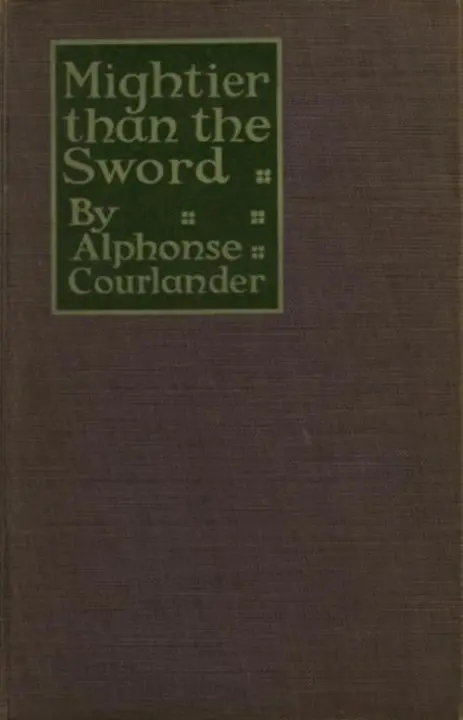
"Mightier than the Sword" by Alphonse Courlander is a novel written in the early 20th century. The story opens with Mr. Pride, a newspaper journalist, who frantically rushes through London to catch the last train home after an evening spent at a high-profile dinner event. It quickly becomes apparent that this work will delve into the life and challenges of journalists, as well as explore the dynamics within the bustling world of Fleet Street, where news and ambition intertwine. The opening of the novel introduces us to Tommy Pride as he navigates the complexities of life as a reporter. After a long day filled with interviews and social engagements, he finds himself in a rush, reflecting on the competitive and often precarious nature of his profession. Through his interactions with fellow journalists in the lift and on the train, we begin to see different attitudes towards their careers, from Pride's determination to succeed to the naivety of younger reporters like Cannock. He is also introduced as a character who finds solace in the familiarity of his routine, underscoring the stark contrast between the romantic notions of journalism and the gritty realities that accompany it. This opening effectively sets the stage for a narrative that promises to unpack the journalism profession during a transformative period in England's history.
Introduction adapted from the source catalogue; source summaries may be automatically generated.
Free to read · English · 97,354 words · No account needed
MAKE TIME FOR A GOOD BOOK
On by default. Untick to stop anonymous reading totals. Each page counts after 10 seconds in view. How this works.
Anonymous counting is on unless you have switched it off.
"En voilà un!" shouted the shaggy man, pointing to Humphrey's white armband. They surged against him, and he was swept from his feet. He heard the shriek of women, and the babble and a murmur that ran like an undercurrent through the storm of noisy voices. The black figure on the roof was wringing his hands, and trying to calm the mob.
Humphrey turned to escape. "What a fool I was to come into the thick of it," he thought. Once, in the struggle, he saw Bouvier standing with a white face in the motor-car, probably wondering what the row was about.
And then, they came at him suddenly and determinedly. Remorseless and menacing faces were thrust close to him. He struck out and a thrill went up his arm as his fist met a hard cheek-bone.
Something fell on his arm with a heavy, aching blow that left it numb and limp, and at the same moment an excruciating spasm of self-pity swept upward from his soul, as he saw, as in a red mist, uplifted, clenched hands struggling to meet him. This was real life at last. He had ceased to be an onlooker; the game was terrible and earnest, and he was, for the first time, the principal figure in the play. His agony did not last long.
The hot breath of the men was on him, and the evil, bloodshot eyes of the shaggy-haired man who had denounced him, loomed terribly large, like great red-veined moons.
And, in that last moment, before all consciousness went from him for ever, as he swayed and fell before the trampling mob, in that supreme moment when deliverance came from all the tribulations that life held for him, an odd, whimsical idea twisted his lips into a smile as he thought:
"What a ripping story this will make for The Day."
Transcriber's Notes:
Italic text is denoted by underscores.
Hyphenation has been retained as in the original publication.
Page 25, in the phrase "every day" a space was kept
(every day, it seemed).
Page 31, comma erased (among which, "Twencent").
Page 41, double quotes added ("We had an awful row.).
Page 56, hyphen retained (a bed-sitting room).
Page 77, apostrophe added (reporters' room).
Page 112, She changed to she (Yes, she had remembered him,).
Page 121, period added (he began.).
Page 190, double quotes added (I know.").
Page 192, period erased (to wait...").
Page 195, apostrophe replaced by period (she was now.).
Page 212, double quotes added (I wrote about....").
Page 212, double quotes added (Thanks for the bob....").
Page 245, period added (of the office.).
Page 254, sedn changed to send in (I'll send you).
Page 256, single quote added (forgotten by to-morrow.').
Your reading position is saved on this browser. Take it to another device with a library code. Reading pages adapt to text, rather than matching a printed edition.
BEHIND THE BOOK
This eBook is for the use of anyone anywhere in the United States and most other parts of the world at no cost and with almost no restrictions whatsoever. You may copy it, give it away or re-use it under the terms of the Project Gutenberg License included with this eBook or online at www.gutenberg.org. If you are not located in the United States, you will have to check the laws of the country where you are located before using this eBook. Read the source licence.
The original source file, including credits and licence, is retained by this library. Request an original-format copy at no charge. Please include the book title and Project Gutenberg identifier #55535.
KEEP YOUR CURIOSITY GOING
Coulson Kernahan

Maurice Baring
Frances Wright
Cécile Tormay

Frederic Jesup Stimson

W. H. P. (William Henry Pope) Jarvis