THE CLASSIC COLLECTION✦A dead man’s diaryCLASSIC FREE BOOKS
A dead man’s diary
Coulson Kernahan
THE CLASSIC COLLECTION · 1912
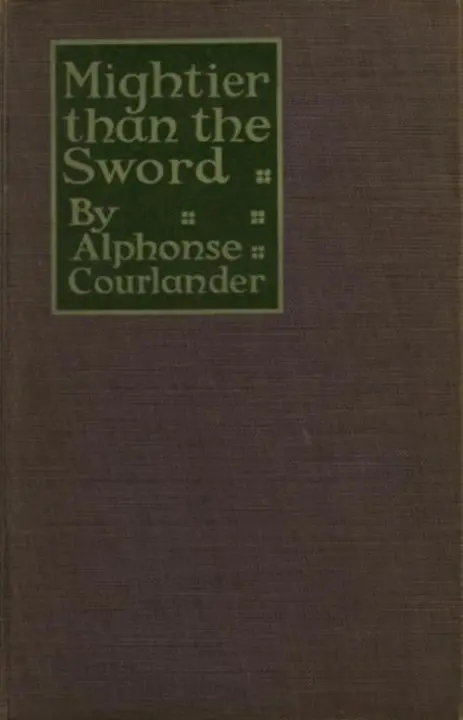
"Mightier than the Sword" by Alphonse Courlander is a novel written in the early 20th century. The story opens with Mr. Pride, a newspaper journalist, who frantically rushes through London to catch the last train home after an evening spent at a high-profile dinner event. It quickly becomes apparent that this work will delve into the life and challenges of journalists, as well as explore the dynamics within the bustling world of Fleet Street, where news and ambition intertwine. The opening of the novel introduces us to Tommy Pride as he navigates the complexities of life as a reporter. After a long day filled with interviews and social engagements, he finds himself in a rush, reflecting on the competitive and often precarious nature of his profession. Through his interactions with fellow journalists in the lift and on the train, we begin to see different attitudes towards their careers, from Pride's determination to succeed to the naivety of younger reporters like Cannock. He is also introduced as a character who finds solace in the familiarity of his routine, underscoring the stark contrast between the romantic notions of journalism and the gritty realities that accompany it. This opening effectively sets the stage for a narrative that promises to unpack the journalism profession during a transformative period in England's history.
Introduction adapted from the source catalogue; source summaries may be automatically generated.
Free to read · English · 97,354 words · No account needed
MAKE TIME FOR A GOOD BOOK
On by default. Untick to stop anonymous reading totals. Each page counts after 10 seconds in view. How this works.
Anonymous counting is on unless you have switched it off.
Humphrey looked at him: he wore a Norfolk jacket, with old trousers, and a tweed hat of no shape at all. Beaver took his pipe out of his mouth, and Humphrey noticed the short nails on his stumpy, fat fingers. Beaver always bit his nails.
"I've given old Worthing the push," said Beaver. "Look at this." He showed a letter to Humphrey, who saw that it was from the "Special News Agency" of London, employing Beaver in their service at £2, 10s. a week.
"How did you get it?" Humphrey asked.
"Wrote in," said Beaver, gnawing a finger-tip. "Been writing in on the quiet for the last year. Fed up with old Worthing and filling up time at case."
"I thought you had to know how to write well if you wanted to work in London," Humphrey said. There were no illusions about Beaver's style.
"Oh! the Agency doesn't want writing--it wants a man who can take down shorthand verbatim.... I'm off next week," said Beaver.
Humphrey looked longingly at him and his letter, and then round at the whitewashed walls of the office, with its Calendars and local Directories for years past on the shelf, and the pile of Gazettes on the corner of the counter. Mr Worthing passed through the office, stopped, and scowled at Beaver.
"Kindly remove your head-gear in the front office," he said, and Beaver, with the unmurmuring discipline of years which nothing could break, took off the crumpled tweed thing he called a hat.
"Nice pig, isn't he?" Beaver said to Humphrey, as Worthing went out. "We had an awful row. Said I ought to have given him a month's notice. A week would have been good enough for me if he was doing the sacking. Pig in knickers, that's what he is," said Beaver, defiantly. "This is a Hole."
"Oh, Beaver!" cried Humphrey, hopelessly. "It is a Hole. He is a Pig.... But what's going to happen to me?"
"You'll do my work," Beaver remarked.
"I can't write shorthand. Besides, I don't want to. How old are you,
Beaver?"
"Just turned thirty. Why?"
"Thirty!" thought Humphrey; fancy Beaver having wasted all these years in doing nothing but local reporting. Would he have to work ten years more and still achieve nothing further than Beaver. There must be some way out of it. Beaver had found it, and surely he could.
"It's fine for you," Humphrey said, admiringly now, for, in the blankness of Beaver leaving the office where they had worked, he had forgotten to congratulate him. "The Special News Agency is the biggest in London, isn't it."
Your reading position is saved on this browser. Take it to another device with a library code. Reading pages adapt to text, rather than matching a printed edition.
BEHIND THE BOOK
This eBook is for the use of anyone anywhere in the United States and most other parts of the world at no cost and with almost no restrictions whatsoever. You may copy it, give it away or re-use it under the terms of the Project Gutenberg License included with this eBook or online at www.gutenberg.org. If you are not located in the United States, you will have to check the laws of the country where you are located before using this eBook. Read the source licence.
The original source file, including credits and licence, is retained by this library. Request an original-format copy at no charge. Please include the book title and Project Gutenberg identifier #55535.
KEEP YOUR CURIOSITY GOING
Coulson Kernahan

Maurice Baring
Frances Wright
Cécile Tormay

Frederic Jesup Stimson

W. H. P. (William Henry Pope) Jarvis