THE CLASSIC COLLECTION✦A dead man’s diaryCLASSIC FREE BOOKS
A dead man’s diary
Coulson Kernahan
THE CLASSIC COLLECTION · 1912
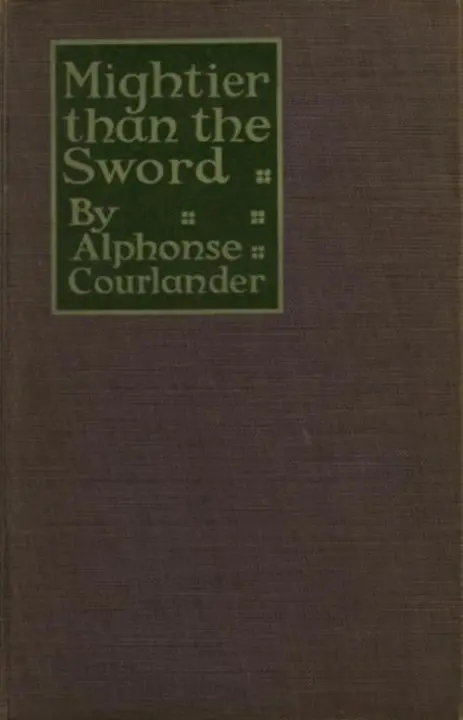
"Mightier than the Sword" by Alphonse Courlander is a novel written in the early 20th century. The story opens with Mr. Pride, a newspaper journalist, who frantically rushes through London to catch the last train home after an evening spent at a high-profile dinner event. It quickly becomes apparent that this work will delve into the life and challenges of journalists, as well as explore the dynamics within the bustling world of Fleet Street, where news and ambition intertwine. The opening of the novel introduces us to Tommy Pride as he navigates the complexities of life as a reporter. After a long day filled with interviews and social engagements, he finds himself in a rush, reflecting on the competitive and often precarious nature of his profession. Through his interactions with fellow journalists in the lift and on the train, we begin to see different attitudes towards their careers, from Pride's determination to succeed to the naivety of younger reporters like Cannock. He is also introduced as a character who finds solace in the familiarity of his routine, underscoring the stark contrast between the romantic notions of journalism and the gritty realities that accompany it. This opening effectively sets the stage for a narrative that promises to unpack the journalism profession during a transformative period in England's history.
Introduction adapted from the source catalogue; source summaries may be automatically generated.
Free to read · English · 97,354 words · No account needed
MAKE TIME FOR A GOOD BOOK
On by default. Untick to stop anonymous reading totals. Each page counts after 10 seconds in view. How this works.
Anonymous counting is on unless you have switched it off.
Desirée turned her pale eyes on him. "I can dance better," she said, and before he had realized it, she was up and in the centre of the room, and everybody laughed and clapped hands, as Desirée began to dance with stealthy, cat-like steps. Her face was impudent, as she twined and twisted her thin body into contortions that set all the men leering at her. It was frankly repulsive and horrible to Humphrey; she seemed suddenly to have ceased to be a woman, just as when she had started to eat. She was inhuman when she sang and ate and danced.
The blur of white flesh through the smoke, the odour of heavy scents, and the sight of Desirée writhing in her horrid dance, sickened him. He saw her white teeth gleaming between her lips, half-parted with the exhaustion of her dance, he saw her eyes laughing at him, as though she were proud and expected his applause, and he felt a profound, inexplicable pity for her that overwhelmed his disgust.
She flung herself, panting, into her seat, and pushed back her disordered yellow hair with her hands. "Oh la! ... la!" she cried, laughing in gasps, "c'est fatiguant, ça ... my throat is like a furnace." And she clicked her glass against the glass that Humphrey held in his hand, and drained it to the finish.
"Why did you do that?" asked Humphrey, huskily.
"Do what?"
"Dance like that--in front of all these people?"
"Why shouldn't I, if I want to?"
"I don't like it," he said, wondering why he was impelled to say so.
"Well, you shouldn't have said she dances well," Desirée replied.
"I must be going," Humphrey said.
"Oh, not yet," Charnac said. "Let's all go together."
"No," he pushed his chair away with sudden resolution. "I must go."
"But, my dear--" Desirée began.
"I must go," Humphrey repeated, slowly. It was like the repetition of a
lesson. "I must go now."
"Oh, well--" Charnac said.
The waiter appeared with a bill. "You will allow me to pay?" Humphrey
asked Charnac.
"Mais non, mais non, mon ami," he replied, good-naturedly. "It was I who asked you to come, wasn't it? Another night it will be your turn."
"Another night," echoed Margot, in her high-pitched voice. "J'adore les Anglais, ils sont si gentils."
"And why cannot you stop?" Desirée asked.
Your reading position is saved on this browser. Take it to another device with a library code. Reading pages adapt to text, rather than matching a printed edition.
BEHIND THE BOOK
This eBook is for the use of anyone anywhere in the United States and most other parts of the world at no cost and with almost no restrictions whatsoever. You may copy it, give it away or re-use it under the terms of the Project Gutenberg License included with this eBook or online at www.gutenberg.org. If you are not located in the United States, you will have to check the laws of the country where you are located before using this eBook. Read the source licence.
The original source file, including credits and licence, is retained by this library. Request an original-format copy at no charge. Please include the book title and Project Gutenberg identifier #55535.
KEEP YOUR CURIOSITY GOING
Coulson Kernahan

Maurice Baring
Frances Wright
Cécile Tormay

Frederic Jesup Stimson

W. H. P. (William Henry Pope) Jarvis