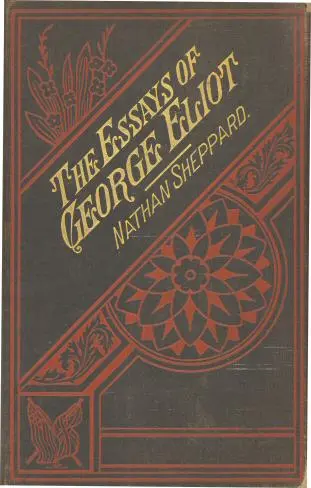
The Essays of “George Eliot” Complete
George Eliot
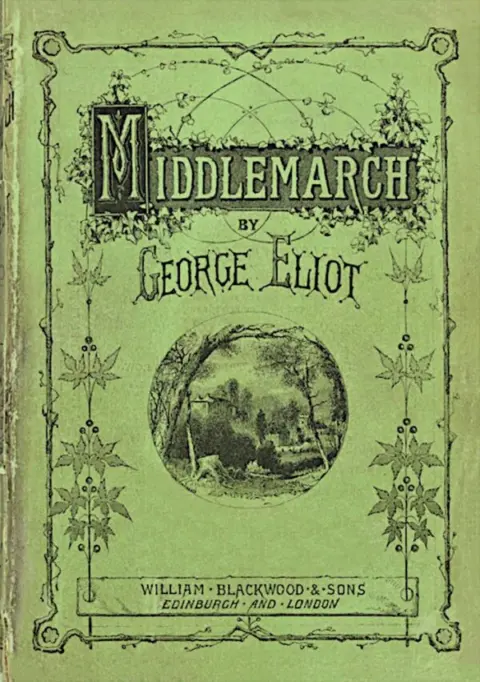
THE CLASSIC COLLECTION · 1871
"Middlemarch" by George Eliot is a novel published in 1871-1872. Set in a fictional English Midlands town from 1829 to 1832, it weaves together multiple intersecting stories exploring the status of women, marriage, idealism, and political reform. The narrative follows Dorothea Brooke's search for purpose, Dr. Lydgate's medical ambitions, and several other inhabitants navigating love, debt, scandal, and social change against the backdrop of the approaching Reform Act of 1832.
Introduction adapted from the source catalogue; source summaries may be automatically generated.
Free to read · English · 321,947 words · No account needed
MAKE TIME FOR A GOOD BOOK
On by default. Untick to stop anonymous reading totals. Each page counts after 10 seconds in view. How this works.
Anonymous counting is on unless you have switched it off.
“Ah, now they are coming out of church,” Mrs. Cadwallader exclaimed. “Dear me, what a wonderfully mixed set! Mr. Lydgate as doctor, I suppose. But that is really a good looking woman, and the fair young man must be her son. Who are they, Sir James, do you know?”
“I see Vincy, the Mayor of Middlemarch; they are probably his wife and son,” said Sir James, looking interrogatively at Mr. Brooke, who nodded and said—
“Yes, a very decent family—a very good fellow is Vincy; a credit to the manufacturing interest. You have seen him at my house, you know.”
“Ah, yes: one of your secret committee,” said Mrs. Cadwallader,
provokingly.
“A coursing fellow, though,” said Sir James, with a fox-hunter’s
disgust.
“And one of those who suck the life out of the wretched handloom weavers in Tipton and Freshitt. That is how his family look so fair and sleek,” said Mrs. Cadwallader. “Those dark, purple-faced people are an excellent foil. Dear me, they are like a set of jugs! Do look at Humphrey: one might fancy him an ugly archangel towering above them in his white surplice.”
“It’s a solemn thing, though, a funeral,” said Mr. Brooke, “if you take it in that light, you know.”
“But I am not taking it in that light. I can’t wear my solemnity too often, else it will go to rags. It was time the old man died, and none of these people are sorry.”
“How piteous!” said Dorothea. “This funeral seems to me the most dismal thing I ever saw. It is a blot on the morning. I cannot bear to think that any one should die and leave no love behind.”
She was going to say more, but she saw her husband enter and seat himself a little in the background. The difference his presence made to her was not always a happy one: she felt that he often inwardly objected to her speech.
“Positively,” exclaimed Mrs. Cadwallader, “there is a new face come out from behind that broad man queerer than any of them: a little round head with bulging eyes—a sort of frog-face—do look. He must be of another blood, I think.”
“Let me see!” said Celia, with awakened curiosity, standing behind Mrs. Cadwallader and leaning forward over her head. “Oh, what an odd face!” Then with a quick change to another sort of surprised expression, she added, “Why, Dodo, you never told me that Mr. Ladislaw was come again!”
Dorothea felt a shock of alarm: every one noticed her sudden paleness as she looked up immediately at her uncle, while Mr. Casaubon looked at her.
Your reading position is saved on this browser. Take it to another device with a library code. Reading pages adapt to text, rather than matching a printed edition.
George Eliot
George Eliot
George Eliot
George Eliot & Elizabeth Barrett Browning & Robert Browning & Percy Bysshe Shelley
BEHIND THE BOOK
This eBook is for the use of anyone anywhere in the United States and most other parts of the world at no cost and with almost no restrictions whatsoever. You may copy it, give it away or re-use it under the terms of the Project Gutenberg License included with this eBook or online at www.gutenberg.org. If you are not located in the United States, you will have to check the laws of the country where you are located before using this eBook. Read the source licence.
The original source file, including credits and licence, is retained by this library. Request an original-format copy at no charge. Please include the book title and Project Gutenberg identifier #145.
KEEP YOUR CURIOSITY GOING
Cécile Tormay

Moritz Busch
Coulson Kernahan
John L. Ransom

Maurice Baring
Frances Wright