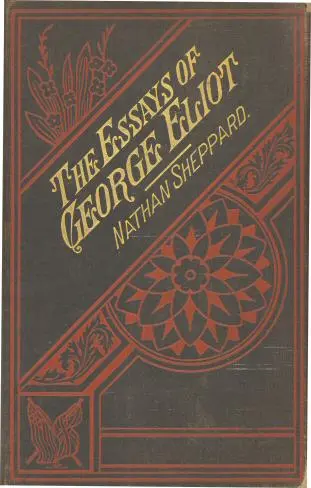
The Essays of “George Eliot” Complete
George Eliot
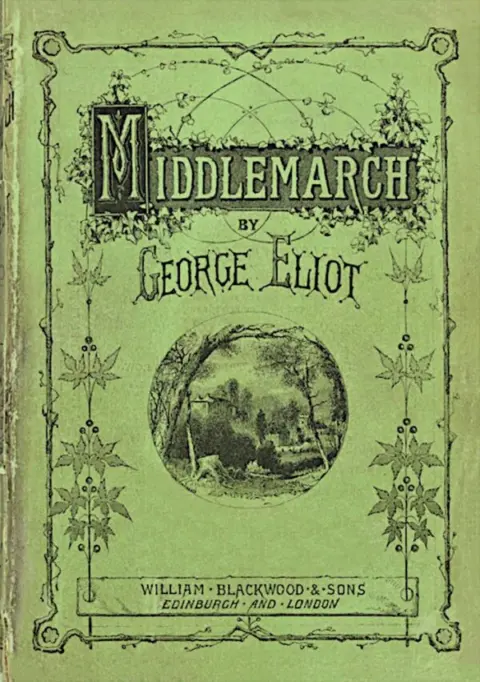
THE CLASSIC COLLECTION · 1871
"Middlemarch" by George Eliot is a novel published in 1871-1872. Set in a fictional English Midlands town from 1829 to 1832, it weaves together multiple intersecting stories exploring the status of women, marriage, idealism, and political reform. The narrative follows Dorothea Brooke's search for purpose, Dr. Lydgate's medical ambitions, and several other inhabitants navigating love, debt, scandal, and social change against the backdrop of the approaching Reform Act of 1832.
Introduction adapted from the source catalogue; source summaries may be automatically generated.
Free to read · English · 321,947 words · No account needed
MAKE TIME FOR A GOOD BOOK
On by default. Untick to stop anonymous reading totals. Each page counts after 10 seconds in view. How this works.
Anonymous counting is on unless you have switched it off.
“To teach you to speak and write correctly, so that you can be understood,” said Mrs. Garth, with severe precision. “Should you like to speak as old Job does?”
“Yes,” said Ben, stoutly; “it’s funnier. He says, ‘Yo goo’—that’s just as good as ‘You go.’”
“But he says, ‘A ship’s in the garden,’ instead of ‘a sheep,’” said Letty, with an air of superiority. “You might think he meant a ship off the sea.”
“No, you mightn’t, if you weren’t silly,” said Ben. “How could a ship off the sea come there?”
“These things belong only to pronunciation, which is the least part of grammar,” said Mrs. Garth. “That apple-peel is to be eaten by the pigs, Ben; if you eat it, I must give them your piece of pasty. Job has only to speak about very plain things. How do you think you would write or speak about anything more difficult, if you knew no more of grammar than he does? You would use wrong words, and put words in the wrong places, and instead of making people understand you, they would turn away from you as a tiresome person. What would you do then?”
“I shouldn’t care, I should leave off,” said Ben, with a sense that this was an agreeable issue where grammar was concerned.
“I see you are getting tired and stupid, Ben,” said Mrs. Garth, accustomed to these obstructive arguments from her male offspring. Having finished her pies, she moved towards the clothes-horse, and said, “Come here and tell me the story I told you on Wednesday, about Cincinnatus.”
“I know! he was a farmer,” said Ben.
“Now, Ben, he was a Roman—let me tell,” said Letty, using her elbow
contentiously.
“You silly thing, he was a Roman farmer, and he was ploughing.”
“Yes, but before that—that didn’t come first—people wanted him,” said
Letty.
“Well, but you must say what sort of a man he was first,” insisted Ben. “He was a wise man, like my father, and that made the people want his advice. And he was a brave man, and could fight. And so could my father—couldn’t he, mother?”
“Now, Ben, let me tell the story straight on, as mother told it us,” said Letty, frowning. “Please, mother, tell Ben not to speak.”
Your reading position is saved on this browser. Take it to another device with a library code. Reading pages adapt to text, rather than matching a printed edition.
George Eliot
George Eliot
George Eliot
George Eliot & Elizabeth Barrett Browning & Robert Browning & Percy Bysshe Shelley
BEHIND THE BOOK
This eBook is for the use of anyone anywhere in the United States and most other parts of the world at no cost and with almost no restrictions whatsoever. You may copy it, give it away or re-use it under the terms of the Project Gutenberg License included with this eBook or online at www.gutenberg.org. If you are not located in the United States, you will have to check the laws of the country where you are located before using this eBook. Read the source licence.
The original source file, including credits and licence, is retained by this library. Request an original-format copy at no charge. Please include the book title and Project Gutenberg identifier #145.
KEEP YOUR CURIOSITY GOING
Cécile Tormay

Moritz Busch
Coulson Kernahan
John L. Ransom

Maurice Baring
Frances Wright