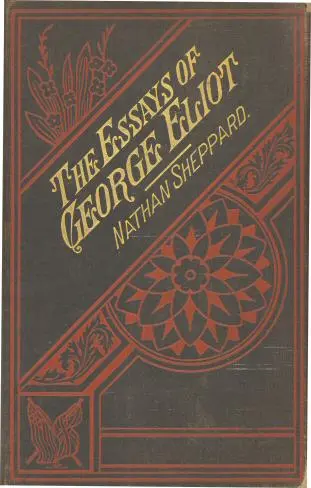
The Essays of “George Eliot” Complete
George Eliot
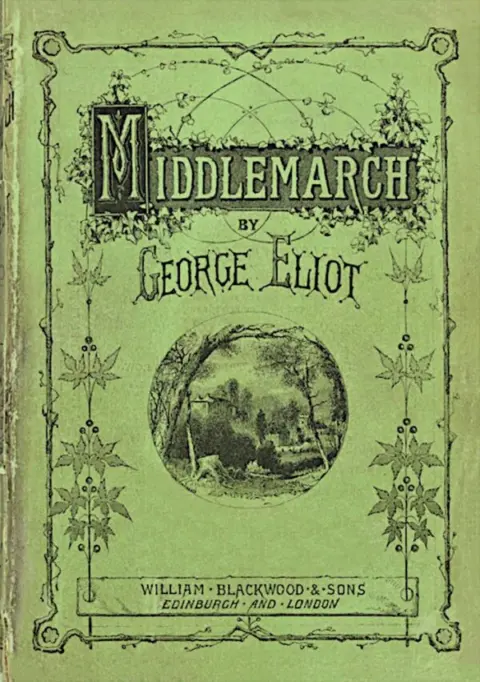
THE CLASSIC COLLECTION · 1871
"Middlemarch" by George Eliot is a novel published in 1871-1872. Set in a fictional English Midlands town from 1829 to 1832, it weaves together multiple intersecting stories exploring the status of women, marriage, idealism, and political reform. The narrative follows Dorothea Brooke's search for purpose, Dr. Lydgate's medical ambitions, and several other inhabitants navigating love, debt, scandal, and social change against the backdrop of the approaching Reform Act of 1832.
Introduction adapted from the source catalogue; source summaries may be automatically generated.
Free to read · English · 321,947 words · No account needed
MAKE TIME FOR A GOOD BOOK
On by default. Untick to stop anonymous reading totals. Each page counts after 10 seconds in view. How this works.
Anonymous counting is on unless you have switched it off.
As to women, he had once already been drawn headlong by impetuous folly, which he meant to be final, since marriage at some distant period would of course not be impetuous. For those who want to be acquainted with Lydgate it will be good to know what was that case of impetuous folly, for it may stand as an example of the fitful swerving of passion to which he was prone, together with the chivalrous kindness which helped to make him morally lovable. The story can be told without many words. It happened when he was studying in Paris, and just at the time when, over and above his other work, he was occupied with some galvanic experiments. One evening, tired with his experimenting, and not being able to elicit the facts he needed, he left his frogs and rabbits to some repose under their trying and mysterious dispensation of unexplained shocks, and went to finish his evening at the theatre of the Porte Saint Martin, where there was a melodrama which he had already seen several times; attracted, not by the ingenious work of the collaborating authors, but by an actress whose part it was to stab her lover, mistaking him for the evil-designing duke of the piece. Lydgate was in love with this actress, as a man is in love with a woman whom he never expects to speak to. She was a Provencale, with dark eyes, a Greek profile, and rounded majestic form, having that sort of beauty which carries a sweet matronliness even in youth, and her voice was a soft cooing. She had but lately come to Paris, and bore a virtuous reputation, her husband acting with her as the unfortunate lover. It was her acting which was “no better than it should be,” but the public was satisfied. Lydgate’s only relaxation now was to go and look at this woman, just as he might have thrown himself under the breath of the sweet south on a bank of violets for a while, without prejudice to his galvanism, to which he would presently return. But this evening the old drama had a new catastrophe. At the moment when the heroine was to act the stabbing of her lover, and he was to fall gracefully, the wife veritably stabbed her husband, who fell as death willed. A wild shriek pierced the house, and the Provencale fell swooning: a shriek and a swoon were demanded by the play, but the swooning too was real this time. Lydgate leaped and climbed, he hardly knew how, on to the stage, and was active in help, making the acquaintance of his heroine by finding a contusion on her head and lifting her gently in his arms. Paris rang with the story of this death:—was it a murder? Some of the actress’s warmest admirers were inclined to believe in her guilt, and liked her the better for it (such was the taste of those times); but Lydgate was not one of these. He vehemently contended for her innocence, and the remote impersonal passion for her beauty which he had felt before, had passed now into personal devotion, and tender thought of her lot. The notion of murder was absurd: no motive was discoverable, the young couple being understood to dote on each other; and it was not unprecedented that an accidental slip of the foot should have brought these grave consequences. The legal investigation ended in Madame Laure’s release. Lydgate by this time had had many interviews with her, and found her more and more adorable. She talked little; but that was an additional charm. She was melancholy, and seemed grateful; her presence was enough, like that of the evening light. Lydgate was madly anxious about her affection, and jealous lest any other man than himself should win it and ask her to marry him. But instead of reopening her engagement at the Porte Saint Martin, where she would have been all the more popular for the fatal episode, she left Paris without warning, forsaking her little court of admirers. Perhaps no one carried inquiry far except Lydgate, who felt that all science had come to a stand-still while he imagined the unhappy Laure, stricken by ever-wandering sorrow, herself wandering, and finding no faithful comforter. Hidden actresses, however, are not so difficult to find as some other hidden facts, and it was not long before Lydgate gathered indications that Laure had taken the route to Lyons. He found her at last acting with great success at Avignon under the same name, looking more majestic than ever as a forsaken wife carrying her child in her arms. He spoke to her after the play, was received with the usual quietude which seemed to him beautiful as clear depths of water, and obtained leave to visit her the next day; when he was bent on telling her that he adored her, and on asking her to marry him. He knew that this was like the sudden impulse of a madman—incongruous even with his habitual foibles. No matter! It was the one thing which he was resolved to do. He had two selves within him apparently, and they must learn to accommodate each other and bear reciprocal impediments. Strange, that some of us, with quick alternate vision, see beyond our infatuations, and even while we rave on the heights, behold the wide plain where our persistent self pauses and awaits us.
Your reading position is saved on this browser. Take it to another device with a library code. Reading pages adapt to text, rather than matching a printed edition.
George Eliot
George Eliot
George Eliot
George Eliot & Elizabeth Barrett Browning & Robert Browning & Percy Bysshe Shelley
BEHIND THE BOOK
This eBook is for the use of anyone anywhere in the United States and most other parts of the world at no cost and with almost no restrictions whatsoever. You may copy it, give it away or re-use it under the terms of the Project Gutenberg License included with this eBook or online at www.gutenberg.org. If you are not located in the United States, you will have to check the laws of the country where you are located before using this eBook. Read the source licence.
The original source file, including credits and licence, is retained by this library. Request an original-format copy at no charge. Please include the book title and Project Gutenberg identifier #145.
KEEP YOUR CURIOSITY GOING
Cécile Tormay

Moritz Busch
Coulson Kernahan
John L. Ransom

Maurice Baring
Frances Wright