The Essays of “George Eliot” Complete
George Eliot
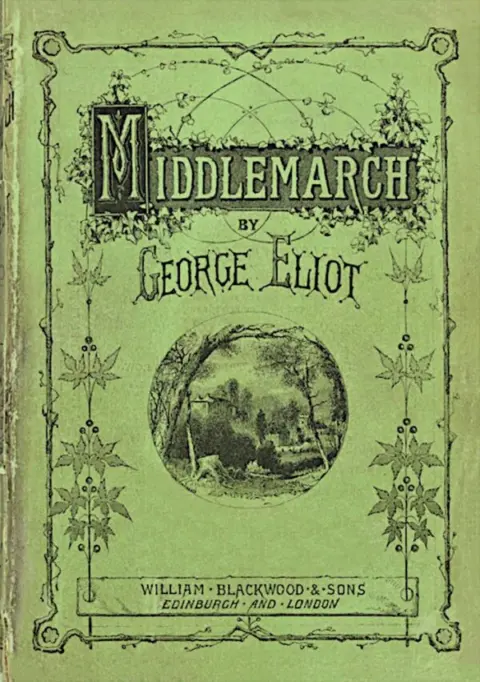
THE CLASSIC COLLECTION · 1871
"Middlemarch" by George Eliot is a novel published in 1871-1872. Set in a fictional English Midlands town from 1829 to 1832, it weaves together multiple intersecting stories exploring the status of women, marriage, idealism, and political reform. The narrative follows Dorothea Brooke's search for purpose, Dr. Lydgate's medical ambitions, and several other inhabitants navigating love, debt, scandal, and social change against the backdrop of the approaching Reform Act of 1832.
Introduction adapted from the source catalogue; source summaries may be automatically generated.
Free to read · English · 321,947 words · No account needed
MAKE TIME FOR A GOOD BOOK
On by default. Untick to stop anonymous reading totals. Each page counts after 10 seconds in view. How this works.
Anonymous counting is on unless you have switched it off.
“No, that is too hard,” said Sir James, in a tone of reproach that showed strong interest. “Your sister is given to self-mortification, is she not?” he continued, turning to Celia, who sat at his right hand.
“I think she is,” said Celia, feeling afraid lest she should say something that would not please her sister, and blushing as prettily as possible above her necklace. “She likes giving up.”
“If that were true, Celia, my giving-up would be self-indulgence, not self-mortification. But there may be good reasons for choosing not to do what is very agreeable,” said Dorothea.
Mr. Brooke was speaking at the same time, but it was evident that Mr. Casaubon was observing Dorothea, and she was aware of it.
“Exactly,” said Sir James. “You give up from some high, generous
motive.”
“No, indeed, not exactly. I did not say that of myself,” answered Dorothea, reddening. Unlike Celia, she rarely blushed, and only from high delight or anger. At this moment she felt angry with the perverse Sir James. Why did he not pay attention to Celia, and leave her to listen to Mr. Casaubon?—if that learned man would only talk, instead of allowing himself to be talked to by Mr. Brooke, who was just then informing him that the Reformation either meant something or it did not, that he himself was a Protestant to the core, but that Catholicism was a fact; and as to refusing an acre of your ground for a Romanist chapel, all men needed the bridle of religion, which, properly speaking, was the dread of a Hereafter.
“I made a great study of theology at one time,” said Mr. Brooke, as if to explain the insight just manifested. “I know something of all schools. I knew Wilberforce in his best days. Do you know Wilberforce?”
Mr. Casaubon said, “No.”
“Well, Wilberforce was perhaps not enough of a thinker; but if I went into Parliament, as I have been asked to do, I should sit on the independent bench, as Wilberforce did, and work at philanthropy.”
Mr. Casaubon bowed, and observed that it was a wide field.
“Yes,” said Mr. Brooke, with an easy smile, “but I have documents. I began a long while ago to collect documents. They want arranging, but when a question has struck me, I have written to somebody and got an answer. I have documents at my back. But now, how do you arrange your documents?”
“In pigeon-holes partly,” said Mr. Casaubon, with rather a startled air
of effort.
“Ah, pigeon-holes will not do. I have tried pigeon-holes, but everything gets mixed in pigeon-holes: I never know whether a paper is in A or Z.”
Your reading position is saved on this browser. Take it to another device with a library code. Reading pages adapt to text, rather than matching a printed edition.
George Eliot
George Eliot
George Eliot
George Eliot & Elizabeth Barrett Browning & Robert Browning & Percy Bysshe Shelley
BEHIND THE BOOK
This eBook is for the use of anyone anywhere in the United States and most other parts of the world at no cost and with almost no restrictions whatsoever. You may copy it, give it away or re-use it under the terms of the Project Gutenberg License included with this eBook or online at www.gutenberg.org. If you are not located in the United States, you will have to check the laws of the country where you are located before using this eBook. Read the source licence.
The original source file, including credits and licence, is retained by this library. Request an original-format copy at no charge. Please include the book title and Project Gutenberg identifier #145.
KEEP YOUR CURIOSITY GOING
Cécile Tormay

Moritz Busch
Coulson Kernahan
John L. Ransom

Maurice Baring
Frances Wright