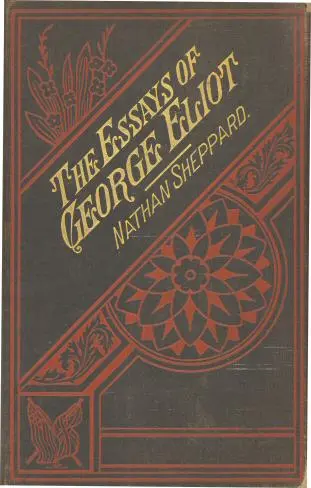
The Essays of “George Eliot” Complete
George Eliot
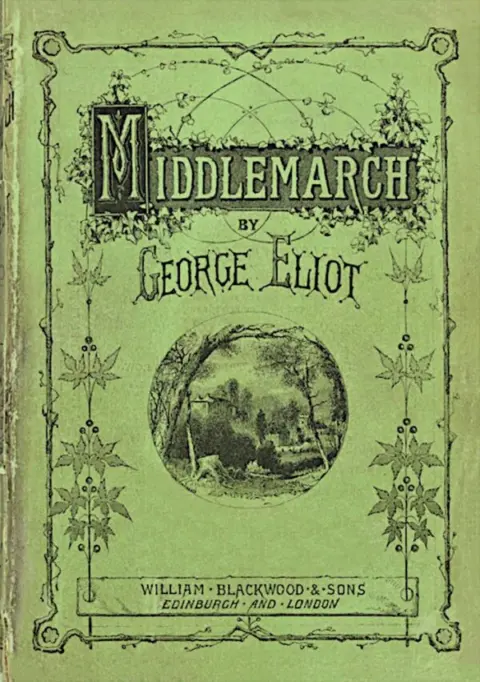
THE CLASSIC COLLECTION · 1871
"Middlemarch" by George Eliot is a novel published in 1871-1872. Set in a fictional English Midlands town from 1829 to 1832, it weaves together multiple intersecting stories exploring the status of women, marriage, idealism, and political reform. The narrative follows Dorothea Brooke's search for purpose, Dr. Lydgate's medical ambitions, and several other inhabitants navigating love, debt, scandal, and social change against the backdrop of the approaching Reform Act of 1832.
Introduction adapted from the source catalogue; source summaries may be automatically generated.
Free to read · English · 321,947 words · No account needed
MAKE TIME FOR A GOOD BOOK
On by default. Untick to stop anonymous reading totals. Each page counts after 10 seconds in view. How this works.
Anonymous counting is on unless you have switched it off.
“How can one describe a man? I can give you an inventory: heavy eyebrows, dark eyes, a straight nose, thick dark hair, large solid white hands—and—let me see—oh, an exquisite cambric pocket-handkerchief. But you will see him. You know this is about the time of his visits.”
Rosamond blushed a little, but said, meditatively, “I rather like a haughty manner. I cannot endure a rattling young man.”
“I did not tell you that Mr. Lydgate was haughty; but il y en a pour tous les goûts, as little Mamselle used to say, and if any girl can choose the particular sort of conceit she would like, I should think it is you, Rosy.”
“Haughtiness is not conceit; I call Fred conceited.”
“I wish no one said any worse of him. He should be more careful. Mrs. Waule has been telling uncle that Fred is very unsteady.” Mary spoke from a girlish impulse which got the better of her judgment. There was a vague uneasiness associated with the word “unsteady” which she hoped Rosamond might say something to dissipate. But she purposely abstained from mentioning Mrs. Waule’s more special insinuation.
“Oh, Fred is horrid!” said Rosamond. She would not have allowed herself so unsuitable a word to any one but Mary.
“What do you mean by horrid?”
“He is so idle, and makes papa so angry, and says he will not take
orders.”
“I think Fred is quite right.”
“How can you say he is quite right, Mary? I thought you had more sense
of religion.”
“He is not fit to be a clergyman.”
“But he ought to be fit.”—“Well, then, he is not what he ought to be. I know some other people who are in the same case.”
“But no one approves of them. I should not like to marry a clergyman; but there must be clergymen.”
“It does not follow that Fred must be one.”
“But when papa has been at the expense of educating him for it! And only suppose, if he should have no fortune left him?”
“I can suppose that very well,” said Mary, dryly.
“Then I wonder you can defend Fred,” said Rosamond, inclined to push
this point.
“I don’t defend him,” said Mary, laughing; “I would defend any parish from having him for a clergyman.”
“But of course if he were a clergyman, he must be different.”
“Yes, he would be a great hypocrite; and he is not that yet.”
“It is of no use saying anything to you, Mary. You always take Fred’s
part.”
Your reading position is saved on this browser. Take it to another device with a library code. Reading pages adapt to text, rather than matching a printed edition.
George Eliot
George Eliot
George Eliot
George Eliot & Elizabeth Barrett Browning & Robert Browning & Percy Bysshe Shelley
BEHIND THE BOOK
This eBook is for the use of anyone anywhere in the United States and most other parts of the world at no cost and with almost no restrictions whatsoever. You may copy it, give it away or re-use it under the terms of the Project Gutenberg License included with this eBook or online at www.gutenberg.org. If you are not located in the United States, you will have to check the laws of the country where you are located before using this eBook. Read the source licence.
The original source file, including credits and licence, is retained by this library. Request an original-format copy at no charge. Please include the book title and Project Gutenberg identifier #145.
KEEP YOUR CURIOSITY GOING
Cécile Tormay

Moritz Busch
Coulson Kernahan
John L. Ransom

Maurice Baring
Frances Wright