The Mentor: The Story of Coal, vol. 6, Num. 6, Serial No. 154, May 1, 1918
Charles Fitzhugh Talman
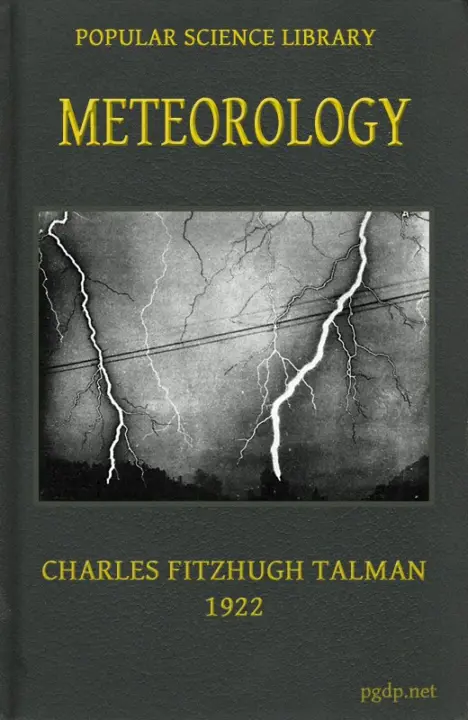
THE CLASSIC COLLECTION · 1922
"Meteorology: The Science of the Atmosphere" by Charles Fitzhugh Talman is a scientific publication written in the early 20th century. The work delves into the complex science of the atmosphere, including weather phenomena and the various factors influencing climate and air composition. It aims to demystify meteorology, providing insights into the crucial role that atmospheric conditions play in everyday life. The opening of the book sets the stage with a detailed explanation of air, highlighting the difference between popular and scientific perceptions of this essential element. Talman clarifies that the atmosphere is not a uniform substance, but rather a mixture of gases with distinct properties, such as oxygen and nitrogen. He discusses the consistent proportions of these gases close to the earth's surface and explains the significance of atmospheric study, emphasizing the importance of understanding how these gases interact and change at different altitudes, thereby laying the groundwork for the exploration of meteorological principles that follow in subsequent chapters.
Introduction adapted from the source catalogue; source summaries may be automatically generated.
Free to read · English · 100,486 words · No account needed
MAKE TIME FOR A GOOD BOOK
On by default. Untick to stop anonymous reading totals. Each page counts after 10 seconds in view. How this works.
Anonymous counting is on unless you have switched it off.
Isobar.--A line of equal barometric pressure. (Isobars are generally drawn on maps to show the horizontal distribution of pressure reduced to sea level, or the pressure at some specified altitude; but in a broader sense any line on a chart or diagram drawn through places of equal pressure is an isobar.)
Isohyet.--A line of equal rainfall.
Isotherm.--A line of equal temperature.
Isothermal Layer.--(See stratosphere.)
January Thaw.--A period of mild weather popularly supposed to recur each January, especially in New England.
Katathermometer.--A device consisting of a dry-bulb and a wet-bulb thermometer, designed for measuring the cooling power of the atmosphere, with reference to its physiological effects. It was invented by Leonard Hill.
Kiosk.--The name given by the U. S. Weather Bureau to a small street pavilion in which are displayed meteorological instruments, maps, tables, etc.
Land and Sea Breezes. Land and Lake Breezes.--The breezes that, on certain coasts and under certain conditions, blow from the land by night and from the water by day.
Lenticular Cloud.--A cloud having approximately the form of a double-convex lens, marking the position of a standing wave in the atmosphere. (See Chapter VI.)
Lightning.--A disruptive electrical discharge in the atmosphere, or, generally, the luminous phenomena attending such a discharge. The various forms of lightning are named and described in Chapter IX.
Lightning Print.--A collection of marks, often treelike in form, sometimes found on the body of a person or animal that has been struck by lightning.
Lightning Rod.--A metallic rod, connected with a suitable “ground,” in earth or water, set up for the purpose of protecting some structure from lightning.
Light-pillar.--A form of halo, consisting of a column of light, vertical or nearly so, extending from or through the sun or moon. Called a sun-pillar, or a moon-pillar, as the case may be.
Line-squall.--A more or less continuous line of squalls and thunderstorms traveling broadside over the country.
Looming.--An apparent elevation of distant objects by mirage.
Low.--An area of low barometric pressure, with its attendant system of winds. Also called a barometric depression or cyclone.
Mackerel Sky.--An area of sky covered with cirro-cumulus clouds; especially when the clouds resemble the patterns seen on the backs of mackerel.
Mammato-cumulus.--A form of cloud showing pendulous sacklike protuberances. (See Chapter VI.)
March.--The variation of a meteorological element in the course of a day, year, or other interval of time; e. g., the diurnal march of temperature; the annual march of barometric pressure.
Mares’-tails.--Cirrus in long slender streaks.
Your reading position is saved on this browser. Take it to another device with a library code. Reading pages adapt to text, rather than matching a printed edition.
BEHIND THE BOOK
This eBook is for the use of anyone anywhere in the United States and most other parts of the world at no cost and with almost no restrictions whatsoever. You may copy it, give it away or re-use it under the terms of the Project Gutenberg License included with this eBook or online at www.gutenberg.org. If you are not located in the United States, you will have to check the laws of the country where you are located before using this eBook. Read the source licence.
The original source file, including credits and licence, is retained by this library. Request an original-format copy at no charge. Please include the book title and Project Gutenberg identifier #47059.
KEEP YOUR CURIOSITY GOING

John Muir

Asa Gray
Asa Gray

Florence Nightingale
Elizabeth Robins Pennell
Denison Olmsted