
George Washington
Woodrow Wilson
THE CLASSIC COLLECTION · 1896
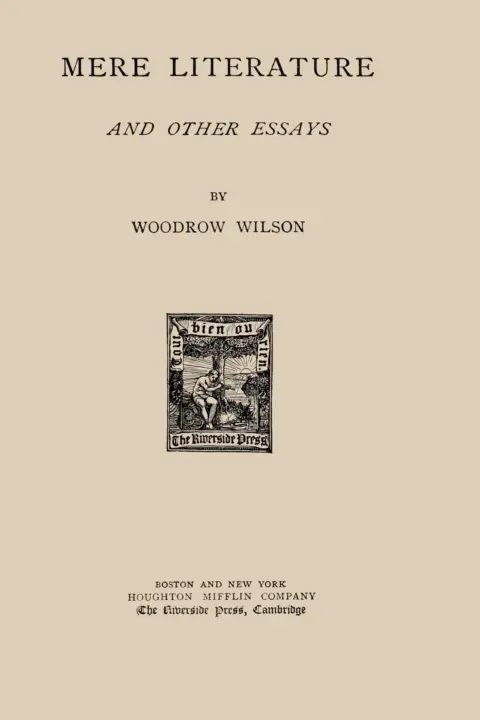
"Mere Literature, and Other Essays" by Woodrow Wilson is a collection of essays written in the late 19th century. This work critically examines the relationship between literature and the more scientific and empirical approaches dominating the intellectual landscape of the time. Wilson's essays explore themes like the value of literature in education, the essence of true literature beyond mere technical prowess, and the influence of individualism in writing. The opening portion of the collection introduces the concept of "mere literature" and serves as a critique of the mentality that undervalues literary works as mere trivial pursuits compared to scientific knowledge. Wilson reflects on the disconnection between the study of literature and its intrinsic value, arguing that true literary appreciation must come from personal, first-hand engagement with works. He eloquently discusses the challenges faced in teaching literature within a scientific framework, emphasizing that genuine literature represents the spirit of its time and reflects the complexities of human experience, transcending mere technical analysis.
Introduction adapted from the source catalogue; source summaries may be automatically generated.
Free to read · English · 55,449 words · No account needed
MAKE TIME FOR A GOOD BOOK
On by default. Untick to stop anonymous reading totals. Each page counts after 10 seconds in view. How this works.
Anonymous counting is on unless you have switched it off.
James Madison, too, we may be said to have inherited. His invaluable gifts of counsel were of the sort so happily imparted to us with our English blood at the first planting of the States which formed the Union. A grave and prudent man, and yet brave withal when new counsel was to be taken, he stands at the beginning of our national history, even in his young manhood, as he faced and led the constitutional convention, a type of the slow and thoughtful English genius for affairs. He held old and tested convictions of the uses of liberty; he was competently read in the history of government; processes of revolution were in his thought no more than processes of adaptation: exigencies were to be met by modification, not by experiment. His reasonable spirit runs through all the proceedings of the great convention that gave us the Constitution, and that noble instrument seems the product of character like his. For all it is so American in its content, it is in its method a thoroughly English production, so full is it of old principles, so conservative of experience, so carefully compounded of compromises, of concessions made and accepted. Such men are of a stock so fine as to need no titles to make it noble, and yet so old and so distinguished as actually to bear the chief titles of English liberty. Madison came of the long line of English constitutional statesmen.
There is a type of genius which closely approaches this in character, but which is, nevertheless, distinctively American. It is to be seen in John Marshall and in Daniel Webster. In these men a new set of ideas find expression, ideas which all the world has received as American. Webster was not an English but an American constitutional statesman. For the English statesman constitutional issues are issues of policy rather than issues of law. He constantly handles questions of change: his constitution is always a-making. He must at every turn construct, and he is deemed conservative if only his rule be consistency and continuity with the past. He will search diligently for precedent, but he is content if the precedent contain only a germ of the policy he proposes. His standards are set him, not by law, but by opinion: his constitution is an ideal of cautious and orderly change. Its fixed element is the conception of political liberty: a conception which, though steeped in history, must ever be added to and altered by social change. The American constitutional statesman, on the contrary, constructs policies like a lawyer. The standard with which he must square his conduct is set him by a document upon whose definite sentences the whole structure of the government directly rests. That document, moreover, is the concrete embodiment of a peculiar theory of government. That theory is, that definitive laws, selected by a power outside the government, are the structural iron of the entire fabric of politics, and that nothing which cannot be constructed upon this stiff framework is a safe or legitimate part of policy. Law is, in his conception, creative of states, and they live only by such permissions as they can extract from it. The functions of the judge and the functions of the man of affairs have, therefore, been very closely related in our history, and John Marshall, scarcely less than Daniel Webster, was a constitutional statesman. With all Madison’s conservative temper and wide-eyed prudence in counsel, the subject-matter of thought for both of these men was not English liberty or the experience of men everywhere in self-government, but the meaning stored up in the explicit sentences of a written fundamental law. They taught men the new--the American--art of extracting life out of the letter, not of statutes merely (that art was not new), but of statute-built institutions and documented governments: the art of saturating politics with law without grossly discoloring law with politics. Other nations have had written constitutions, but no other nation has ever filled a written constitution with this singularly compounded content, of a sound legal conscience and a strong national purpose. It would have been easy to deal with our Constitution like subtle dialecticians; but Webster and Marshall did much more and much better than that. They viewed the fundamental law as a great organic product, a vehicle of life as well as a charter of authority; in disclosing its life they did not damage its tissue; and in thus expanding the law without impairing its structure or authority they made great contributions alike to statesmanship and to jurisprudence. Our notable literature of decision and commentary in the field of constitutional law is America’s distinctive gift to the history and the science of law. John Marshall wrought out much of its substance; Webster diffused its great body of principles throughout national policy, mediating between the law and affairs. The figures of the two men must hold the eye of the world as the figures of two great national representatives, as the figures of two great Americans.
Your reading position is saved on this browser. Take it to another device with a library code. Reading pages adapt to text, rather than matching a printed edition.
Woodrow Wilson
Woodrow Wilson
Woodrow Wilson
Woodrow Wilson
BEHIND THE BOOK
This eBook is for the use of anyone anywhere in the United States and most other parts of the world at no cost and with almost no restrictions whatsoever. You may copy it, give it away or re-use it under the terms of the Project Gutenberg License included with this eBook or online at www.gutenberg.org. If you are not located in the United States, you will have to check the laws of the country where you are located before using this eBook. Read the source licence.
The original source file, including credits and licence, is retained by this library. Request an original-format copy at no charge. Please include the book title and Project Gutenberg identifier #66074.
KEEP YOUR CURIOSITY GOING

David Patterson (Spirit) Hatch

David Patterson (Spirit) Hatch

David Patterson (Spirit) Hatch
Cécile Tormay

Moritz Busch
John L. Ransom