
George Washington
Woodrow Wilson
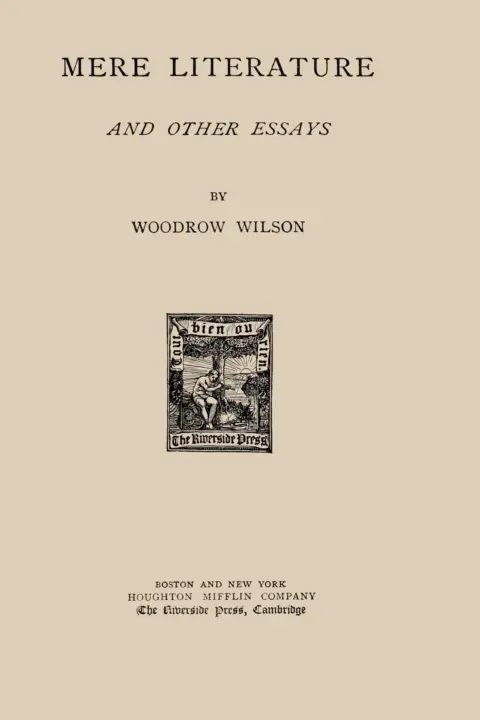
THE CLASSIC COLLECTION · 1896
"Mere Literature, and Other Essays" by Woodrow Wilson is a collection of essays written in the late 19th century. This work critically examines the relationship between literature and the more scientific and empirical approaches dominating the intellectual landscape of the time. Wilson's essays explore themes like the value of literature in education, the essence of true literature beyond mere technical prowess, and the influence of individualism in writing. The opening portion of the collection introduces the concept of "mere literature" and serves as a critique of the mentality that undervalues literary works as mere trivial pursuits compared to scientific knowledge. Wilson reflects on the disconnection between the study of literature and its intrinsic value, arguing that true literary appreciation must come from personal, first-hand engagement with works. He eloquently discusses the challenges faced in teaching literature within a scientific framework, emphasizing that genuine literature represents the spirit of its time and reflects the complexities of human experience, transcending mere technical analysis.
Introduction adapted from the source catalogue; source summaries may be automatically generated.
Free to read · English · 55,449 words · No account needed
MAKE TIME FOR A GOOD BOOK
On by default. Untick to stop anonymous reading totals. Each page counts after 10 seconds in view. How this works.
Anonymous counting is on unless you have switched it off.
These passages, it should be remembered, are taken from a speech in Parliament and from a letter written by Burke to his constituents in Bristol. He had no thought to make them permanent sentences of political philosophy. They were meant only to serve an immediate purpose in the advancement of contemporaneous policy. They were framed for the circumstances of the time. They speak out spontaneously amidst matter of the moment: and they could be matched everywhere throughout his pamphlets and public utterances. No other similar productions that I know of have this singular, and as it were inevitable, quality of permanency. They have emerged from the mass of political writings put forth in their time with their freshness untouched, their significance unobscured, their splendid vigor unabated. It is this that we marvel at, that they should remain modern and timely, purged of every element and seed of decay. The man who could do this must needs arrest our attention and challenge our inquiry. We wish to account for him as we should wish to penetrate the secrets of the human spirit and know the springs of genius.
Of the public life of Burke we know all that we could wish. He became so prominent a figure in the great affairs of his day that even the casual observer cannot fail to discern the main facts of his career; while the close student can follow him year by year through every step of his service. But his private life was withdrawn from general scrutiny in an unusual degree. He manifested always a marked reserve about his individual and domestic affairs, deliberately, it would seem, shielding them from impertinent inquiry. He loved the privacy of life in a great city, where one may escape notice in the crowd and enjoy a grateful “freedom from remark and petty censure.” “Though I have the honor to represent Bristol,” he said to Boswell, “I should not like to live there; I should be obliged to be so much upon my good behavior. In London a man may live in splendid society at one time, and in frugal retirement at another, without animadversion. There, and there alone, a man’s house is truly his castle, in which he can be in perfect safety from intrusion whenever he pleases. I never shall forget how well this was expressed to me one day by Mr. Meynell: ‘The chief advantage of London,’ he said, ‘is, that a man is always so near his burrow.’” Burke took to his burrow often enough to pique our curiosity sorely. This singular, high-minded adventurer had some queer companions, we know: questionable fellows, whose life he shared, perhaps with a certain Bohemian relish, without sharing their morals or their works. It seems as incongruous that such wisdom and public spirit as breathe through his writings should have come to his thought in such company as that an exquisite idyll like Goldsmith’s “Vicar of Wakefield” should have been conceived and written in squalid garrets. But neither Burke nor Goldsmith had been born into such comradeships or such surroundings. Doubtless, as sometimes happens, their minds kept their first freshness, taking no taint from the world that touched them on every hand in their manhood, after their minds had been formed. Goldsmith, as everybody knows, remained an innocent all his life, a naïf and pettish boy amidst sophisticated men; and Burke too, notwithstanding his dignity and commanding intellectual habit, shows sometimes a touch of the same simplicity, a like habit of unguarded self-revelation. ’Twas their form, no doubt, of that impulsive and ingenuous quality which we observe in all Irishmen, and which we often mistake for simplicity. ’Twas a flavor of their native soil. It was also something more and better than that, however. Not every Irishman displays such hospitality for direct and simple images of truth as these men showed, for that is characteristic only of the open and unsophisticated mind,--the mind that has kept pure and open eyes. Not that Burke always sees the truth; he is even deeply prejudiced often, and there are some things that he cannot see. But the passion that dominates him when he is wrong, as when he is right, is a natural passion, born with him, not acquired from a disingenuous world that mistakes interest for justice. His nature tells in everything. It is stock of his character which he contributes to the subjects his mind handles. He is trading always with the original treasure he brought over with him at the first. He has never impaired his genuineness, or damaged his principles.
Your reading position is saved on this browser. Take it to another device with a library code. Reading pages adapt to text, rather than matching a printed edition.
Woodrow Wilson
Woodrow Wilson
Woodrow Wilson
Woodrow Wilson
BEHIND THE BOOK
This eBook is for the use of anyone anywhere in the United States and most other parts of the world at no cost and with almost no restrictions whatsoever. You may copy it, give it away or re-use it under the terms of the Project Gutenberg License included with this eBook or online at www.gutenberg.org. If you are not located in the United States, you will have to check the laws of the country where you are located before using this eBook. Read the source licence.
The original source file, including credits and licence, is retained by this library. Request an original-format copy at no charge. Please include the book title and Project Gutenberg identifier #66074.
KEEP YOUR CURIOSITY GOING

David Patterson (Spirit) Hatch

David Patterson (Spirit) Hatch

David Patterson (Spirit) Hatch
Cécile Tormay

Moritz Busch
John L. Ransom