
George Washington
Woodrow Wilson
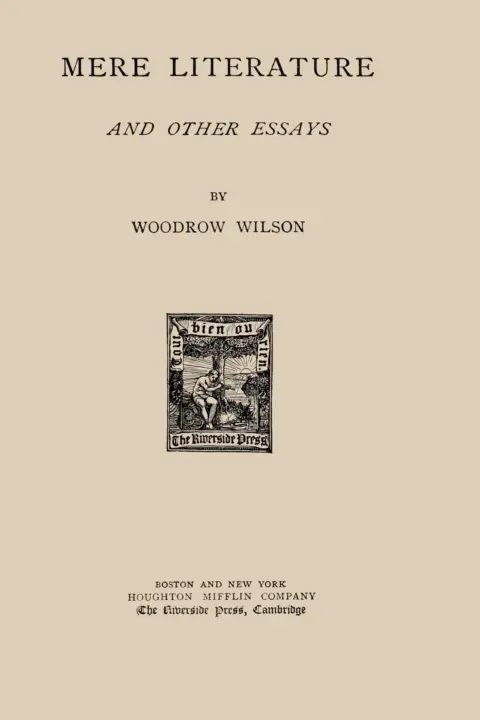
THE CLASSIC COLLECTION · 1896
"Mere Literature, and Other Essays" by Woodrow Wilson is a collection of essays written in the late 19th century. This work critically examines the relationship between literature and the more scientific and empirical approaches dominating the intellectual landscape of the time. Wilson's essays explore themes like the value of literature in education, the essence of true literature beyond mere technical prowess, and the influence of individualism in writing. The opening portion of the collection introduces the concept of "mere literature" and serves as a critique of the mentality that undervalues literary works as mere trivial pursuits compared to scientific knowledge. Wilson reflects on the disconnection between the study of literature and its intrinsic value, arguing that true literary appreciation must come from personal, first-hand engagement with works. He eloquently discusses the challenges faced in teaching literature within a scientific framework, emphasizing that genuine literature represents the spirit of its time and reflects the complexities of human experience, transcending mere technical analysis.
Introduction adapted from the source catalogue; source summaries may be automatically generated.
Free to read · English · 55,449 words · No account needed
MAKE TIME FOR A GOOD BOOK
On by default. Untick to stop anonymous reading totals. Each page counts after 10 seconds in view. How this works.
Anonymous counting is on unless you have switched it off.
When they did, the great determining movement of our history began. The very visages of the people changed. That alert movement of the eye, that openness to every thought of enterprise or adventure, that nomadic habit which knows no fixed home and has plans ready to be carried any whither,--all the marks of the authentic type of the “American” as we know him came into our life. The crack of the whip and the song of the teamster, the heaving chorus of boatmen poling their heavy rafts upon the rivers, the laughter of the camp, the sound of bodies of men in the still forests, became the characteristic notes in our air. A roughened race, embrowned in the sun, hardened in manner by a coarse life of change and danger, loving the rude woods and the crack of the rifle, living to begin something new every day, striking with the broad and open hand, delicate in nothing but the touch of the trigger, leaving cities in its track as if by accident rather than design, settling again to the steady ways of a fixed life only when it must: such was the American people whose achievement it was to be to take possession of their continent from end to end ere their national government was a single century old. The picture is a very singular one! Settled life and wild side by side: civilization frayed at the edges,--taken forward in rough and ready fashion, with a song and a swagger,--not by statesmen, but by woodsmen and drovers, with axes and whips and rifles in their hands, clad in buckskin, like huntsmen.
It has been said that we have here repeated some of the first processes of history; that the life and methods of our frontiersmen take us back to the fortunes and hopes of the men who crossed Europe when her forests, too, were still thick upon her. But the difference is really very fundamental, and much more worthy of remark than the likeness. Those shadowy masses of men whom we see moving upon the face of the earth in the far-away, questionable days when states were forming: even those stalwart figures we see so well as they emerge from the deep forests of Germany, to displace the Roman in all his western provinces and set up the states we know and marvel upon at this day, show us men working their new work at their own level. They do not turn back a long cycle of years from the old and settled states, the ordered cities, the tilled fields, and the elaborated governments of an ancient civilization, to begin as it were once more at the beginning. They carry alike their homes and their states with them in the camp and upon the ordered march of the host. They are men of the forest, or else men hardened always to take the sea in open boats. They live no more roughly in the new lands than in the old. The world has been frontier for them from the first. They may go forward with their life in these new seats from where they left off in the old. How different the circumstances of our first settlement and the building of new states on this side the sea! Englishmen, bred in law and ordered government ever since the Norman lawyers were followed a long five hundred years ago across the narrow seas by those masterful administrators of the strong Plantagenet race, leave an ancient realm and come into a wilderness where states have never been; leave a land of art and letters, which saw but yesterday “the spacious times of great Elizabeth,” where Shakespeare still lives in the gracious leisure of his closing days at Stratford, where cities teem with trade and men go bravely dight in cloth of gold, and turn back six centuries,--nay, a thousand years and more,--to the first work of building states in a wilderness! They bring the steadied habits and sobered thoughts of an ancient realm into the wild air of an untouched continent. The weary stretches of a vast sea lie, like a full thousand years of time, between them and the life in which till now all their thought was bred. Here they stand, as it were, with all their tools left behind, centuries struck out of their reckoning, driven back upon the long dormant instincts and forgotten craft of their race, not used this long age. Look how singular a thing: the work of a primitive race, the thought of a civilized! Hence the strange, almost grotesque groupings of thought and affairs in that first day of our history. Subtle politicians speak the phrases and practice the arts of intricate diplomacy from council chambers placed within log huts within a clearing. Men in ruffs and lace and polished shoe-buckles thread the lonely glades of primeval forests. The microscopical distinctions of the schools, the thin notes of a metaphysical theology are woven in and out through the labyrinths of grave sermons that run hours long upon the still air of the wilderness. Belief in dim refinements of dogma is made the test for man or woman who seeks admission to a company of pioneers. When went there by an age since the great flood when so singular a thing was seen as this: thousands of civilized men suddenly rusticated and bade do the work of primitive peoples,--Europe frontiered!
Your reading position is saved on this browser. Take it to another device with a library code. Reading pages adapt to text, rather than matching a printed edition.
Woodrow Wilson
Woodrow Wilson
Woodrow Wilson
Woodrow Wilson
BEHIND THE BOOK
This eBook is for the use of anyone anywhere in the United States and most other parts of the world at no cost and with almost no restrictions whatsoever. You may copy it, give it away or re-use it under the terms of the Project Gutenberg License included with this eBook or online at www.gutenberg.org. If you are not located in the United States, you will have to check the laws of the country where you are located before using this eBook. Read the source licence.
The original source file, including credits and licence, is retained by this library. Request an original-format copy at no charge. Please include the book title and Project Gutenberg identifier #66074.
KEEP YOUR CURIOSITY GOING

David Patterson (Spirit) Hatch

David Patterson (Spirit) Hatch

David Patterson (Spirit) Hatch
Cécile Tormay

Moritz Busch
John L. Ransom