
Two Women, 1862; a Poem
Constance Fenimore Woolson
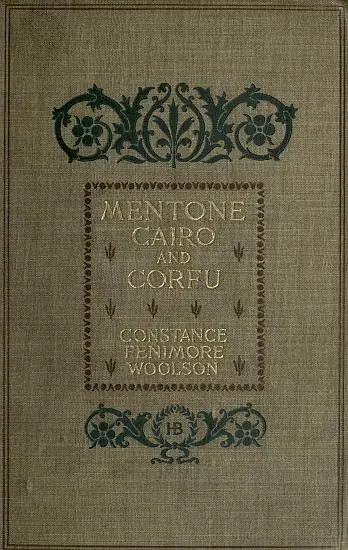
THE CLASSIC COLLECTION · 1895
"Mentone, Cairo, and Corfu" by Constance Fenimore Woolson is a collection of travel sketches written in the late 19th century. The work chronicles the author's experiences and observations as she visits three distinct Mediterranean destinations: Mentone, Cairo, and Corfu, each portrayed vividly through a blend of narrative and reflection. The sketches bring to life the cultures, landscapes, and notable interactions with diverse characters, likely featuring characters like Mrs. Trescott, her daughter Janet, and Professor Mackenzie among others. At the start of the collection, Woolson introduces readers to Mentone, detailing the arrival of a group of travelers, including herself through her character Jane Jefferson. They settle into a hotel in the picturesque town, and the narrative captures their appreciation of the sunny environment, local quirks, and the captivating views of the Mediterranean. The characters engage in lively discussions about the beauty of their surroundings, the importance of the sun, and the fascinating history of the area, all while encountering humorous interactions and insights about each other, setting an inviting tone for the adventures and observations that follow in Cairo and Corfu.
Introduction adapted from the source catalogue; source summaries may be automatically generated.
Free to read · English · 72,794 words · No account needed
MAKE TIME FOR A GOOD BOOK
On by default. Untick to stop anonymous reading totals. Each page counts after 10 seconds in view. How this works.
Anonymous counting is on unless you have switched it off.
We approach the bazaars by the Mooski, a street which has lost all its ancient attraction--which is, in fact, one of the most commonplace avenues I know. But near its end the enchantment begins, and whether we enter the flag bazaar, the lemon-colored-slipper bazaar, the gold-and-silver bazaar, the bazaar of the Soudan, the bazaar of silks and embroideries, the bazaar of Turkish carpets, or the lane of perfumes felicitously named by the donkey-boys the smell bazaar, we are soon in the condition of children before a magician's table. I defy any one to resist it. The most tired American business man looks about him with awakened interest, the lines of his face relax and turn into the wrinkles we associate with laughter, as he sees the small, frontless shops, the long-skirted merchants, and the sewing, embroidering, cross-legged crowd. The best way, indeed, to view the bazaars is to relax--to relax your ideas of time as well as of pace, and not be in a hurry about anything. Accompany some one who is buying, but do not buy yourself; then you can have a seat on the divan, and even (as a friend of the purchaser) one of those wee cups of black coffee which the merchant offers, and which, whether you like it or not, you take, because it belongs to the scene. Thus seated, you can look about at your ease.
In these days, when every one is rereading the Arabian Nights, the learned in Burton's translation, the outside public in Lady Burton's, even the most unmethodical of writers feels himself, in connection with Cairo, forced towards the inevitable allusion to Haroun. But once within the precincts of the Khan Khaleel, he does not need to have his fancy jogged by Burton or any one else; he thinks of the Arabian Nights instinctively, and "it's a poor tale," indeed, to quote Mrs. Poyser, if he does not meet the one-eyed calendar in the very first booth. But, as has already been said, it is useless to describe. All one can do is to set down a few impressions. One of the first of these is the charming light. The sunshine of Egypt has a great radiance, but it has also--and this is especially visible when one looks across any breadth of landscape--a pleasant quality of softness; it is a radiance which is slightly hazy and slightly golden brown, being in these respects quite unlike the pellucid white light of Greece. The Greeks frown; even the youngest of the handsome men who go about in ballet-like white petticoats and the brimless cap, has the ugly little perpendicular line between the eyes, produced by a constant knitting of the brows. Like the Greek, the Egyptian also is without protection for his eyes; the dragoman wears a small shawl over the fez, which covers the back of the neck and sides of the face, the Bedouins have a hood, but the large majority of the natives are unprotected. It is said that a Mohammedan can have no brim to his turban or tarboosh, because he must place his bare forehead upon the ground when he says his prayers, and this without removing his head-gear (which would be irreverent). However this may be, he goes about in Egypt with the sun in his eyes, though, owing to the softer quality of the light, he does not frown as the Greek frowns. For those who are not Egyptians, however, the light in Cairo sometimes seems too omnipresent; then, for refuge, they can go to the bazaars. The sunshine is here cut off horizontally by thick walls, and from above it is filtered through mats, whose many interstices cause a checker of light and shade in an infinite variety of unexpected patterns on the ground. This ground is watered. Somehow the air is cool; coming in from the bright streets outside is like entering an arbor. The little shops resemble cupboards; their floors are about three feet above the street. They have no doors at the back. When the merchant wishes to close his establishment, he comes out, pulls down the lid, locks it, and goes home. A picturesque characteristic is that in many cases the wares are simply sold here; they are also made, one by one, upon the spot. You can see the brass-workers incising the arabesques of their trays; you can see the armorers making arms, the ribbon-makers making ribbons, the jewellers blowing their forges, the ivory-carvers bending over their delicate task. As soon as each article is finished, it is dusted and placed upon the little shelf above, and then the apprentice sets to work upon a new one. In addition to the light, another thing one notices is the amazing way in which the feet are used. In Cairo one soon becomes as familiar with feet as one is elsewhere with hands; it is not merely that they are bare; it is that the toes appear to be prehensile, like fingers. In the bazaars the embroiderers hold their cloth with their toes; the slipper-makers, the flag-cutters, the brass-workers, the goldsmiths, employ their second set of fingers almost as much as they employ the first. Both the hands and feet of these men are well formed, slender, and delicate, and, by the rules of their religion, they are bathed five times each day.
Your reading position is saved on this browser. Take it to another device with a library code. Reading pages adapt to text, rather than matching a printed edition.
Constance Fenimore Woolson

Constance Fenimore Woolson

Constance Fenimore Woolson
Constance Fenimore Woolson
BEHIND THE BOOK
This eBook is for the use of anyone anywhere in the United States and most other parts of the world at no cost and with almost no restrictions whatsoever. You may copy it, give it away or re-use it under the terms of the Project Gutenberg License included with this eBook or online at www.gutenberg.org. If you are not located in the United States, you will have to check the laws of the country where you are located before using this eBook. Read the source licence.
The original source file, including credits and licence, is retained by this library. Request an original-format copy at no charge. Please include the book title and Project Gutenberg identifier #33367.
KEEP YOUR CURIOSITY GOING
Wilfrid Scawen Blunt
Wilfrid Scawen Blunt

E. W. (Edgar Watson) Howe
Francis Greenleaf Allinson & Anne C. E. (Anne Crosby Emery) Allinson
Cyrenus Cole

John Martineau