
Two Women, 1862; a Poem
Constance Fenimore Woolson
THE CLASSIC COLLECTION · 1895
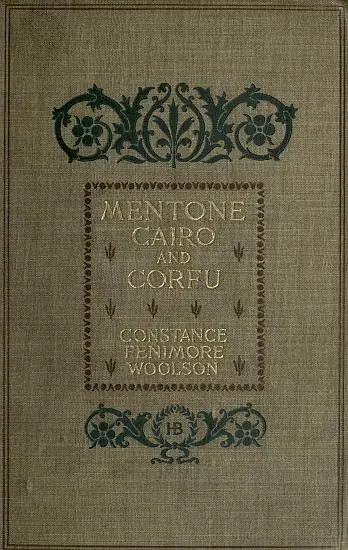
"Mentone, Cairo, and Corfu" by Constance Fenimore Woolson is a collection of travel sketches written in the late 19th century. The work chronicles the author's experiences and observations as she visits three distinct Mediterranean destinations: Mentone, Cairo, and Corfu, each portrayed vividly through a blend of narrative and reflection. The sketches bring to life the cultures, landscapes, and notable interactions with diverse characters, likely featuring characters like Mrs. Trescott, her daughter Janet, and Professor Mackenzie among others. At the start of the collection, Woolson introduces readers to Mentone, detailing the arrival of a group of travelers, including herself through her character Jane Jefferson. They settle into a hotel in the picturesque town, and the narrative captures their appreciation of the sunny environment, local quirks, and the captivating views of the Mediterranean. The characters engage in lively discussions about the beauty of their surroundings, the importance of the sun, and the fascinating history of the area, all while encountering humorous interactions and insights about each other, setting an inviting tone for the adventures and observations that follow in Cairo and Corfu.
Introduction adapted from the source catalogue; source summaries may be automatically generated.
Free to read · English · 72,794 words · No account needed
MAKE TIME FOR A GOOD BOOK
On by default. Untick to stop anonymous reading totals. Each page counts after 10 seconds in view. How this works.
Anonymous counting is on unless you have switched it off.
One day when I was passing the hot hours in the shaded rooms of the museum, surrounded by seated granite figures with their hands on their knees (the coolest companions I know), I heard chattering and laughter. These are unusual sounds in those echoing halls, where unconsciously everybody whispers, partly because of the echo, and partly also, I think, on account of the mystic mummy cases which stand on end and look at one so queerly with their oblique eyes. Presently there came into view ten or twelve Cairo ladies, followed by eunuchs, and preceded by a guide. The eunuchs were (as eunuchs generally are) hideous, though they represented all ages, from a tall lank boy of seventeen to a withered old creature well beyond sixty. The Cairo eunuchs are negroes; one distinguishes them always by the extreme care with which they are dressed. They wear coats and trousers of black broadcloth made in the latest European style, with patent-leather shoes, and they are decorated with gold chains, seal rings, and scarf-pins; they have one merit as regards their appearance--I know of but one--they do look clean. The ladies were taking their ease; the muffling black silk outer cloaks, which all Egyptian women of the upper class wear when they leave the house, had been thrown aside; the white face veils had been loosened so that they dropped below the chin. It was the hareem of the Minister for Foreign Affairs; their carriages were waiting below. The most modest of men--a missionary, for instance, or an entomologist--would, I suppose, have put them to flight; but as the tourist season was over, and as it was luncheon-time for Europeans, no one appeared but myself, and the ladies strayed hither and thither as they chose, occasionally stopping to hear a few words of the explanations which the guide (a woman also) was vainly trying to give before each important statue. With one exception, these Cairo dames were, to say the least, extremely plump; their bare hands were deeply dimpled, their cheeks round. They all had the same very white complexion without rose tints; their features were fairly good, though rather thick; the eyes in each case were beautiful--large, dark, lustrous, with sweeping lashes. Their figures, under their loose garments, looked like feather pillows. They were awkward in bearing and gait, but this might have been owing to the fact that their small plump feet (in white open-work cotton stockings) were squeezed into very tight French slippers with abnormally high heels, upon which it must have been difficult to balance so many dimples. The one exception to the rule of billowy beauty was a slender, even meagrely formed girl, who in America would pass perhaps for seventeen; probably she was three years younger. Her thin, dark, restless face, with its beautiful inquiring eyes, was several times close beside mine as we both inspected the golden bracelets and ear-rings, the necklaces and fan, of Queen Ahhotpu, our sister in vanity of three thousand five hundred years ago. I looked more at her than I did at the jewels, and she returned my gaze; we might have had a conversation. What would I not have given to have been able to talk with her in her own tongue! After a while they all assembled in what is called the winter garden, an up-stairs apartment, where grass grows over the floor in formal little plots. Chairs were brought, and they seated themselves amid this aerial verdure to partake of sherbet, which the youngest eunuch handed about with a business-like air. While they were still here, much relaxed as regards attire and attitude, my attention was attracted by the rush through the outer room (where I myself was seated) of the four older eunuchs. They had been idling about; they had even gone down the stairs, leaving to the youngest of their number the task of serving the sherbet; but now they all appeared again, and the swiftness with which they crossed the outer room and dashed into the winter-garden created a breeze. They called to their charges as they came, and there was a general smoothing down of draperies. The eunuchs, however, stood upon no ceremony; they themselves attired the ladies in the muffling cloaks, and refastened their veils securely, as a nurse dresses children, and with quite as much authority. I noticed that the handsomer faces showed no especial haste to disappear from view; but there was no real resistance; there was only a good deal of laughter.
Your reading position is saved on this browser. Take it to another device with a library code. Reading pages adapt to text, rather than matching a printed edition.
Constance Fenimore Woolson

Constance Fenimore Woolson

Constance Fenimore Woolson
Constance Fenimore Woolson
BEHIND THE BOOK
This eBook is for the use of anyone anywhere in the United States and most other parts of the world at no cost and with almost no restrictions whatsoever. You may copy it, give it away or re-use it under the terms of the Project Gutenberg License included with this eBook or online at www.gutenberg.org. If you are not located in the United States, you will have to check the laws of the country where you are located before using this eBook. Read the source licence.
The original source file, including credits and licence, is retained by this library. Request an original-format copy at no charge. Please include the book title and Project Gutenberg identifier #33367.
KEEP YOUR CURIOSITY GOING
Wilfrid Scawen Blunt
Wilfrid Scawen Blunt

E. W. (Edgar Watson) Howe
Francis Greenleaf Allinson & Anne C. E. (Anne Crosby Emery) Allinson
Cyrenus Cole

John Martineau