
Two Women, 1862; a Poem
Constance Fenimore Woolson
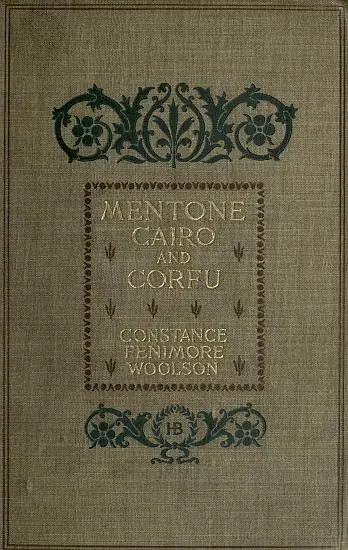
THE CLASSIC COLLECTION · 1895
"Mentone, Cairo, and Corfu" by Constance Fenimore Woolson is a collection of travel sketches written in the late 19th century. The work chronicles the author's experiences and observations as she visits three distinct Mediterranean destinations: Mentone, Cairo, and Corfu, each portrayed vividly through a blend of narrative and reflection. The sketches bring to life the cultures, landscapes, and notable interactions with diverse characters, likely featuring characters like Mrs. Trescott, her daughter Janet, and Professor Mackenzie among others. At the start of the collection, Woolson introduces readers to Mentone, detailing the arrival of a group of travelers, including herself through her character Jane Jefferson. They settle into a hotel in the picturesque town, and the narrative captures their appreciation of the sunny environment, local quirks, and the captivating views of the Mediterranean. The characters engage in lively discussions about the beauty of their surroundings, the importance of the sun, and the fascinating history of the area, all while encountering humorous interactions and insights about each other, setting an inviting tone for the adventures and observations that follow in Cairo and Corfu.
Introduction adapted from the source catalogue; source summaries may be automatically generated.
Free to read · English · 72,794 words · No account needed
MAKE TIME FOR A GOOD BOOK
On by default. Untick to stop anonymous reading totals. Each page counts after 10 seconds in view. How this works.
Anonymous counting is on unless you have switched it off.
Most of us do not lose our admiration for the Orientalness of the camel. But we learn in time that he has been praised for qualities which he does not possess. He is industrious, but he continually scolds about his industry; he may not trouble one with his thirst, but he revenges himself by his sneer. The smile of a camel is the most disdainful thing I know. On the other side of the Nile bridge one comes sometimes upon an acre of these beasts, all kneeling down in the extraordinary way peculiar to them, with their hind-legs turned up; here they chew as they rest, and put out their long necks to look at the passers-by. But the way to appreciate the neck of a camel is to be on a donkey; then, when the creature comes up behind and lopes past you, his neck seems to be the highest thing in Cairo--higher than a mosque.
Beyond the bridge the road to Gizeh follows the river. Gizeh itself is the typical Nile village, with the low, clustered houses built of Nile mud (which looks like yellow-brown stucco), and beautiful feathery palms with a minaret or two rising above. The palace stands apart from the village, and is surrounded by large gardens. Opposite the central portico is the tomb of Mariette Pasha, the founder of the museum--a high sarcophagus designed from an antique model. Mariette Pasha (it may be mentioned here that the title Pasha means General, and that of Bey, Colonel) was a native of Boulogne. A mummy case in the museum of that town of schools first attracted his attention towards Egyptian antiquities, and in 1850 he came to Egypt. Khedive Said authorized him to found a museum; and Said's successor, Ismail, conferred upon him the exclusive right to make excavations, placing in his charge all the antiquities of Egypt. Mariette used these powers with intelligence and energy, giving the rest of his life to the task--a period of thirty years. He died in Cairo, at the age of sixty-one, in January, 1882. This Frenchman made many important discoveries, and he preserved to Egypt her remaining antiquities; before his time her treasures had been stolen and bought by all the world. A thought which haunts all travellers in this strange country is, how many more rich stores must still remain hidden! The most generally interesting among the recent discoveries was the finding of the Pharaohs, in 1881. The story has been given to the world in print, therefore it will be only outlined here. But by far the most fortunate way is to hear it directly from the lips of the keeper of the museum, Emil Brugsch Bey himself, his vivid, briefly direct narration adding the last charm to the striking facts. By the museum authorities it had been for several years suspected that some one at Luxor (Thebes) had discovered a hitherto unopened tomb; for funeral statuettes, papyri, and other objects, all of importance, were offered for sale there, one by one, and bought by travellers, who, upon their return to Cairo, displayed the treasures, without comprehending their value. Watch was kept, and suspicion finally centred upon a family of brothers; these Arabs at last confessed, and one of them led the way to a place not far from the temple called Deir-el-Bahari, which all visitors to Thebes will remember. Here, filled with sand, there was a shaft not unlike a well, which the man had discovered by chance. When the sand was removed, the opening of a lateral tunnel was visible below, and this tunnel led into the heart of the hill, where, in a rude chamber twenty feet high, were piled thirty or more mummy cases, most of them decorated with the royal asp. The mummies proved to be those of Sethi the First, the conqueror who carried his armies as far into Asia as the Orontes; and of Rameses the Great (called Sesostris by the Greeks), the Pharaoh who oppressed the Israelites; and of Sethi the Second, the Pharaoh of the Exodus, together with other sovereigns and members of their families, princes, princesses, and priests. At some unknown period these mummies had been taken from the magnificent rock tombs in that terrible Apocalyptic Valley of the Kings, not far distant, and hidden in this rough chamber. No one knows why this was done; a record of it may yet be discovered. But in time all knowledge of the hiding-place was lost, and here the Pharaohs remained until that July day in 1881. They were all transported across the burning plain and down the Nile to Cairo. Now at last they repose in state in an apartment which might well be called a throne-room. You reach this great cruciform hall by a handsome double stairway; upon entering, you see the Pharaohs ranged in a majestic circle, and careless though you may be, unhistorical, practical, you are impressed. The features are distinct. Some of the dark faces have dignity; others show marked resolution and power. Curiously enough, one of them closely resembles Voltaire. This, however, is probably due to the fact that Voltaire closely resembled a mummy while living. How would it seem, the thought that beings who are to come into existence A.D. 5000 should be able, in the land which we now call the United States of America (what will it be called then?), to gaze upon the features of some of our Presidents--for instance, George Washington and Abraham Lincoln? I am afraid that the fancy is not as striking as it should be, for New World ambition grasps without difficulty all futures, even A.D. 25,000; it is only when our eyes are turned towards the past, where we have no importance and represent nothing, that an enumeration of centuries overpowers us--a little. But in any case, after visiting Egypt, we all learn to hate the art of the embalmer; those who have been up the Nile, and beheld the poor relics of mortality offered for sale on the shores, become, as it were by force, advocates of cremation.
Your reading position is saved on this browser. Take it to another device with a library code. Reading pages adapt to text, rather than matching a printed edition.
Constance Fenimore Woolson

Constance Fenimore Woolson

Constance Fenimore Woolson
Constance Fenimore Woolson
BEHIND THE BOOK
This eBook is for the use of anyone anywhere in the United States and most other parts of the world at no cost and with almost no restrictions whatsoever. You may copy it, give it away or re-use it under the terms of the Project Gutenberg License included with this eBook or online at www.gutenberg.org. If you are not located in the United States, you will have to check the laws of the country where you are located before using this eBook. Read the source licence.
The original source file, including credits and licence, is retained by this library. Request an original-format copy at no charge. Please include the book title and Project Gutenberg identifier #33367.
KEEP YOUR CURIOSITY GOING
Wilfrid Scawen Blunt
Wilfrid Scawen Blunt

E. W. (Edgar Watson) Howe
Francis Greenleaf Allinson & Anne C. E. (Anne Crosby Emery) Allinson
Cyrenus Cole

John Martineau