
Two Women, 1862; a Poem
Constance Fenimore Woolson
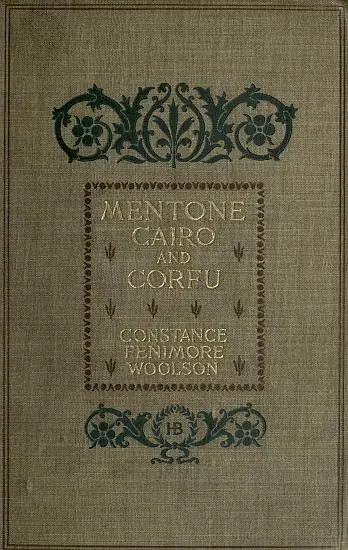
THE CLASSIC COLLECTION · 1895
"Mentone, Cairo, and Corfu" by Constance Fenimore Woolson is a collection of travel sketches written in the late 19th century. The work chronicles the author's experiences and observations as she visits three distinct Mediterranean destinations: Mentone, Cairo, and Corfu, each portrayed vividly through a blend of narrative and reflection. The sketches bring to life the cultures, landscapes, and notable interactions with diverse characters, likely featuring characters like Mrs. Trescott, her daughter Janet, and Professor Mackenzie among others. At the start of the collection, Woolson introduces readers to Mentone, detailing the arrival of a group of travelers, including herself through her character Jane Jefferson. They settle into a hotel in the picturesque town, and the narrative captures their appreciation of the sunny environment, local quirks, and the captivating views of the Mediterranean. The characters engage in lively discussions about the beauty of their surroundings, the importance of the sun, and the fascinating history of the area, all while encountering humorous interactions and insights about each other, setting an inviting tone for the adventures and observations that follow in Cairo and Corfu.
Introduction adapted from the source catalogue; source summaries may be automatically generated.
Free to read · English · 72,794 words · No account needed
MAKE TIME FOR A GOOD BOOK
On by default. Untick to stop anonymous reading totals. Each page counts after 10 seconds in view. How this works.
Anonymous counting is on unless you have switched it off.
After long neglect, something is being done at last to arrest the ruin of the more ancient of these temples. A commission has been appointed by the present government whose duty is the preservation of the monuments of Arabian art; occasionally, therefore, in a mosque one finds scaffolding in place and a general dismantlement. One can only hope for the best--in much the same spirit in which one hopes when one sees the beautiful old front of St. Mark's, Venice, gradually encroached upon by the new raw timbers. But in Cairo, at least, the work of repairing goes on very slowly; three hundred mosques, probably, out of the four hundred still remain untouched, and many of these are adorned with a delicate beauty which is unrivalled. I know no quest so enchanting as a search through the winding lanes of the old quarters for these gems of Saracenic taste, which no guide-book has as yet chronicled, no dragoman discovered. The street is so narrow that your donkey fills almost all the space; passers-by are obliged to flatten themselves against the walls in response to the Oriental adjurations of your donkey-boy behind: "Take heed, O maid!" "Your foot, O chief!" Presently you see a minaret--there is always a minaret somewhere; but it is not always easy to find the mosque to which it belongs, hidden, perhaps, as it is, behind other buildings in the crowded labyrinth. At length you observe a door with a dab or two of the well-known Saracenic honeycomb-work above it; instantly you dismount, climb the steps, and look in. You are almost sure to find treasures, either fragments of the pearly Cairo mosaic, or a wonderful ceiling, or gilded Kufic (old Arabian text) inscriptions and arabesques, or remains of the ancient colored glass which changes its tint hour by hour. Best of all, sometimes you find a space open to the sky, with a fountain in the centre, the whole surrounded by arcades of marble columns adorned with hanging lamps (or, rather, with the bronze chains which once carried the lamps), and with suspended ostrich eggs--the emblems of good-luck. One day, when my donkey was making his way through a dilapidated region, I came upon a mosque so small that it seemed hardly more than a base for its exquisite minaret, which towered to an unusual height above it. Of course I dismounted. The little mosque was open; but as it was never visited by strangers, it possessed no slippers, and without coverings of some kind it was impossible that unsanctified shoes, such as mine, should touch its matted floor; the bent, ancient guardian glared at me fiercely for the mere suggestion. One sees sometimes (even in 1890) in the eyes of old men sitting in the mosques the original spirit of Islam shining still. Once their religion commanded the sword; they would like to grasp it again, if they could. It was suggested that the matting might, for a backsheesh, be rolled up and put away, as the place was small. But the stern old keeper remained inflexible. Then the offer was made that so many piasters--ten (that is, fifty cents)--would be given to the blind. Now the blind are sacred in Cairo; this offer, therefore, was successful; all the matting was carefully rolled and stacked in a corner, the three or four Muslims present withdrew to the door, and the unbeliever was allowed to enter. She found herself in a temple of color which was incredibly rich. The floor was of delicate marble, and every inch of the walls was covered with a mosaic of porphyry and jasper, adorned with gilded inscriptions and bands of Kufic text; the tall pulpit, made of mahogany-colored wood, was carved from top to bottom in intricate designs, and ornamented with odd little plaques of fretted bronze; the sacred niche was lined with alabaster, turquoise, and gleaming mother-of-pearl; the only light came through the thick glass of the small windows far above, in downward-falling rays of crimson, violet, and gold. The old mosaic-work of the Cairo mosques is composed of small plates of marble and of mother-of-pearl arranged in geometrical designs; the delicacy of the minute cubes employed, and the intricacy of the patterns, are marvellous; the color is faint, unless turquoise has been added; but the glitter of the mother-of-pearl gives the whole an appearance like that of jewelry. Upon our departure five blind men were found drawn up in a line at the door. It would not have been difficult to collect fifty.
Your reading position is saved on this browser. Take it to another device with a library code. Reading pages adapt to text, rather than matching a printed edition.
Constance Fenimore Woolson

Constance Fenimore Woolson

Constance Fenimore Woolson
Constance Fenimore Woolson
BEHIND THE BOOK
This eBook is for the use of anyone anywhere in the United States and most other parts of the world at no cost and with almost no restrictions whatsoever. You may copy it, give it away or re-use it under the terms of the Project Gutenberg License included with this eBook or online at www.gutenberg.org. If you are not located in the United States, you will have to check the laws of the country where you are located before using this eBook. Read the source licence.
The original source file, including credits and licence, is retained by this library. Request an original-format copy at no charge. Please include the book title and Project Gutenberg identifier #33367.
KEEP YOUR CURIOSITY GOING
Wilfrid Scawen Blunt
Wilfrid Scawen Blunt

E. W. (Edgar Watson) Howe
Francis Greenleaf Allinson & Anne C. E. (Anne Crosby Emery) Allinson
Cyrenus Cole

John Martineau