
Two Women, 1862; a Poem
Constance Fenimore Woolson
THE CLASSIC COLLECTION · 1895
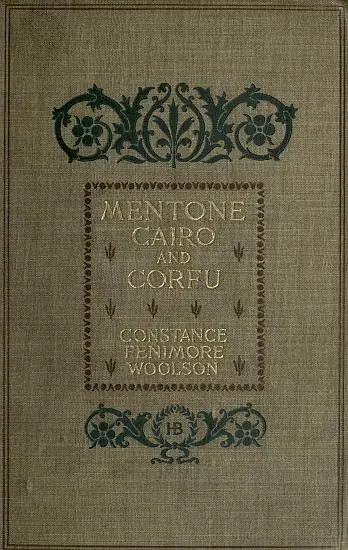
"Mentone, Cairo, and Corfu" by Constance Fenimore Woolson is a collection of travel sketches written in the late 19th century. The work chronicles the author's experiences and observations as she visits three distinct Mediterranean destinations: Mentone, Cairo, and Corfu, each portrayed vividly through a blend of narrative and reflection. The sketches bring to life the cultures, landscapes, and notable interactions with diverse characters, likely featuring characters like Mrs. Trescott, her daughter Janet, and Professor Mackenzie among others. At the start of the collection, Woolson introduces readers to Mentone, detailing the arrival of a group of travelers, including herself through her character Jane Jefferson. They settle into a hotel in the picturesque town, and the narrative captures their appreciation of the sunny environment, local quirks, and the captivating views of the Mediterranean. The characters engage in lively discussions about the beauty of their surroundings, the importance of the sun, and the fascinating history of the area, all while encountering humorous interactions and insights about each other, setting an inviting tone for the adventures and observations that follow in Cairo and Corfu.
Introduction adapted from the source catalogue; source summaries may be automatically generated.
Free to read · English · 72,794 words · No account needed
MAKE TIME FOR A GOOD BOOK
On by default. Untick to stop anonymous reading totals. Each page counts after 10 seconds in view. How this works.
Anonymous counting is on unless you have switched it off.
We went eastward. Presently we passed a small house bearing the following naive inscription in French on the side towards the road: "The first villa built at Mentone, in 1855, to attract hither the strangers. The sun, the sea, and the soft air combined are benefactions bestowed upon us by the good God. Thanks be to Him, therefore, for His mercies in thus favoring us."
"Mentone is said to have been 'discovered by the English' in 1857," said Mrs. Clary. "Dr. Bennet, the London physician, may be called its real discoverer, as Lord Brougham was the discoverer of Cannes. From a sleepy, unknown little Riviera village it has grown into the winter resort we now see, with fifty hotels and two hundred villas full of strangers from all parts of the world."
The Professor was discoursing upon the climate. "It is very beneficial to all whose lungs are delicate," he said. "Also" (checking off the different classes on his fingers) "to the aged, to those who need general renovating, to the rheumatic, and to those afflicted with gout."
"Where, then, do I come in?" said Janet, sweetly, as he finished the
left hand.
"Nowhere," answered the Professor, meaning to be gallant, but not quite succeeding. Perceiving this, he added, slowly, and with solemnity, "But the fair and healthy flower should be willing to shine upon the less endowed for the pure beneficence of the act."
Baker and Inness sat down on the sea-wall behind him to recover from this. The two Englishmen were equally amused, although Miss Elaine, who was walking with them, did not discover it. However, Miss Elaine seldom discovered anything save herself. We now began to ascend, passing between the high walls of villa gardens along a smooth, broad, white road.
"This is the Cornice," said Mrs. Clary; "it winds along this coast from
Marseilles to Genoa."
"From Nice to Genoa," said the Professor, turning to correct her. But by turning he lost his place. Inness slipped into it, and not only that, but into his information also. In the leisure hour or two before and after "breakfast," Inness had carried out his threat of "studying up," and we soon became aware of it.
"The genius of Napoleon, Miss Trescott," he began, "caused this wonderful road to spring from the bosom of the mighty rock."
"Before it there was no road, only a mule track," said the Professor
from behind.
"I beg your pardon," said Inness, suavely, "but there was a road, the old Roman way, called Via Julia Augusta, traces of which are still to be seen at more than one point in this neighborhood."
Your reading position is saved on this browser. Take it to another device with a library code. Reading pages adapt to text, rather than matching a printed edition.
Constance Fenimore Woolson

Constance Fenimore Woolson

Constance Fenimore Woolson
Constance Fenimore Woolson
BEHIND THE BOOK
This eBook is for the use of anyone anywhere in the United States and most other parts of the world at no cost and with almost no restrictions whatsoever. You may copy it, give it away or re-use it under the terms of the Project Gutenberg License included with this eBook or online at www.gutenberg.org. If you are not located in the United States, you will have to check the laws of the country where you are located before using this eBook. Read the source licence.
The original source file, including credits and licence, is retained by this library. Request an original-format copy at no charge. Please include the book title and Project Gutenberg identifier #33367.
KEEP YOUR CURIOSITY GOING
Wilfrid Scawen Blunt
Wilfrid Scawen Blunt

E. W. (Edgar Watson) Howe
Francis Greenleaf Allinson & Anne C. E. (Anne Crosby Emery) Allinson
Cyrenus Cole

John Martineau