
Two Women, 1862; a Poem
Constance Fenimore Woolson
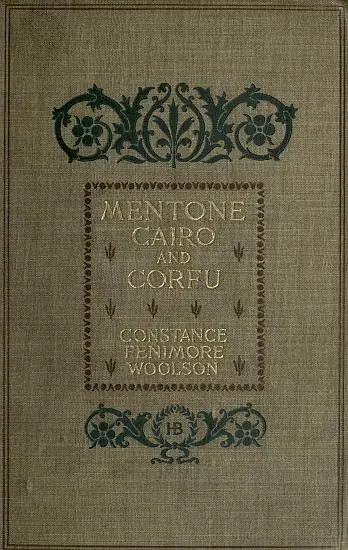
THE CLASSIC COLLECTION · 1895
"Mentone, Cairo, and Corfu" by Constance Fenimore Woolson is a collection of travel sketches written in the late 19th century. The work chronicles the author's experiences and observations as she visits three distinct Mediterranean destinations: Mentone, Cairo, and Corfu, each portrayed vividly through a blend of narrative and reflection. The sketches bring to life the cultures, landscapes, and notable interactions with diverse characters, likely featuring characters like Mrs. Trescott, her daughter Janet, and Professor Mackenzie among others. At the start of the collection, Woolson introduces readers to Mentone, detailing the arrival of a group of travelers, including herself through her character Jane Jefferson. They settle into a hotel in the picturesque town, and the narrative captures their appreciation of the sunny environment, local quirks, and the captivating views of the Mediterranean. The characters engage in lively discussions about the beauty of their surroundings, the importance of the sun, and the fascinating history of the area, all while encountering humorous interactions and insights about each other, setting an inviting tone for the adventures and observations that follow in Cairo and Corfu.
Introduction adapted from the source catalogue; source summaries may be automatically generated.
Free to read · English · 72,794 words · No account needed
MAKE TIME FOR A GOOD BOOK
On by default. Untick to stop anonymous reading totals. Each page counts after 10 seconds in view. How this works.
Anonymous counting is on unless you have switched it off.
But Athens was before us; we must leave the groves; we must leave Nausicaa's shore. We did so at last in the wake of a departing storm. For several days the wind had been tempestuous. The signal, which is displayed from the Citadel, had become a riddle; it is an arrangement of flags by day and of lanterns by night, and no two of us ever deciphered it alike. If the order was thus and so, it meant that something belonging to the Austrian-Lloyd company was in sight; if so and thus, it meant the Florio line; if neither of these, then it might possibly be our boat--that is, the Greek coasting steamer which we had decided to take because we had been told that it was the best. I have never fathomed the mystery as to why our informant told us this. If he had been a Greek, it would have been at least a patriotic misrepresentation. We were dismayed when we reached the rough tub. But, after all, in one sense she was the best, for she dawdled in and out among the islands, never in the least hurry, and stopping to gossip with them all; this gave us a good chance to see them, if it gave us nothing else. I have said "when we reached her," for there were several false starts. We rose in the morning in a mood of regretful good-bye, expecting to be far away at night. And at night, with our good-bye on our hands, we were still in our hotel. But it is only fair to add that with its garlands of flowers and myrtle for the Christmas season; with its queer assemblage of Levantines in the dining-room; with its bath-room in the depths of the earth, to which one descended by stairway leading down underground; with its group of petticoated Greeks in the hall, and, in its rooms of honor above, a young Austrian princess of historic name and extraordinary beauty--with all this, and its cheerful lies, its smiling, gay-hearted irresponsibility, the Corfu inn was an entertaining place. The Greek steamer came at last. She had been driven out of her course by the gale, so said the pirate, ostensibly retired from business, who superintended the embarkations from the hotel. This lithe freebooter had presented himself at frequent intervals during the baffling days when we watched the signal, and he always entered without knocking. He could not grasp the idea, probably, that ceremonies would be required by persons who intended to sail by the coaster. When we reached this bark ourselves, later, we forgave him--a little. Her deck was the most democratic place I have ever seen. We think that we approve of equality in the United States. But the Greeks carry their approval further than we do. On this deck there were no reserved portions, no prohibitions; the persons who had paid for a first-class ticket had the same rights as those which were accorded to the steerage travellers, and no more; and as the latter were numerous, they obtained by far the larger share, eating the provisions which they had brought with them, sleeping on their coverlids, playing games, and smoking in the best places. There was no system, and little discipline; the sailors came up and washed the deck (a process which was very necessary) whenever and however they pleased, and we had to jump for our lives and mount a bench to escape the stream from the hose, as it suddenly appeared without warning from an unlooked-for quarter. The passengers, who came on board at various points during a cruise of several days, brought with them light personal luggage, which consisted of hens tied together by the legs, a live sheep, kitchen utensils, and bedding, all of which they placed everywhere and anywhere, according to their pleasure. A Greek dressed in the full national costume accompanied us all the way to Missolonghi so closely that he was closer than a brother; save when we were locked in our small sleeping-cabins below (the one extra possession which a first-class ticket bestows), we were literally elbow to elbow with him. And his elbows were a weapon, like the closed umbrella held under the arm in a crowded street--that pleasant habit of persons who are not Greeks. The Greek elbow was clothed in a handsome sleeve covered with gold embroidery, for our friend was a dandy of dandies. His petticoats and his shirt were of fine linen, snowy in its whiteness; his small waist was encircled by a magnificent Syrian scarf; his cream-colored leggings were spotless; and his conspicuous garters new and brilliantly scarlet. He was an athletic young man of thirty, his good looks marred only by his over-eager eyes and his restlessness. It was his back which he presented to us, for his attention was given entirely to a party of his own friends, men and women. He talked to them; he read aloud to them from a small newspaper (they all had newspapers, and read them often); he stood up and argued; he grew excited and harangued; then he sat down, his inflated skirts puffing out over his chair, and went on with his argument, if argument it was, until, worn out by the hours of his eloquence, some of his companions fell asleep where they sat. His meals were astonishingly small. As everything went on under our eyes, we saw what they all ate, and it was unmistakable testimony to the Greek frugality. Our companion had brought with him from Corfu, by way of provisions for several days, a loaf of bread about as large as three muffins in one, a vial containing capers, a grapeleaf folded into a cornucopia and filled with olives, and a pint bottle of the light wine of the country. The only addition which he made to this store was a salted fish about four inches long, which he purchased daily from the steward. There was always a discussion before he went in search of this morsel, which represented, I suppose, the roast meat of his dinner, and when he returned after a long absence, bearing it triumphantly on the palm of his hand, it was passed from one to the next, turned over, inspected, and measured by each member of the group, amid the most animated, eager discussion. When comment was at last exhausted, the superb orator seated himself (always with his chair against our knees), and placed before him, on a newspaper spread over the bench, his precious fishlette divided into small slices, with a few capers and olives arranged in as many wee heaps as there were portions of fish, so that all should come out even. Then, with the diminutive loaf of bread by his side and the bottle of wine at his feet, he began his repast, using the point of his pocketknife as a fork, eating slowly and meditatively, and intently watched by all his friends, who sat in silence, following with their eyes each mouthful on its way from the newspaper to his lips. They had previously made their own repasts in the same meagre fashion, but perhaps they derived some small additional nourishment from watching the mastication of their friend. When his fish had disappeared, accompanied by one slender little slice of bread, our neighbor lifted the wine-bottle, and gave himself a swallow of wine; then, after a pause of a minute or two, another. This was all. The bottle was recorked, and with the remaining provisions put carefully away. All foreign residents in Greece, whether they like the people or dislike them, agree in pronouncing them extraordinarily abstemious. Drunkenness hardly exists among them.
Your reading position is saved on this browser. Take it to another device with a library code. Reading pages adapt to text, rather than matching a printed edition.
Constance Fenimore Woolson

Constance Fenimore Woolson

Constance Fenimore Woolson
Constance Fenimore Woolson
BEHIND THE BOOK
This eBook is for the use of anyone anywhere in the United States and most other parts of the world at no cost and with almost no restrictions whatsoever. You may copy it, give it away or re-use it under the terms of the Project Gutenberg License included with this eBook or online at www.gutenberg.org. If you are not located in the United States, you will have to check the laws of the country where you are located before using this eBook. Read the source licence.
The original source file, including credits and licence, is retained by this library. Request an original-format copy at no charge. Please include the book title and Project Gutenberg identifier #33367.
KEEP YOUR CURIOSITY GOING
Wilfrid Scawen Blunt
Wilfrid Scawen Blunt

E. W. (Edgar Watson) Howe
Francis Greenleaf Allinson & Anne C. E. (Anne Crosby Emery) Allinson
Cyrenus Cole

John Martineau