
Two Women, 1862; a Poem
Constance Fenimore Woolson
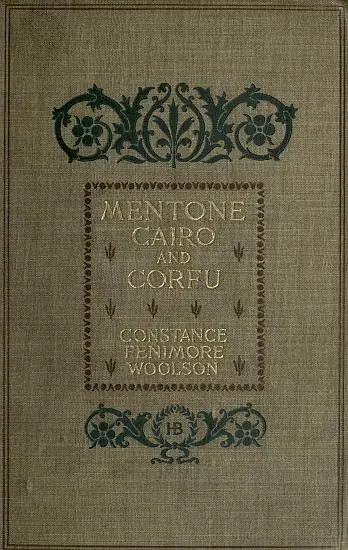
THE CLASSIC COLLECTION · 1895
"Mentone, Cairo, and Corfu" by Constance Fenimore Woolson is a collection of travel sketches written in the late 19th century. The work chronicles the author's experiences and observations as she visits three distinct Mediterranean destinations: Mentone, Cairo, and Corfu, each portrayed vividly through a blend of narrative and reflection. The sketches bring to life the cultures, landscapes, and notable interactions with diverse characters, likely featuring characters like Mrs. Trescott, her daughter Janet, and Professor Mackenzie among others. At the start of the collection, Woolson introduces readers to Mentone, detailing the arrival of a group of travelers, including herself through her character Jane Jefferson. They settle into a hotel in the picturesque town, and the narrative captures their appreciation of the sunny environment, local quirks, and the captivating views of the Mediterranean. The characters engage in lively discussions about the beauty of their surroundings, the importance of the sun, and the fascinating history of the area, all while encountering humorous interactions and insights about each other, setting an inviting tone for the adventures and observations that follow in Cairo and Corfu.
Introduction adapted from the source catalogue; source summaries may be automatically generated.
Free to read · English · 72,794 words · No account needed
MAKE TIME FOR A GOOD BOOK
On by default. Untick to stop anonymous reading totals. Each page counts after 10 seconds in view. How this works.
Anonymous counting is on unless you have switched it off.
The casino of the Empress is not the only royal residence at Corfu. About a mile from the town is the country-house called "Mon Repos," the property of the King of Greece. King George and Queen Olga, with their children, have frequently spent summers here. The mansion is ordinary as regards its architecture--it was built by one of the Lords High. The situation is altogether admirable, with a view of the harbor and town. But the especial loveliness of Mon Repos is to be found in its gardens; their foliage is tropical, with superb magnolias, palms, bananas, aloes, and orange and lemon trees. There are flowers of all kinds, with roses clambering everywhere, and blossoming vines. The royal family who rule, or rather preside over, the kingdom of the Hellenes are much respected and beloved at Corfu. The King, who was Prince William of Denmark--the brother of the Czarina of Russia and of the Princess of Wales--took the name of George when he ascended the throne in 1863. He was elected by the National Assembly. Now that he has been reigning nearly thirty years, and has a grandson as well as a son to succeed him, it is amusing to turn back to the original candidates and the votes; for it was an election (within certain limits) by the people, and all sorts of tastes were represented. Prince Alfred of England, the Duke of Edinburgh, was at the head of the list; but as it had been stipulated that no member of the reigning families of England, France, or Russia should have the crown, his name was struck off. There were votes for Prince Jerome Napoleon. There were votes for the Prince Imperial. There were even votes for "A Republic." But Greece, as she stands, is as near a republic as a country with a sovereign can be. Suffrage is universal; there is no aristocracy; there are no hereditary titles, no entailed estates; the liberty of the press is untrammelled; education is free. Everywhere the people are ardently patriotic; they are actively, and one may say almost dangerously, interested in everything that pertains to the political condition of their country. This interest is quickened by their acute intellects. I have never seen faces more sharply intelligent than those of the Greek men of to-day. I speak of men who have had some advantages in the way of education. But as all are intensely eager to obtain these advantages, and as schools are now numerous, education to a certain extent is widely diffused. The men are, as a general rule, handsome. But they are not in the least after the model of the Greek god, as he exists in art and fiction. This model has an ideal height and strength, massive shoulders, a statuesque head with closely curling hair, and an unruffled repose. The actual Greek possesses a meagre frame, thin face, with high cheek-bones, a dry, dark complexion, straight hair, small eyes, and as for repose, he has never heard of it; he is overwhelmingly, never-endingly restless. With this enumeration my statement that he is handsome may not appear to accord. Nevertheless, he is a good-looking fellow; his spare form is often tall, the quickly turning eyes are wonderfully brilliant, the dark face is lighted by the gleam of white teeth, the gait is very graceful, the step light. The Albanian costume, which was adopted after the revolution as the national dress for the whole country, is amazing. We have all seen it in paintings and photographs, where it is merely picturesque. But when you meet it in the streets every day, when you see the wearer of it engaged in cooking his dinner, in cleaning fish, in driving a cart, in carrying a hod, or hanging out clothes on a line, then it becomes perfectly fantastic. The climax of my own impressions about it was reached, I think, a little later, at Athens, when I beheld the guards walking their beats before the King's palace, and before the simple house of the Crown Prince opposite; they are soldiers of the regular army, and they held their muskets with military precision as they marched to and fro, attired in ordinary overcoats (it happened to be a rainy day) over the puffed-out white skirts of a ballet-dancer. Robert Louis Stevenson, in one of his recent letters from the South Seas, writes that "the mind of the female missionary" (British) "tends to be constantly busied about dress; she can be taught with extreme difficulty to think any costume decent but that to which she grew accustomed on Clapham Common, and, to gratify this prejudice, the native is put to useless expense." And here it occurs to me that it is high time to explore this Clapham Common. We go as worshippers to Shakespeare's Avon; we go to the land of Scott and Burns; we know the "stripling Thames at Bablockhithe," where "the punt's rope chops round"; but to Clapham Common we make, I think, no pilgrimages, although it has as clearly marked a place in English literature as the Land of Beulah or the Slough of Despond. I fancy that Americans are not so closely tied to a fixed standard in dress as are the missionaries who excite Mr. Stevenson's wrath. A half of our population seeks its ideal in Paris, but as a whole we are easy-going. We accept the Chinese attire in our streets without demur; the lack of attire of the Sioux does not disconcert us; when abroad we admire impartially the Egyptian gown and the Cossack uniform, and we adorn ourselves liberally with the fez. But the Greek costume makes us pause; it seems a bravado in whimsicality. One can describe it in detail: one can say that it consists of a cap with a long tassel, a full white shirt, an embroidered jacket with open sleeves, a tight girdle, the white kilt or fustanella, long leggings with bright-colored garters, and, usually, shoes with turned-up toes. The enumeration, however, does not do away with the one general impression of men striding about in short white ballet petticoats.
Your reading position is saved on this browser. Take it to another device with a library code. Reading pages adapt to text, rather than matching a printed edition.
Constance Fenimore Woolson

Constance Fenimore Woolson

Constance Fenimore Woolson
Constance Fenimore Woolson
BEHIND THE BOOK
This eBook is for the use of anyone anywhere in the United States and most other parts of the world at no cost and with almost no restrictions whatsoever. You may copy it, give it away or re-use it under the terms of the Project Gutenberg License included with this eBook or online at www.gutenberg.org. If you are not located in the United States, you will have to check the laws of the country where you are located before using this eBook. Read the source licence.
The original source file, including credits and licence, is retained by this library. Request an original-format copy at no charge. Please include the book title and Project Gutenberg identifier #33367.
KEEP YOUR CURIOSITY GOING
Wilfrid Scawen Blunt
Wilfrid Scawen Blunt

E. W. (Edgar Watson) Howe
Francis Greenleaf Allinson & Anne C. E. (Anne Crosby Emery) Allinson
Cyrenus Cole

John Martineau