
Two Women, 1862; a Poem
Constance Fenimore Woolson
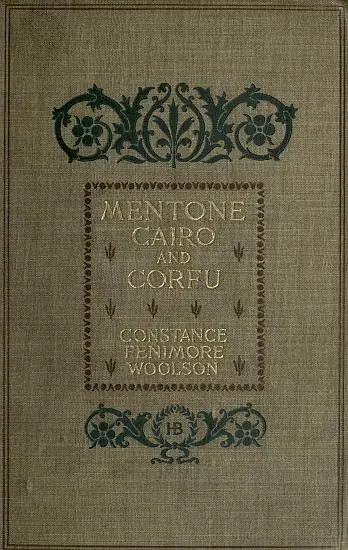
THE CLASSIC COLLECTION · 1895
"Mentone, Cairo, and Corfu" by Constance Fenimore Woolson is a collection of travel sketches written in the late 19th century. The work chronicles the author's experiences and observations as she visits three distinct Mediterranean destinations: Mentone, Cairo, and Corfu, each portrayed vividly through a blend of narrative and reflection. The sketches bring to life the cultures, landscapes, and notable interactions with diverse characters, likely featuring characters like Mrs. Trescott, her daughter Janet, and Professor Mackenzie among others. At the start of the collection, Woolson introduces readers to Mentone, detailing the arrival of a group of travelers, including herself through her character Jane Jefferson. They settle into a hotel in the picturesque town, and the narrative captures their appreciation of the sunny environment, local quirks, and the captivating views of the Mediterranean. The characters engage in lively discussions about the beauty of their surroundings, the importance of the sun, and the fascinating history of the area, all while encountering humorous interactions and insights about each other, setting an inviting tone for the adventures and observations that follow in Cairo and Corfu.
Introduction adapted from the source catalogue; source summaries may be automatically generated.
Free to read · English · 72,794 words · No account needed
MAKE TIME FOR A GOOD BOOK
On by default. Untick to stop anonymous reading totals. Each page counts after 10 seconds in view. How this works.
Anonymous counting is on unless you have switched it off.
I, however, discovered something, although not from Inness; I discovered why Janet had wished to pass a second time through that Rue Longue. For here was the French artist sketching the old mansion, and with him (she could not have known this, of course; but chance always favored Janet) were the two Englishmen, the respectful gazers of the breakfast-table, sketching also. There were therefore six artistic eyes instead of two to dwell upon her as she approached, passed, and went onward, her slender figure outlined against the light coming through the archway beyond, old St. Julian's Gate, a remnant of feudal fortification. Artists are not slack in the use of their eyes; an "artistic gaze" is not considered a stare. I was obliged to repeat this axiom to Baker, who did not appreciate it, but looked as though he would like to go back and artistically demolish those gazers. He contented himself, however, with the remark that water-color sketches were "weak, puling daubs," and then he went on through the old archway as majestically as he could.
"One of the features of Mentone seems to be the number of false windows carefully painted on the outside of the houses, windows adorned with blinds, muslin curtains, pots of flowers, and even gay rugs hanging over the sill," said Margaret.
"And then the frescos," I added--"landscapes, trees, gods and goddesses, in the most brilliant colors, on the side of the house."
"I like it," said Mrs. Clary; "it is so tropical."
"You commend falsity, then," said Miss Graves. "What can be more false
than a false rug?"
We went homeward by the sea-wall, and saw some boys coming up from the beach with a basket of sea-urchins. "They eat them, you know," said Mrs. Clary.
"Is that tropical too?" said Janet, shuddering.
"It is, after all, but a difference in custom," observed the Professor. "I myself have eaten puppies in China, and found them not unpalatable."
Janet surveyed him; then fell behind and joined Inness and Baker.
Some fishermen on the beach were talking to two women with red handkerchiefs on their heads, who were leaning over the sea-wall. "Their language is a strange patois," said the Professor; "it is composed of a mixture of Italian, French, Spanish, and even Arabic."
"But the people themselves are thoroughly Italian, I think, in spite of the French boundary line," said Margaret. "They are a handsome race, with their dark eyes, thick hair, and rich coloring."
"I have never bestowed much thought upon beauty per se," responded the Professor. "The imperishable mind has far more interest."
"How much of the imperishable M. do you possess, Miss Trescott?" I heard
Inness murmur.
Your reading position is saved on this browser. Take it to another device with a library code. Reading pages adapt to text, rather than matching a printed edition.
Constance Fenimore Woolson

Constance Fenimore Woolson

Constance Fenimore Woolson
Constance Fenimore Woolson
BEHIND THE BOOK
This eBook is for the use of anyone anywhere in the United States and most other parts of the world at no cost and with almost no restrictions whatsoever. You may copy it, give it away or re-use it under the terms of the Project Gutenberg License included with this eBook or online at www.gutenberg.org. If you are not located in the United States, you will have to check the laws of the country where you are located before using this eBook. Read the source licence.
The original source file, including credits and licence, is retained by this library. Request an original-format copy at no charge. Please include the book title and Project Gutenberg identifier #33367.
KEEP YOUR CURIOSITY GOING
Wilfrid Scawen Blunt
Wilfrid Scawen Blunt

E. W. (Edgar Watson) Howe
Francis Greenleaf Allinson & Anne C. E. (Anne Crosby Emery) Allinson
Cyrenus Cole

John Martineau