
Two Women, 1862; a Poem
Constance Fenimore Woolson
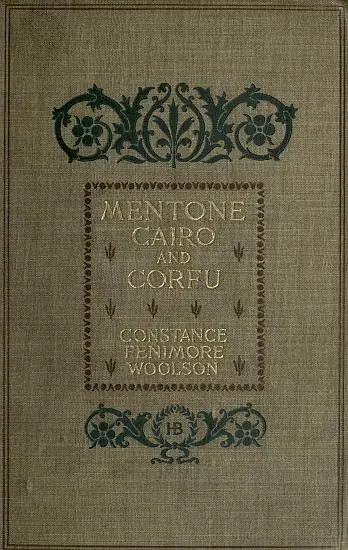
THE CLASSIC COLLECTION · 1895
"Mentone, Cairo, and Corfu" by Constance Fenimore Woolson is a collection of travel sketches written in the late 19th century. The work chronicles the author's experiences and observations as she visits three distinct Mediterranean destinations: Mentone, Cairo, and Corfu, each portrayed vividly through a blend of narrative and reflection. The sketches bring to life the cultures, landscapes, and notable interactions with diverse characters, likely featuring characters like Mrs. Trescott, her daughter Janet, and Professor Mackenzie among others. At the start of the collection, Woolson introduces readers to Mentone, detailing the arrival of a group of travelers, including herself through her character Jane Jefferson. They settle into a hotel in the picturesque town, and the narrative captures their appreciation of the sunny environment, local quirks, and the captivating views of the Mediterranean. The characters engage in lively discussions about the beauty of their surroundings, the importance of the sun, and the fascinating history of the area, all while encountering humorous interactions and insights about each other, setting an inviting tone for the adventures and observations that follow in Cairo and Corfu.
Introduction adapted from the source catalogue; source summaries may be automatically generated.
Free to read · English · 72,794 words · No account needed
MAKE TIME FOR A GOOD BOOK
On by default. Untick to stop anonymous reading totals. Each page counts after 10 seconds in view. How this works.
Anonymous counting is on unless you have switched it off.
The Arab Museum has been established recently. Every one is grateful to the zeal which has rescued from further injury so many specimens of a vanishing art. One covets a little chest for the Koran which is made of sandal-wood. It is incrusted with arabesques carved in ivory, and has broad hasps and locks of embossed silver. There are many koursis, or small, stool-like tables; one of these has panels of silver filigree, and fretted medallions bearing the name of the Sultan Mohammed ebn Kalaoon, thus showing that it once belonged to the mosque at the Citadel which was built by that Memlook ruler--the mosque whose minarets are ornamented with picturesque bands of emerald-hued porcelain. The illuminated Korans are not here; they are kept in the Public Library in the Street of the Sycamores. Perhaps the most beautiful of the museum's treasures are the old lamps of Arabian glass. In shape they are vases, as they were simply filled with perfumed oil which carried a floating wick; the colors are usually a pearly background, faintly tinged sometimes by the hue we call ashes of roses; upon this background are ornaments of blue, gold, and red; occasionally these ornaments are Arabic letters forming a name or text. These lamps were made in the thirteenth and fourteenth centuries; the glass, which has as marked characteristics of its own as Palissy ware, so that once seen it can never be confounded with any other, has a delicate beauty which is unrivalled.
Like the pyramids, Heliopolis belongs to Cairo. On the way thither, one first traverses the pleasant suburb of Abbasieh. How one traverses it depends upon his taste. The most enthusiastic pedestrian soon gives up walking in the city of the Khedive save in the broad streets of the new quarter. The English ride, one meets every day their gallant mounted bands; but these are generally residents and their visitors, and the horses are their own; for the traveller there are only the street carriages and the donkeys. The carriages are dubiously loose-jointed, and the horses (whose misery has already been described) have but two gaits--the walk of a dying creature and the gallop of despair; unless, therefore, one wishes to mount a dromedary, he must take a donkey. But the "must" is not a disparagement; the white and gray donkeys of Cairo--the best of them--are good-natured, gay-hearted, strong, and even handsome. They have a coquettish way of arching their necks and holding their chins (if a donkey can be said to have a chin), which always reminded me of George Eliot's description of Gwendolen's manner of poising her head in Daniel Deronda. George Eliot goes on to warn other young ladies that it is useless to try to imitate this proud little air, unless one has a throat like Gwendolen's. And, in the same spirit, one must warn other donkeys that they must be born in Cairo to be beautiful. Upon several occasions I recognized vanity in my donkey. He knew perfectly when he was adorned with his holiday necklaces--one of imitation sequins, the other of turquoise-hued beads. I am sure that he would have felt much depressed if deprived of his charm against magic--the morsel of parchment inscribed with Arabic characters which decorated his breast. His tail and his short mane were dyed fashionably with henna, but his legs had not been shaved in the pattern which represents filigree garters, and whenever a comrade who had this additional glory passed him, he became distinctly melancholy, and brooded about it for several minutes. There is nothing in the world so deprecating as the profile of one of these Cairo donkeys when he finds himself obliged, by the pressure of the crowd, to push against a European; his long nose and his polite eye as he passes are full of friendly apologies. The donkey-boy, in his skull-cap and single garment, runs behind his beast. These lads are very quick-witted. They have ready for their donkeys five or six names, and they seldom make a mistake in applying them according to the supposed nationality of their patrons of the moment, so that the Englishman learns that he has Annie Laurie; the Frenchman, Napoleon; the German, Bismarck; the Italian, Garibaldi; and the Americans, indiscriminately, Hail Columbia, Yankee Doodle, and General Grant.
Your reading position is saved on this browser. Take it to another device with a library code. Reading pages adapt to text, rather than matching a printed edition.
Constance Fenimore Woolson

Constance Fenimore Woolson

Constance Fenimore Woolson
Constance Fenimore Woolson
BEHIND THE BOOK
This eBook is for the use of anyone anywhere in the United States and most other parts of the world at no cost and with almost no restrictions whatsoever. You may copy it, give it away or re-use it under the terms of the Project Gutenberg License included with this eBook or online at www.gutenberg.org. If you are not located in the United States, you will have to check the laws of the country where you are located before using this eBook. Read the source licence.
The original source file, including credits and licence, is retained by this library. Request an original-format copy at no charge. Please include the book title and Project Gutenberg identifier #33367.
KEEP YOUR CURIOSITY GOING
Wilfrid Scawen Blunt
Wilfrid Scawen Blunt

E. W. (Edgar Watson) Howe
Francis Greenleaf Allinson & Anne C. E. (Anne Crosby Emery) Allinson
Cyrenus Cole

John Martineau