
Two Women, 1862; a Poem
Constance Fenimore Woolson
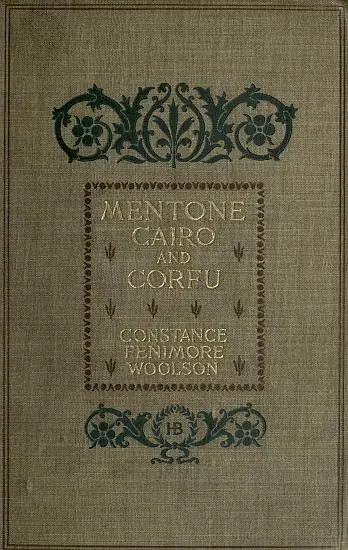
THE CLASSIC COLLECTION · 1895
"Mentone, Cairo, and Corfu" by Constance Fenimore Woolson is a collection of travel sketches written in the late 19th century. The work chronicles the author's experiences and observations as she visits three distinct Mediterranean destinations: Mentone, Cairo, and Corfu, each portrayed vividly through a blend of narrative and reflection. The sketches bring to life the cultures, landscapes, and notable interactions with diverse characters, likely featuring characters like Mrs. Trescott, her daughter Janet, and Professor Mackenzie among others. At the start of the collection, Woolson introduces readers to Mentone, detailing the arrival of a group of travelers, including herself through her character Jane Jefferson. They settle into a hotel in the picturesque town, and the narrative captures their appreciation of the sunny environment, local quirks, and the captivating views of the Mediterranean. The characters engage in lively discussions about the beauty of their surroundings, the importance of the sun, and the fascinating history of the area, all while encountering humorous interactions and insights about each other, setting an inviting tone for the adventures and observations that follow in Cairo and Corfu.
Introduction adapted from the source catalogue; source summaries may be automatically generated.
Free to read · English · 72,794 words · No account needed
MAKE TIME FOR A GOOD BOOK
On by default. Untick to stop anonymous reading totals. Each page counts after 10 seconds in view. How this works.
Anonymous counting is on unless you have switched it off.
Now that modern schools have been established by the government in addition to the excellent and energetic mission seminaries maintained by the English, the Americans, the Germans, and the French, one wonders whether this venerable Arabian college will modify its tenets or shrink to a shadow and disappear. There are hopeful souls who prophesy the former; but I do not agree with them. Let us aid the American schools by all the means in our power. But as for El Azhar, may it fade (as fade it must) with its ancient legends draped untouched about it.
All who visit Cairo see the Assiout ware--pottery made of red and black earth, and turned on a wheel; it comes from Assiout, two hundred and thirty miles up the Nile, and the simple forms of the vases and jugs, the rose-water stoups and narrow-necked perfume-throwers, are often very graceful. Assiout ware is offered for sale in the streets; but the itinerant venders are sent out by a dealer in the bazaars, and the fatality which makes it happen that the vender has two black stoups and one red jug when you wish for one black stoup and two red jugs sent us to headquarters. But the crowded booth did not contain our heart's desire, and as we still lingered, making ourselves, I dare say, too pressing for the Oriental ease of the proprietor, it was at last suggested that Mustapha might perhaps go to the store-room for more--? (the interrogation-point meaning backsheesh). Seizing the opportunity, we asked permission to accompany the messenger. No one objecting--as the natives consider all strangers more or less mad--we were soon following our guide through a dusky passageway behind the shop, the darkness lit by the gleam of his white teeth as he turned, every now and then, to give us an encouraging smile and a wink of his one eye, over his shoulder. At length--still in the dark--we arrived at a stairway, and, ascending, found ourselves in a second-story court, which was roofed over with matting. This court was surrounded by chambers fitted with rough, sliding fronts: almost all of the fronts were at the moment thrown up, as a window is thrown up and held by its pulleys. In one of these rooms we found Assiout ware in all its varieties; but we made a slow choice. We were evidently in a lodging-house of native Cairo; all the chambers save this one store-room appeared to be occupied as bachelors' apartments. The two rooms nearest us belonged to El Azhar students, so Mustapha said: he could speak no English, but he imparted the information in Arabic to our dragoman. Seeing that we were more interested in the general scene than in his red jugs, Mustapha left the Assiout ware to its fate, and, lighting a cigarette, seated himself on the railing with a disengaged air, as much as to say: "Two more mad women! But it's nothing to me." One of the students was evidently an ascetic; his room contained piles of books and pamphlets, and almost nothing else; his one rug was spread out close to the front in order to get the light, and placed upon it we saw his open inkstand, his pens, and a page of freshly copied manuscript. When we asked where he was, Mustapha replied that he had gone down to the fountain to wash himself, so that he could say his prayers. The second chamber belonged to a student of another disposition; this extravagant young man had three rugs; clothes hung from pegs upon his walls, and he possessed an extra pair of lemon-colored slippers; in addition we saw cups and saucers upon a shelf. Only two books were visible, and these were put away in a corner; instead of books he had flowers; the whole place was adorned with them; pots containing plants in full bloom were standing on the floor round the walls of his largely exposed abode, and were also drawn up in two rows in the passageway outside, where he himself, sitting on a mat, was sewing. His blossoms were so gay that involuntarily we smiled. Whereupon he smiled too, and gave us a salam. Opposite the rooms of the students there was a large chamber, almost entirely filled with white bales, like small cotton bales; in a niche between these high piles, an old man, kneeling at the threshold, was washing something in a large earthen-ware tub of a pink tint. His body was bare from the waist upward, and, as he bent over his task, his short chest, with all the ribs clearly visible, his long brown back with the vertebrae of the spine standing out, and his lean, seesawing arms, looked skeleton-like, while his head, supported on a small wizened throat, was adorned with such an enormous bobbing turban, dark green in hue, that it resembled vegetation of some sort--a colossal cabbage. Directly behind him, also on the threshold, squatted a large gray baboon, whose countenance expressed a fixed misanthropy. Every now and then this creature, who was secured by a long, loose cord, ascended slowly to the top of the bales and came down on the other side, facing his master. He then looked deeply into the tub for several minutes, touched the water carefully with his small black hand, withdrew it, and inspected the palm, and then returned gravely, and by the same roundabout way over the bales, to resume his position at the doorsill, looking as if he could not understand the folly of such unnecessary and silly toil.
Your reading position is saved on this browser. Take it to another device with a library code. Reading pages adapt to text, rather than matching a printed edition.
Constance Fenimore Woolson

Constance Fenimore Woolson

Constance Fenimore Woolson
Constance Fenimore Woolson
BEHIND THE BOOK
This eBook is for the use of anyone anywhere in the United States and most other parts of the world at no cost and with almost no restrictions whatsoever. You may copy it, give it away or re-use it under the terms of the Project Gutenberg License included with this eBook or online at www.gutenberg.org. If you are not located in the United States, you will have to check the laws of the country where you are located before using this eBook. Read the source licence.
The original source file, including credits and licence, is retained by this library. Request an original-format copy at no charge. Please include the book title and Project Gutenberg identifier #33367.
KEEP YOUR CURIOSITY GOING
Wilfrid Scawen Blunt
Wilfrid Scawen Blunt

E. W. (Edgar Watson) Howe
Francis Greenleaf Allinson & Anne C. E. (Anne Crosby Emery) Allinson
Cyrenus Cole

John Martineau