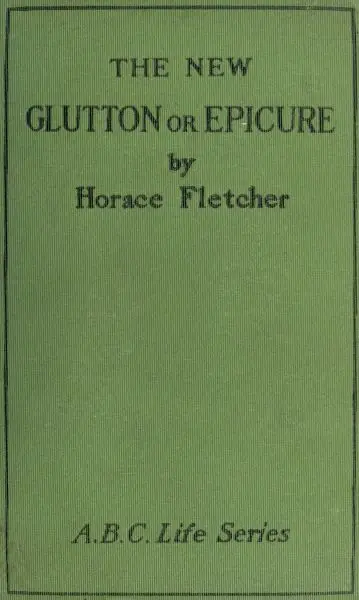
The New Glutton or Epicure
Horace Fletcher
THE CLASSIC COLLECTION · 1895
"Menticulture; or, the A-B-C of True Living" by Horace Fletcher is a self-help and philosophical guide written in the late 19th century. This book centers around mental well-being and personal growth, advocating for the elimination of negative emotions such as anger and worry to achieve a more fulfilling life. The author draws on historical and philosophical teachings to expound on his ideas, seeking to cultivate a mindset conducive to happiness and personal development. In "Menticulture," Fletcher presents his theory of personal betterment through the 'germ cure,' which posits that harmful emotions are mental parasites rooted in anger and worry, inhibiting growth in both mental and physical health. The book recounts Fletcher's personal experiences and observations, demonstrating how he transformed his life by consciously dispelling these negative emotions. He encourages readers to adopt an attitude of appreciation and gratitude, positing that true freedom and happiness can be achieved through the practice of mental discipline. By organizing communities around the principles of Emancipation, Fletcher envisions a collective shift towards a more harmonious society where individuals support each other in their mental and spiritual growth.
Introduction adapted from the source catalogue; source summaries may be automatically generated.
Free to read · English · 16,919 words · No account needed
MAKE TIME FOR A GOOD BOOK
On by default. Untick to stop anonymous reading totals. Each page counts after 10 seconds in view. How this works.
Anonymous counting is on unless you have switched it off.
[Sidenote: "Got to be Superintendent"]
[Sidenote: It Became a Habit]
[Sidenote: "Frightened out of my Wits"]
[Sidenote: Anger and Worry Caused Sickness]
[Sidenote: Emancipation Makes Good Neighbors]
[Sidenote: "Looking Backward" from Emancipation]
"When I got to be superintendent I thought that one of the things that I had to do was to be sure and maintain my dignity, and show it by occasionally making believe mad at something. At first I did not feel it half as much as I showed it; but I thought it was part of the business of a boss to get mad, until finally it got to be a habit, and grew on me till I was in a state of anger most of the time. I also thought that I had to worry about things, or I would not show the proper respect for my responsibilities. It was the way I had of letting myself feel that I was carrying a terrible burden and earning my salary. The trouble was that, while it was partly play-acting at first, it came to be habit, and worked on my health in the end. The doctors dosed me with all sorts of medicine. I was a regular pigeon, and gave up many a hard-earned dollar to them for no good at all. One day Dr. L----, to whom I went as a last resort, for I was beginning to have dizzy spells and twitching in the face that was serious, asked me a lot of questions about myself and my habits and duties. I told him frankly, and when I had done so he said: 'There is no use giving you any medicine, you have got to quit worrying and take it easy; that is the only trouble with you. If you keep on with your worry I will have to give your family a certificate of death; so, if you don't want me to do that, you just quit your worrying and take life easy. Whatever you do, don't get into fits of anger, for that is more wearing to a man in your condition than anything else.' Well, to 'fess up and tell you the truth, I got frightened out of my wits. I hadn't got near enough to eighty (my limit) to think about dying, and I didn't want to do it right then, especially as I hadn't got Mary and the boys well enough fixed to leave. The other doctors had made a monkey of me, and took my money, and told me that I would be all right in a few days; but this honest German told me the truth and set me to thinking. I didn't say a word to anyone, but made up my mind I would take his advice. At first I thought that I was shirking some of the duties of a superintendent, when I quit getting mad and worrying; but I squared it with myself by saying to myself, 'Better be a tame donkey for the company than a dead one.' Well, I didn't know it at the time; that is, I didn't know the cause of it, but from that time I have just had luck under my wing all the time. I have pleased my employers, and I have pleased the men, and things have been coming my way in great shape, and they are still a-coming. Why, I see it all as plain as the nose on your face. Those little devils that keep a man back, and keep him from being happy, have no business there by rights; and all you have got to know is that they are poachers, and all you have got to do is to tell them to 'git.' And just see how it would work if everybody knew this as I see it. If you knew that your neighbor knew that Emancipation was possible, you would know at the same time that he was no fool, and that, knowing it, he had become Emancipated, of course, and there would be a trustful sympathy established at once, and you would pull together and never apart after that. If his fence accidentally encroached an inch on your land, you would be glad of it; or, if your fence had been set on his side of the legal line, he would not object; and so it would go on between you, and you would be happy and good neighbors to each other. Why, I would rather my men would have that secret and day's wages, than a million of dollars without it; and my boys, if I don't leave them a cent, I will leave them full of this secret, and won't worry about their future happiness. I was much interested in that book you gave me several years ago called 'Looking Backward.' What the author said about co-operation, and all that, was all right and very beautiful; but I didn't take much stock in it because I had such a poor opinion of human nature, that I didn't think people could quit grabbing and get down to brass tacks in a co-operative way. But if you can spread the idea of Mental Emancipation as you have told it to me (and I don't see what can help its spreading like wildfire as soon as it gets out), the social paradise pictured in 'Looking Backward' will come as a matter of course; and I see it a-coming. If you take off a brake I can see how a car can run down a hill, but with the brake on I couldn't see how you could push it down.
Your reading position is saved on this browser. Take it to another device with a library code. Reading pages adapt to text, rather than matching a printed edition.
Horace Fletcher

Horace Fletcher
Horace Fletcher
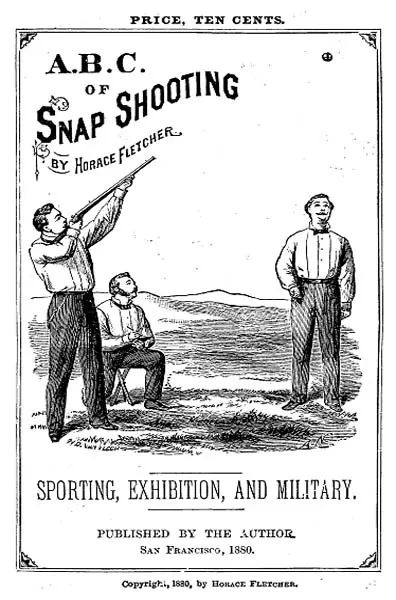
Horace Fletcher
BEHIND THE BOOK
This eBook is for the use of anyone anywhere in the United States and most other parts of the world at no cost and with almost no restrictions whatsoever. You may copy it, give it away or re-use it under the terms of the Project Gutenberg License included with this eBook or online at www.gutenberg.org. If you are not located in the United States, you will have to check the laws of the country where you are located before using this eBook. Read the source licence.
The original source file, including credits and licence, is retained by this library. Request an original-format copy at no charge. Please include the book title and Project Gutenberg identifier #45040.
KEEP YOUR CURIOSITY GOING

David Patterson (Spirit) Hatch

David Patterson (Spirit) Hatch

David Patterson (Spirit) Hatch
Coulson Kernahan

Ralph Waldo Emerson
Frances Wright