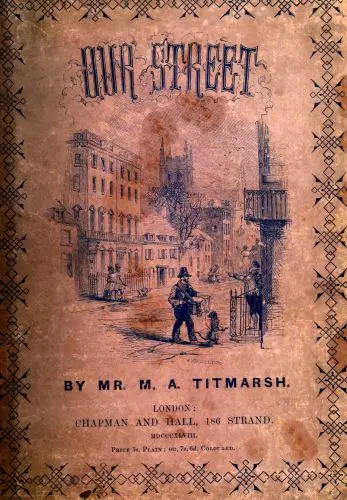
“Our Street”
William Makepeace Thackeray
THE CLASSIC COLLECTION · 1852
"Men's Wives" by William Makepeace Thackeray is a novel likely written during the mid-19th century. The story revolves around the lives of the Crump family, particularly their daughter Morgiana, who attracts the attention of multiple suitors, including the ambitious Captain Howard Walker and rival tradesmen, the perfumer Mr. Archibald Eglantine and the tailor Mr. Woolsey. The narrative deftly explores themes of love, ambition, rivalry, and societal norms through its colorful characters in a comedic and satirical manner. The opening of the novel introduces readers to the Bootjack Hotel, managed by Mr. Crump, and paints a vivid picture of its inhabitants, especially Morgiana, who is depicted as a lively and ambitious young woman. We learn about her mother, Mrs. Crump, a former actress, and the dynamic within the family as they navigate the expectations of society. Several suitors, including both Woolsey and Eglantine, are vying for Morgiana's attention, creating an atmosphere of competition and rivalry that sets the stage for further developments in the plot. The chapter also hints at the character of Captain Walker, a charming but somewhat dubious figure who desires to win Morgiana's heart while using his connections in high society, adding layers of complexity to the story.
Introduction adapted from the source catalogue; source summaries may be automatically generated.
Free to read · English · 65,709 words · No account needed
MAKE TIME FOR A GOOD BOOK
On by default. Untick to stop anonymous reading totals. Each page counts after 10 seconds in view. How this works.
Anonymous counting is on unless you have switched it off.
The Woolsey compared in the above sentence both to a leg of mutton and a cherub, was not the eminent member of the firm of Linsey, Woolsey, and Co., but the little baby, who was christened Howard Woolsey Walker, with the full consent of the father; who said the tailor was a deuced good fellow, and felt really obliged to him for the sherry, for a frock-coat which he let him have in prison, and for his kindness to Morgiana. The tailor loved the little boy with all his soul; he attended his mother to her churching, and the child to the font; and, as a present to his little godson on his christening, he sent two yards of the finest white kerseymere in his shop, to make him a cloak. The Duke had had a pair of inexpressibles off that very piece.
House-furniture is bought and sold, music-lessons are given, children are born and christened, ladies are confined and churched--time, in other words, passes--and yet Captain Walker still remains in prison! Does it not seem strange that he should still languish there between palisaded walls near Fleet Market, and that he should not be restored to that active and fashionable world of which he was an ornament? The fact is, the Captain had been before the court for the examination of his debts; and the Commissioner, with a cruelty quite shameful towards a fallen man, had qualified his ways of getting money in most severe language, and had sent him back to prison again for the space of nine calendar months, an indefinite period, and until his accounts could be made up. This delay Walker bore like a philosopher, and, far from repining, was still the gayest fellow of the tennis-court, and the soul of the midnight carouse.
There is no use in raking up old stories, and hunting through files of dead newspapers, to know what were the specific acts which made the Commissioner so angry with Captain Walker. Many a rogue has come before the Court, and passed through it since then: and I would lay a wager that Howard Walker was not a bit worse than his neighbours. But as he was not a lord, and as he had no friends on coming out of prison, and had settled no money on his wife, and had, as it must be confessed, an exceedingly bad character, it is not likely that the latter would be forgiven him when once more free in the world. For instance, when Doublequits left the Fleet, he was received with open arms by his family, and had two-and-thirty horses in his stables before a week was over. Pam, of the Dragoons, came out, and instantly got a place as government courier--a place found so good of late years (and no wonder, it is better pay than that of a colonel), that our noblemen and gentry eagerly press for it. Frank Hurricane was sent out as registrar of Tobago, or Sago, or Ticonderago; in fact, for a younger son of good family it is rather advantageous to get into debt twenty or thirty thousand pounds: you are sure of a good place afterwards in the colonies. Your friends are so anxious to get rid of you, that they will move heaven and earth to serve you. And so all the above companions of misfortune with Walker were speedily made comfortable; but HE had no rich parents; his old father was dead in York jail. How was he to start in the world again? What friendly hand was there to fill his pocket with gold, and his cup with sparkling champagne? He was, in fact, an object of the greatest pity--for I know of no greater than a gentleman of his habits without the means of gratifying them. He must live well, and he has not the means. Is there a more pathetic case? As for a mere low beggar--some labourless labourer, or some weaver out of place--don't let us throw away our compassion upon THEM. Psha! they're accustomed to starve. They CAN sleep upon boards, or dine off a crust; whereas a gentleman would die in the same situation. I think this was poor Morgiana's way of reasoning. For Walker's cash in prison beginning presently to run low, and knowing quite well that the dear fellow could not exist there without the luxuries to which he had been accustomed, she borrowed money from her mother, until the poor old lady was a sec. She even confessed, with tears, to Woolsey, that she was in particular want of twenty pounds, to pay a poor milliner, whose debt she could not bear to put in her husband's schedule. And I need not say she carried the money to her husband, who might have been greatly benefited by it--only he had a bad run of luck at the cards; and how the deuce can a man help THAT?
Your reading position is saved on this browser. Take it to another device with a library code. Reading pages adapt to text, rather than matching a printed edition.
William Makepeace Thackeray
William Makepeace Thackeray
Charles Dickens & William Makepeace Thackeray
William Makepeace Thackeray
BEHIND THE BOOK
This eBook is for the use of anyone anywhere in the United States and most other parts of the world at no cost and with almost no restrictions whatsoever. You may copy it, give it away or re-use it under the terms of the Project Gutenberg License included with this eBook or online at www.gutenberg.org. If you are not located in the United States, you will have to check the laws of the country where you are located before using this eBook. Read the source licence.
The original source file, including credits and licence, is retained by this library. Request an original-format copy at no charge. Please include the book title and Project Gutenberg identifier #1985.
KEEP YOUR CURIOSITY GOING
Coulson Kernahan

Maurice Baring
Frances Wright
Cécile Tormay

Frederic Jesup Stimson

W. H. P. (William Henry Pope) Jarvis