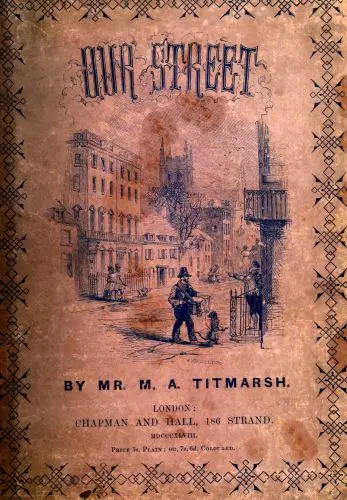
“Our Street”
William Makepeace Thackeray
THE CLASSIC COLLECTION · 1852
"Men's Wives" by William Makepeace Thackeray is a novel likely written during the mid-19th century. The story revolves around the lives of the Crump family, particularly their daughter Morgiana, who attracts the attention of multiple suitors, including the ambitious Captain Howard Walker and rival tradesmen, the perfumer Mr. Archibald Eglantine and the tailor Mr. Woolsey. The narrative deftly explores themes of love, ambition, rivalry, and societal norms through its colorful characters in a comedic and satirical manner. The opening of the novel introduces readers to the Bootjack Hotel, managed by Mr. Crump, and paints a vivid picture of its inhabitants, especially Morgiana, who is depicted as a lively and ambitious young woman. We learn about her mother, Mrs. Crump, a former actress, and the dynamic within the family as they navigate the expectations of society. Several suitors, including both Woolsey and Eglantine, are vying for Morgiana's attention, creating an atmosphere of competition and rivalry that sets the stage for further developments in the plot. The chapter also hints at the character of Captain Walker, a charming but somewhat dubious figure who desires to win Morgiana's heart while using his connections in high society, adding layers of complexity to the story.
Introduction adapted from the source catalogue; source summaries may be automatically generated.
Free to read · English · 65,709 words · No account needed
MAKE TIME FOR A GOOD BOOK
On by default. Untick to stop anonymous reading totals. Each page counts after 10 seconds in view. How this works.
Anonymous counting is on unless you have switched it off.
“I--that is--yes--it's a painful affair, mem,” he said, giving one look at her pale face, and then turning away in a flurry. “I beg to refer you to Blunt, Hone, and Sharpus, my lawyers, mem,” he added, collecting himself.
“I didn't expect this from YOU, Mr. Eglantine,” said the lady, and began
to sob.
“And after what's 'appened, I didn't expect a visit from YOU, mem. I thought Mrs. Capting Walker was too great a dame to visit poor Harchibald Eglantine (though some of the first men in the country DO visit him). Is there anything in which I can oblige you, mem?”
“O heavens!” cried the poor woman; “have I no friend left? I never thought that you, too, would have deserted me, Mr. Archibald.”
The “Archibald,” pronounced in the old way, had evidently an effect on the perfumer; he winced and looked at her very eagerly for a moment. “What can I do for you, mem?” at last said he.
“What is this bill against Mr. Walker, for which he is now in prison?”
“Perfumery supplied for five years; that man used more 'air-brushes than any duke in the land, and as for eau-de-Cologne, he must have bathed himself in it. He hordered me about like a lord. He never paid me one shilling--he stabbed me in my most vital part--but ah! ah! never mind THAT: and I said I would be revenged, and I AM.”
The perfumer was quite in a rage again by this time, and wiped his fat face with his pocket-handkerchief, and glared upon Mrs. Walker with a most determined air.
“Revenged on whom? Archibald--Mr. Eglantine, revenged on me--on a poor woman whom you made miserable! You would not have done so once.”
“Ha! and a precious way you treated me ONCE,” said Eglantine: “don't talk to me, mem, of ONCE. Bury the recollection of once for hever! I thought my 'eart would have broke once, but no: 'earts are made of sterner stuff. I didn't die, as I thought I should; I stood it--and I live to see the woman who despised me at my feet.”
“Oh, Archibald!” was all the lady could say, and she fell to sobbing again: it was perhaps her best argument with the perfumer.
“Oh, Harchibald, indeed!” continued he, beginning to swell; “don't call me Harchibald, Morgiana. Think what a position you might have held if you'd chose: when, when--you MIGHT have called me Harchibald. Now it's no use,” added he, with harrowing pathos; “but, though I've been wronged, I can't bear to see women in tears--tell me what I can do.”
Your reading position is saved on this browser. Take it to another device with a library code. Reading pages adapt to text, rather than matching a printed edition.
William Makepeace Thackeray
William Makepeace Thackeray
Charles Dickens & William Makepeace Thackeray
William Makepeace Thackeray
BEHIND THE BOOK
This eBook is for the use of anyone anywhere in the United States and most other parts of the world at no cost and with almost no restrictions whatsoever. You may copy it, give it away or re-use it under the terms of the Project Gutenberg License included with this eBook or online at www.gutenberg.org. If you are not located in the United States, you will have to check the laws of the country where you are located before using this eBook. Read the source licence.
The original source file, including credits and licence, is retained by this library. Request an original-format copy at no charge. Please include the book title and Project Gutenberg identifier #1985.
KEEP YOUR CURIOSITY GOING
Coulson Kernahan

Maurice Baring
Frances Wright
Cécile Tormay

Frederic Jesup Stimson

W. H. P. (William Henry Pope) Jarvis