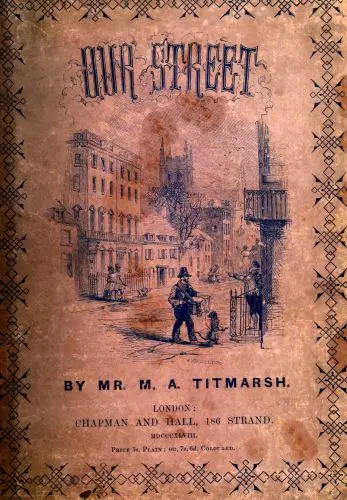
“Our Street”
William Makepeace Thackeray
THE CLASSIC COLLECTION · 1852
"Men's Wives" by William Makepeace Thackeray is a novel likely written during the mid-19th century. The story revolves around the lives of the Crump family, particularly their daughter Morgiana, who attracts the attention of multiple suitors, including the ambitious Captain Howard Walker and rival tradesmen, the perfumer Mr. Archibald Eglantine and the tailor Mr. Woolsey. The narrative deftly explores themes of love, ambition, rivalry, and societal norms through its colorful characters in a comedic and satirical manner. The opening of the novel introduces readers to the Bootjack Hotel, managed by Mr. Crump, and paints a vivid picture of its inhabitants, especially Morgiana, who is depicted as a lively and ambitious young woman. We learn about her mother, Mrs. Crump, a former actress, and the dynamic within the family as they navigate the expectations of society. Several suitors, including both Woolsey and Eglantine, are vying for Morgiana's attention, creating an atmosphere of competition and rivalry that sets the stage for further developments in the plot. The chapter also hints at the character of Captain Walker, a charming but somewhat dubious figure who desires to win Morgiana's heart while using his connections in high society, adding layers of complexity to the story.
Introduction adapted from the source catalogue; source summaries may be automatically generated.
Free to read · English · 65,709 words · No account needed
MAKE TIME FOR A GOOD BOOK
On by default. Untick to stop anonymous reading totals. Each page counts after 10 seconds in view. How this works.
Anonymous counting is on unless you have switched it off.
After the pair had been married for about a year, the omnibus that passes both by Mrs. Crump's house near “The Wells,” and by Mrs. Walker's street off the Edgware Road, brought up the former-named lady almost every day to her daughter. She came when the Captain had gone to his business; she stayed to a two-o'clock dinner with Morgiana; she drove with her in the pony-carriage round the Park; but she never stopped later than six. Had she not to go to the play at seven? And, besides, the Captain might come home with some of his great friends, and he always swore and grumbled much if he found his mother-in-law on the premises. As for Morgiana, she was one of those women who encourage despotism in husbands. What the husband says must be right, because he says it; what he orders must be obeyed tremblingly. Mrs. Walker gave up her entire reason to her lord. Why was it? Before marriage she had been an independent little person; she had far more brains than her Howard. I think it must have been his moustaches that frightened her, and caused in her this humility.
Selfish husbands have this advantage in maintaining with easy-minded wives a rigid and inflexible behaviour, viz. that if they DO by any chance grant a little favour, the ladies receive it with such transports of gratitude as they would never think of showing to a lord and master who was accustomed to give them everything they asked for; and hence, when Captain Walker signified his assent to his wife's prayer that she should take a singing-master, she thought his generosity almost divine, and fell upon her mamma's neck, when that lady came the next day, and said what a dear adorable angel her Howard was, and what ought she not to do for a man who had taken her from her humble situation, and raised her to be what she was! What she was, poor soul! She was the wife of a swindling parvenu gentleman. She received visits from six ladies of her husband's acquaintances--two attorneys' ladies, his bill-broker's lady, and one or two more, of whose characters we had best, if you please, say nothing; and she thought it an honour to be so distinguished: as if Walker had been a Lord Exeter to marry a humble maiden, or a noble prince to fall in love with a humble Cinderella, or a majestic Jove to come down from heaven and woo a Semele. Look through the world, respectable reader, and among your honourable acquaintances, and say if this sort of faith in women is not very frequent? They WILL believe in their husbands, whatever the latter do. Let John be dull, ugly, vulgar, and a humbug, his Mary Ann never finds it out; let him tell his stories ever so many times, there is she always ready with her kind smile; let him be stingy, she says he is prudent; let him quarrel with his best friend, she says he is always in the right; let him be prodigal, she says he is generous, and that his health requires enjoyment; let him be idle, he must have relaxation; and she will pinch herself and her household that he may have a guinea for his club. Yes; and every morning, as she wakes and looks at the face, snoring on the pillow by her side--every morning, I say, she blesses that dull ugly countenance, and the dull ugly soul reposing there, and thinks both are something divine. I want to know how it is that women do not find out their husbands to be humbugs? Nature has so provided it, and thanks to her. When last year they were acting the “Midsummer Night's Dream,” and all the boxes began to roar with great coarse heehaws at Titania hugging Bottom's long long ears--to me, considering these things, it seemed that there were a hundred other male brutes squatted round about, and treated just as reasonably as Bottom was. Their Titanias lulled them to sleep in their laps, summoned a hundred smiling delicate household fairies to tickle their gross intellects and minister to their vulgar pleasures; and (as the above remarks are only supposed to apply to honest women loving their own lawful spouses) a mercy it is that no wicked Puck is in the way to open their eyes, and point out their folly. Cui bono? let them live on in their deceit: I know two lovely ladies who will read this, and will say it is just very likely, and not see in the least, that it has been written regarding THEM.
Your reading position is saved on this browser. Take it to another device with a library code. Reading pages adapt to text, rather than matching a printed edition.
William Makepeace Thackeray
William Makepeace Thackeray
Charles Dickens & William Makepeace Thackeray
William Makepeace Thackeray
BEHIND THE BOOK
This eBook is for the use of anyone anywhere in the United States and most other parts of the world at no cost and with almost no restrictions whatsoever. You may copy it, give it away or re-use it under the terms of the Project Gutenberg License included with this eBook or online at www.gutenberg.org. If you are not located in the United States, you will have to check the laws of the country where you are located before using this eBook. Read the source licence.
The original source file, including credits and licence, is retained by this library. Request an original-format copy at no charge. Please include the book title and Project Gutenberg identifier #1985.
KEEP YOUR CURIOSITY GOING
Coulson Kernahan

Maurice Baring
Frances Wright
Cécile Tormay

Frederic Jesup Stimson

W. H. P. (William Henry Pope) Jarvis