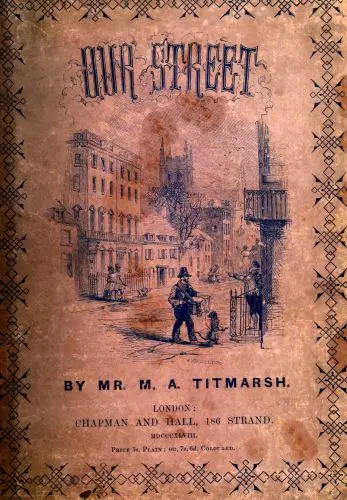
“Our Street”
William Makepeace Thackeray
THE CLASSIC COLLECTION · 1852
"Men's Wives" by William Makepeace Thackeray is a novel likely written during the mid-19th century. The story revolves around the lives of the Crump family, particularly their daughter Morgiana, who attracts the attention of multiple suitors, including the ambitious Captain Howard Walker and rival tradesmen, the perfumer Mr. Archibald Eglantine and the tailor Mr. Woolsey. The narrative deftly explores themes of love, ambition, rivalry, and societal norms through its colorful characters in a comedic and satirical manner. The opening of the novel introduces readers to the Bootjack Hotel, managed by Mr. Crump, and paints a vivid picture of its inhabitants, especially Morgiana, who is depicted as a lively and ambitious young woman. We learn about her mother, Mrs. Crump, a former actress, and the dynamic within the family as they navigate the expectations of society. Several suitors, including both Woolsey and Eglantine, are vying for Morgiana's attention, creating an atmosphere of competition and rivalry that sets the stage for further developments in the plot. The chapter also hints at the character of Captain Walker, a charming but somewhat dubious figure who desires to win Morgiana's heart while using his connections in high society, adding layers of complexity to the story.
Introduction adapted from the source catalogue; source summaries may be automatically generated.
Free to read · English · 65,709 words · No account needed
MAKE TIME FOR A GOOD BOOK
On by default. Untick to stop anonymous reading totals. Each page counts after 10 seconds in view. How this works.
Anonymous counting is on unless you have switched it off.
In a word, I found that Berry, like many simple fellows before him, had made choice of an imperious, ill-humoured, and underbred female for a wife, and could see with half an eye that he was a great deal too much her slave.
The struggle was not over yet, however. Witness that little encounter before dinner; and once or twice the honest fellow replied rather smartly during the repast, taking especial care to atone as much as possible for his wife's inattention to Jack and Mrs. Muchit, by particular attention to those personages, whom he helped to everything round about and pressed perpetually to champagne; he drank but little himself, for his amiable wife's eye was constantly fixed on him.
Just at the conclusion of the dessert, madame, who had bouded Berry during dinner-time, became particularly gracious to her lord and master, and tenderly asked me if I did not think the French custom was a good one, of men leaving table with the ladies.
“Upon my word, ma'am,” says I, “I think it's a most abominable
practice.”
“And so do I,” says Cutler.
“A most abominable practice! Do you hear THAT?” cries Berry, laughing, and filling his glass.
“I'm sure, Frank, when we are alone you always come to the drawing-room,” replies the lady, sharply.
“Oh, yes! when we're alone, darling,” says Berry, blushing; “but now we're NOT alone--ha, ha! Anatole, du Bordeaux!”
“I'm sure they sat after the ladies at Carlton House; didn't they, Lady Pash?” says Dobus, who likes his glass.
“THAT they did!” says my Lady, giving him a jolly nod.
“I racklackt,” exclaims Captain Goff, “when I was in the Mauritius, that Mestress MacWhirter, who commanded the Saxty-Sackond, used to say, 'Mac, if ye want to get lively, ye'll not stop for more than two hours after the leddies have laft ye: if ye want to get drunk, ye'll just dine at the mass.' So ye see, Mestress Barry, what was Mac's allowance--haw, haw! Mester Whey, I'll trouble ye for the o-lives.”
But although we were in a clear majority, that indomitable woman, Mrs. Berry, determined to make us all as uneasy as possible, and would take the votes all round. Poor Jack, of course, sided with her, and Whey said he loved a cup of tea and a little music better than all the wine of Bordeaux. As for the Frenchman, when Mrs. Berry said, “And what do you think, M. le Vicomte?”
“Vat you speak?” said M. de Blagueval, breaking silence for the first time during two hours. “Yase--eh? to me you speak?”
“Apry deeny, aimy-voo ally avec les dam?”
“Comment avec les dames?”
Your reading position is saved on this browser. Take it to another device with a library code. Reading pages adapt to text, rather than matching a printed edition.
William Makepeace Thackeray
William Makepeace Thackeray
Charles Dickens & William Makepeace Thackeray
William Makepeace Thackeray
BEHIND THE BOOK
This eBook is for the use of anyone anywhere in the United States and most other parts of the world at no cost and with almost no restrictions whatsoever. You may copy it, give it away or re-use it under the terms of the Project Gutenberg License included with this eBook or online at www.gutenberg.org. If you are not located in the United States, you will have to check the laws of the country where you are located before using this eBook. Read the source licence.
The original source file, including credits and licence, is retained by this library. Request an original-format copy at no charge. Please include the book title and Project Gutenberg identifier #1985.
KEEP YOUR CURIOSITY GOING
Coulson Kernahan

Maurice Baring
Frances Wright
Cécile Tormay

Frederic Jesup Stimson

W. H. P. (William Henry Pope) Jarvis