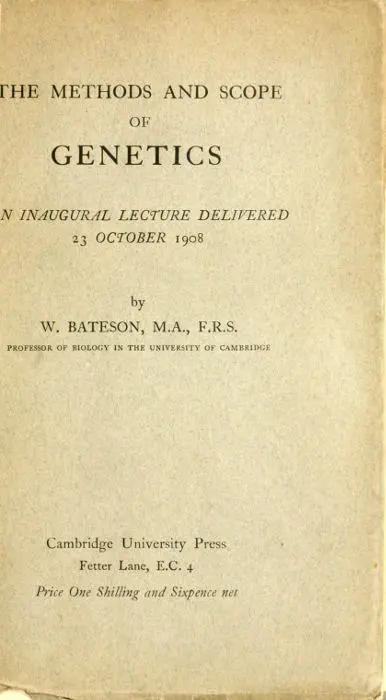
The Methods and Scope of Genetics An inaugural lecture delivered 23 October 1908
William Bateson
THE CLASSIC COLLECTION · 1902
"Mendel's Principles of Heredity: A Defence" by William Bateson is a scientific publication written in the early 20th century. This work serves to elucidate and defend the groundbreaking principles of heredity established by Gregor Mendel, alongside a translation of Mendel's original papers on hybridization. The book discusses the significance of Mendel’s work within the context of evolution and inheritance, providing insights into the mechanics of genetic inheritance through detailed experiments with pea plants. The opening of the work presents a preface by William Bateson, highlighting the historical neglect of Mendel’s discoveries despite their transformative implications for evolutionary biology. In it, Bateson discusses the competitive and somewhat conservative nature of the scientific community regarding new ideas and theories stemming from Darwinism. He expresses discontent over critiques levied against Mendel’s principles, specifically addressing Professor Weldon's objections, and emphasizes the necessity for Mendel's work to reach a wider audience to inspire further investigation into heredity. Bateson hints at the considerable advances in scientific understanding that could be achieved through the continued study of Mendelian genetics, setting the stage for the in-depth analysis of Mendel’s experiments to follow in subsequent chapters.
Introduction adapted from the source catalogue; source summaries may be automatically generated.
Free to read · English · 62,221 words · No account needed
MAKE TIME FOR A GOOD BOOK
On by default. Untick to stop anonymous reading totals. Each page counts after 10 seconds in view. How this works.
Anonymous counting is on unless you have switched it off.
To resume, then, it was found that by self-fertilising the original cross-breds the same proportion was always approached, namely--
25 dominants, 50 cross-breds, 25 recessives,
or 1D : 2DR : 1R.
Like the pure recessives, the pure dominants are thenceforth pure, and only give rise to dominants in all succeeding generations studied.
On the contrary the fifty cross-breds, as stated above, have mixed offspring. But these offspring, again, in their numerical proportions, follow the same law, namely, that there are three dominants to one recessive. The recessives are pure like those of the last generation, but the dominants can, by further self-fertilisation, and examination or cultivation of the seeds produced, be again shown to be made up of pure dominants and cross-breds in the same proportion of one dominant to two cross-breds.
The process of breaking up into the parent forms is thus continued in each successive generation, the same numerical law being followed so far as has yet been observed.
Mendel made further experiments with Pisum sativum, crossing pairs of varieties which differed from each other in two characters, and the results, though necessarily much more complex, showed that the law exhibited in the simpler case of pairs differing in respect of one character operated here also.
In the case of the union of varieties AB and ab differing in two distinct pairs of characters, A and a, B and b, of which A and B are dominant, a and b recessive, Mendel found that in the first cross-bred generation there was only one class of offspring, really AaBb.
But by reason of the dominance of one character of each pair these first crosses were hardly if at all distinguishable from AB.
By letting these AaBb’s fertilise themselves, only four classes of offspring seemed to be produced, namely,
AB showing both dominant characters.
Ab " dominant A and recessive b.
aB " recessive a and dominant B.
ab " both recessive characters a and b.
The numerical ratio in which these classes appeared were also regular
and approached the ratio
9AB : 3Ab : 3aB : 1ab.
But on cultivating these plants and allowing them to fertilise themselves it was found that the members of the
1 ab class produce only ab’s.
3 {1 aB class may produce either all aB’s,
{2 or both aB’s and ab’s.
3 { 1 Ab class may produce either all Ab’s,
{ 2 or both Ab’s and ab’s.
{ 1 AB class may produce either all AB’s, { 2 or both AB’s and Ab’s, 9 { 2 or both AB’s and aB’s, { 4 or all four possible classes again, namely, { AB’s, Ab’s, aB’s, and ab’s,
and the average number of members of each class will approach the ratio 1 : 3 : 3 : 9 as indicated above.
Your reading position is saved on this browser. Take it to another device with a library code. Reading pages adapt to text, rather than matching a printed edition.
BEHIND THE BOOK
This eBook is for the use of anyone anywhere in the United States and most other parts of the world at no cost and with almost no restrictions whatsoever. You may copy it, give it away or re-use it under the terms of the Project Gutenberg License included with this eBook or online at www.gutenberg.org. If you are not located in the United States, you will have to check the laws of the country where you are located before using this eBook. Read the source licence.
The original source file, including credits and licence, is retained by this library. Request an original-format copy at no charge. Please include the book title and Project Gutenberg identifier #69362.
KEEP YOUR CURIOSITY GOING

John Muir

Asa Gray
Asa Gray

Florence Nightingale
Elizabeth Robins Pennell
Denison Olmsted