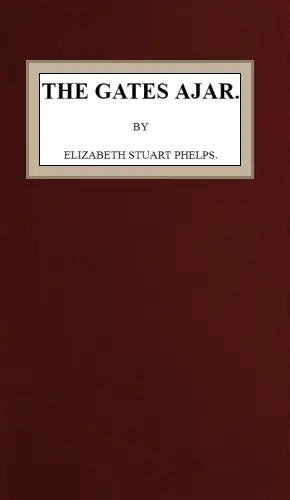
The Gates Ajar
Elizabeth Stuart Phelps
THE CLASSIC COLLECTION · 1869
"Men, Women, and Ghosts" by Elizabeth Stuart Phelps is a collection of short stories written during the late 19th century. This work explores themes of love, domestic life, and the struggles of women in a rapidly changing society, often focusing on the complex emotional experiences of its characters. The opening story centers around the wedding of Harrie Bird and Dr. Myron Sharpe, setting the stage for the exploration of their relationship and the challenges they face as they navigate life together. The opening of the collection introduces readers to the idyllic yet complicated beginnings of Harrie's marriage to Dr. Sharpe. The narrator reflects on the wedding ceremony, capturing the joy and hope surrounding the young couple. However, as the narrative unfolds, it hints at the underlying tensions of marital life, especially as they become consumed by the demands of parenthood and societal expectations. The idyllic imagery of their early love contrasts sharply with the reality of their everyday struggles, setting up a tension that invites readers to ponder the complexities of love, ambition, and the roles of men and women in society.
Introduction adapted from the source catalogue; source summaries may be automatically generated.
Free to read · English · 82,697 words · No account needed
MAKE TIME FOR A GOOD BOOK
On by default. Untick to stop anonymous reading totals. Each page counts after 10 seconds in view. How this works.
Anonymous counting is on unless you have switched it off.
"Well, Martha," he said, coming up to her uneasily, "you look tired."
"Tired? No, I was only thinking, Amos."
The pallor of her face, its timid eyes and patient mouth, the whole crushed look of the woman, struck him freshly. He stooped and kissed her forehead, the sharp lines of his face relaxing a little.
"I didn't mean to be hard on you, Martha; we both have enough to bear without that, but it's best not to talk of what can't be helped,--you see."
"Yes."
"Don't think anything more about the day; it's not--it's not really good for you; you must cheer up, little woman."
"Yes, Amos."
Perhaps his unusual tenderness gave her courage; she stood up, putting both arms around his neck.
"If you'd only try to love her a little, after all, my husband! He would know it; He might save her for it."
Amos Ryck choked, coughed, and said it was time for prayers. He took down the old Bible in which his child's baby-fingers used to trace their first lessons after his own, and read, not of her who loved much and was forgiven, but one of the imprecatory Psalms.
When Mrs. Ryck was sure that her husband was asleep that night, she rose softly from her bed, unlocked, with noiseless key, one of her bureau drawers, took something from it, and then felt her way down the dark stairs into the kitchen.
She drew a chair up to the fire, wrapped her shawl closely about her, and untied, with trembling fingers, the knots of a soft silken handkerchief in which her treasures were folded.
Some baby dresses of purest white; a child's little pink apron; a pair of tiny shoes, worn through by pattering feet; and a toy or two all broken, as some impatient little fingers had left them; she was such a careless baby! Yet they never could scold her, she always affected such pretty surprises, and wide blue-eyed penitence: a bit of a queen she was at the farm.
Was it not most kindly ordered by the Infinite Tenderness which pitieth its sorrowing ones, that into her still hours her child should come so often only as a child, speaking pure things only, touching her mother so like a restful hand, and stealing into a prayer?
For where was ever grief like this one? Beside this sorrow, death was but a joy. If she might have closed her child's baby-eyes, and seen the lips which had not uttered their first "Mother!" stilled, and laid her away under the daisies, she would have sat there alone that night, and thanked Him who had given and taken away.
Your reading position is saved on this browser. Take it to another device with a library code. Reading pages adapt to text, rather than matching a printed edition.
Elizabeth Stuart Phelps
Elizabeth Stuart Phelps
Elizabeth Stuart Phelps
Elizabeth Stuart Phelps
BEHIND THE BOOK
This eBook is for the use of anyone anywhere in the United States and most other parts of the world at no cost and with almost no restrictions whatsoever. You may copy it, give it away or re-use it under the terms of the Project Gutenberg License included with this eBook or online at www.gutenberg.org. If you are not located in the United States, you will have to check the laws of the country where you are located before using this eBook. Read the source licence.
The original source file, including credits and licence, is retained by this library. Request an original-format copy at no charge. Please include the book title and Project Gutenberg identifier #10744.
KEEP YOUR CURIOSITY GOING
Coulson Kernahan

Maurice Baring
Frances Wright
Cécile Tormay

Frederic Jesup Stimson

W. H. P. (William Henry Pope) Jarvis