THE CLASSIC COLLECTION✦An outlaw’s diary: the CommuneCLASSIC FREE BOOKS
An outlaw’s diary: the Commune
Cécile Tormay
THE CLASSIC COLLECTION · 1914
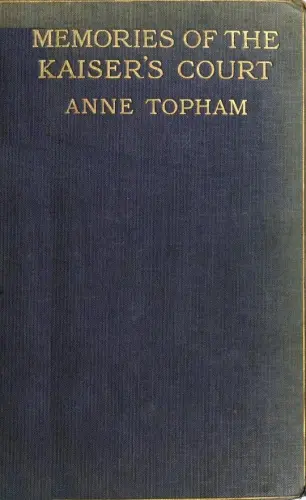
"Memories of the Kaiser's Court" by Anne Topham is a historical account written in the early 20th century. The book recounts Topham's experiences as the English governess to Princess Victoria Louise of Prussia, who is the daughter of the German Emperor. Through her eyes, readers get a vivid portrayal of royal life in Germany, highlighting the complexities and quirks of court etiquette, the personalities of royal family members, and the juxtaposition of Topham's British sensibilities with the customs of the Prussian court. At the start of the narrative, Topham describes her arrival at the Prussian court in Homburg in 1902, characterized by chaotic travel and cultural adjustments. Initially overwhelmed by the court's grandeur yet accompanied by practical difficulties, she recounts the awkwardness of her formal introductions, including a dinner with the Empress. Topham captures her early impressions of the royal family, especially the spirited young Princess Victoria Louise and her exuberant antics. The opening sets the stage for a rich exploration of court life, revealing the contrast between the children’s playful innocence and the formalities demanded within the royal household.
Introduction adapted from the source catalogue; source summaries may be automatically generated.
Free to read · English · 93,012 words · No account needed
MAKE TIME FOR A GOOD BOOK
On by default. Untick to stop anonymous reading totals. Each page counts after 10 seconds in view. How this works.
Anonymous counting is on unless you have switched it off.
On the evening of the wedding of the Princess with Prince Ernest of Cumberland, now Duke of Brunswick, at the beginning of the historic Torch Dance which concludes the ceremonies, the radiant bride, taking her father by one hand and the Duke of Cumberland by the other, walked between them round the hall to the sound of the stately bridal music.
It was a happy symbol, the erstwhile enemies linked together by the Kaiser’s daughter, a visible sign of the alleviation, if not quite the ending, of a situation which had for long years galled and irritated the German people.
Now, with the departure of his youngest child, the last one left at home, the private life of the Kaiser’s Court has grown in these later days somewhat still and a trifle lonely. There is as yet no little girl among the children of the Crown Prince to take even partially the place of the one who has gone away, the one who was her father’s particular companion and pride.
The Bauern Haus is closed, the Prinzen Wohnung shut up.
“It is really quite sad,” wrote recently a lady of the Court, “to see all those apartments deserted and locked up, the curtains drawn across the windows, no movement or life where formerly there was so much. Christmas was strange indeed without our Princess. We all felt it like a shadow over the festivities. We seemed to feel that we were getting old.”
And the Emperor, who in his private friendships has undergone many disappointments and disillusions, becomes increasingly conscious of the soul solitude brought by advancing years.
Yet, though suffering from occasional moods of depression, he faces the future with confidence in the destiny of his house.
Among his later literary admirations Kipling’s poem
“If” holds first place. A copy hangs above his writing-table; he quotes it frequently to his sons, and translates it into terse and expressive German for the benefit of his adjutants. It embodies his own experience of Life, crystallizes his own aspirations. He too has always been anxious
“to fill the unforgiving minute
With sixty-seconds’ worth of distance run.”
Adalbert, Prince, of Prussia, 44;
his fancy-dress ball, 160
Africa, German, 46, 168
Albany, Duchess of, 53
Alexander of Teck, Princess, 53, 55
Alexandra, Queen, 68, 228
Alexandria, the Emperor’s river-steamer, 169
Amber, 76, 182
Aosta, Duchess of, 151
Apollo-Saal, 45
Aubade of court ladies and gentlemen, 155
Augusta-Stift, 101
Augusta Victoria, German Empress, adventure in Königsberg, 201;
appearance, personal, 216;
audience, 8;
birthday, 95;
Christmas gifts, 69, 76;
cruise on the Iduna, 183, 218;
fall from horse, 172;
Irish apron, 70;
interest in social schemes, 214;
recreations, 216;
speech at Königsberg, 217;
treats to school-children, 188, 213;
unmarried sister, 136
August Wilhelm, Prince, of Prussia, 44
Baden, Louise, Grand Duchess of, 231
Ballin, head of Hamburg-America line of steamships, 210
Your reading position is saved on this browser. Take it to another device with a library code. Reading pages adapt to text, rather than matching a printed edition.
BEHIND THE BOOK
This eBook is for the use of anyone anywhere in the United States and most other parts of the world at no cost and with almost no restrictions whatsoever. You may copy it, give it away or re-use it under the terms of the Project Gutenberg License included with this eBook or online at www.gutenberg.org. If you are not located in the United States, you will have to check the laws of the country where you are located before using this eBook. Read the source licence.
The original source file, including credits and licence, is retained by this library. Request an original-format copy at no charge. Please include the book title and Project Gutenberg identifier #51290.
KEEP YOUR CURIOSITY GOING
Cécile Tormay

Moritz Busch
John L. Ransom
Frances Wright
Cécile Tormay

Mabel Potter Daggett