THE CLASSIC COLLECTION✦Andersonville diaryCLASSIC FREE BOOKS
Andersonville diary
John L. Ransom
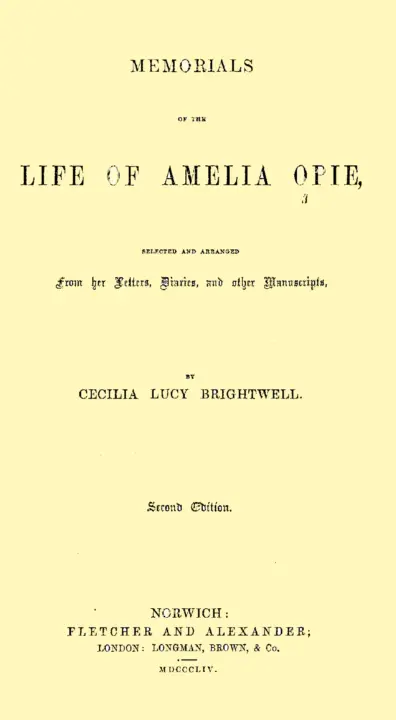
THE CLASSIC COLLECTION · 1854
"Memorials of the Life of Amelia Opie" by Amelia Opie is a biographical memoir written in the mid-19th century. The work compiles the life and experiences of Amelia Opie, detailing her upbringing, family influences, and significant events that shaped her character and artistic pursuits. Through this memoir, readers gain insight into her personal reflections, relationships, and the social context of her time. The opening of the memoir introduces the reader to Opie's early life, focusing on her birth, parentage, and formative years in Norwich. It emphasizes her close bond with her father, Dr. James Alderson, following the death of her mother when Amelia was a child. As she recounts her childhood experiences, including her early fears and her mother's methods of nurturing her, the foundation for Opie's lifelong values of compassion and benevolence emerges. The narrative sets the stage for exploring her interests in literature and social issues, as well as her eventual prominence as a writer and artist. This opening portion memorably blends personal narrative with broader themes of family, loss, and the shaping of one's character through early experiences.
Introduction adapted from the source catalogue; source summaries may be automatically generated.
Free to read · English · 139,153 words · No account needed
MAKE TIME FOR A GOOD BOOK
On by default. Untick to stop anonymous reading totals. Each page counts after 10 seconds in view. How this works.
Anonymous counting is on unless you have switched it off.
The three following letters to Mrs. Taylor admit us behind the scenes, and allow us to see the palpitations of her heart.
Sunday Evening, 1801.
MY DEAR FRIEND,
The only paper I can find consists of two half sheets, comme vous voyez. But no matter. I will not, for appearance’ sake, baulk my inclination to write to you.
* * I am very sorry that Mrs. Jordan and the Duke of Clarence have hitherto managed their matters so ill, as always to disappoint you; but the lady is now about again, though, from pecuniary disputes with the manager, probably, she is, as yet, invisible to the public. However, by the time you come, I hope she will be on the boards again. I believe you were very right in what you said to me, about the good arising from my having delayed publishing my juvenile pieces; but some of those things which have now gained me reputation are juvenile pieces, written years ago; however, I am contented that I have, till now, lived unconscious of the anxieties of an author. I wish I were launched! As usual, all the good I saw in my work, before it was printed, is now vanished from my sight, and I remember only its faults. All the authors, of both sexes, and artists too, that are not too ignorant or full of conceit to be capable of alarm, tell me they have had the same feeling when about to receive judgment from the public. Besides, whatever I read appears to me so superior to my own productions, that I am in a state of most unenviable humility. Mr. Opie has no patience with me; but he consoles me by averring that fear makes me overrate others, and underrate myself. Be so good as to tell my father that, as a subscriber to Dyer’s book, he has half a guinea to pay for the volume I have received for him, and when the other two volumes are done, he will have to pay half a guinea more! Poor man; but tell him, as some little consolation, that there are three pretty stanzas addressed to me in the first volume, the old verses lengthened and improved, but they are “To a Lady,” not to Mrs. Opie. Viganoni was with me from twelve to three to-day, alternately singing with me and talking; he has, with all his genius, a great deal of what the French call bonhommie, which makes him talkative and confiding, when he is with those he thinks his friends. I was pleased, for his sake, to hear him say he should sing only two or three years longer, as he had saved money enough to live quite at his ease in his native country. He says music is now so cultivated and courted in England, that it is at its height, and must soon fall “en décadence;” but he thinks the present taste a vicious one. “Le monde Anglais;” he says, “like nothing equal to bravura singing,” which he thinks no singing at all, and which never goes to the heart like simple sentimental singing. Indeed he never puts in a grace, but what tends to illustrate the sentiment of the words, and the style of the air; his singing is conversation, put into sweet sounds. My plaudit is of no weight, perhaps; but Viganoni has, unrivalled, that of all the oldest, most experienced, and able professors of music—men who unite theory with practice, and are the only good judges, from having, from their situations, an opportunity of comparing singers and styles—men who have learnt to hear, an art, nothing but hearing constantly the first music and performers, can teach. I long to hear Mara again. V. says she sings better than ever, though her voice is on the wane. How strange it is that Bante retains her unequalled voice, though she gets drunk every day. This extraordinary creature can’t even write her name, and knows not a note of music. V. is sometimes forced to pinch her to keep her in time, and make her leave off her vile shake, or rather no shake, at the proper point. A gentleman declared to me he saw this; but I did not believe it, till I asked V., who told me it was true. Adieu! Love to all.
Your reading position is saved on this browser. Take it to another device with a library code. Reading pages adapt to text, rather than matching a printed edition.
BEHIND THE BOOK
This eBook is for the use of anyone anywhere in the United States and most other parts of the world at no cost and with almost no restrictions whatsoever. You may copy it, give it away or re-use it under the terms of the Project Gutenberg License included with this eBook or online at www.gutenberg.org. If you are not located in the United States, you will have to check the laws of the country where you are located before using this eBook. Read the source licence.
The original source file, including credits and licence, is retained by this library. Request an original-format copy at no charge. Please include the book title and Project Gutenberg identifier #47595.
KEEP YOUR CURIOSITY GOING
John L. Ransom

Herman W. Mudgett

Harriet Monroe
Daniel Dulany Addison
Charles Lanman

Harold Rosher