THE CLASSIC COLLECTION✦Andersonville diaryCLASSIC FREE BOOKS
Andersonville diary
John L. Ransom
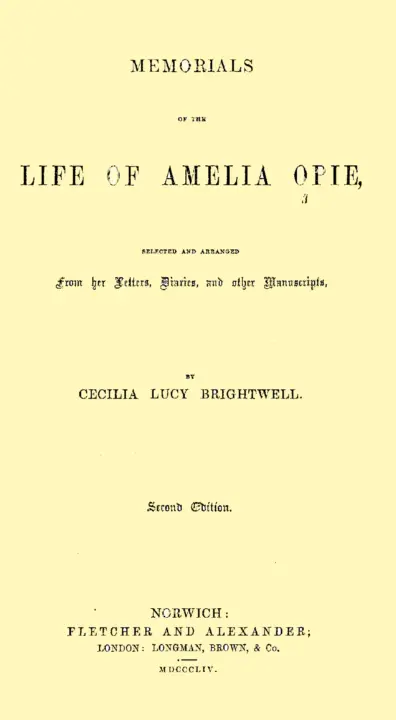
THE CLASSIC COLLECTION · 1854
"Memorials of the Life of Amelia Opie" by Amelia Opie is a biographical memoir written in the mid-19th century. The work compiles the life and experiences of Amelia Opie, detailing her upbringing, family influences, and significant events that shaped her character and artistic pursuits. Through this memoir, readers gain insight into her personal reflections, relationships, and the social context of her time. The opening of the memoir introduces the reader to Opie's early life, focusing on her birth, parentage, and formative years in Norwich. It emphasizes her close bond with her father, Dr. James Alderson, following the death of her mother when Amelia was a child. As she recounts her childhood experiences, including her early fears and her mother's methods of nurturing her, the foundation for Opie's lifelong values of compassion and benevolence emerges. The narrative sets the stage for exploring her interests in literature and social issues, as well as her eventual prominence as a writer and artist. This opening portion memorably blends personal narrative with broader themes of family, loss, and the shaping of one's character through early experiences.
Introduction adapted from the source catalogue; source summaries may be automatically generated.
Free to read · English · 139,153 words · No account needed
MAKE TIME FOR A GOOD BOOK
On by default. Untick to stop anonymous reading totals. Each page counts after 10 seconds in view. How this works.
Anonymous counting is on unless you have switched it off.
With this woman of excelling genius and winning manners, I had the pleasure of being acquainted in the year 1813; when, with her daughter, then of the age of sixteen, who afterwards became Duchess de Broglie, and Mr. Rocca, to whom she was then privately married, she was residing for some months in London, when exiled by Napoleon from France. One morning I went to call on her by appointment, accompanied by a friend of mine whom she wished to see, on some particular business. Scarcely had that business been concluded, when the servant announced Lord Erskine, who came in with books in his hands, and when he saw me he cried, “I am glad to see you here, for I want you to read something for me.” He then gracefully bowed to Madame de Staël and presented the two books to her, containing, he said, his most celebrated speeches; and opening the first volume he turned to the first page, on which he had written a dedication to la Baronne de Staël in English, which he begged me to read to her. “No, no, not so,” she exclaimed eagerly, taking the book from me, “I can read it myself.” Accordingly she began; while I, myself an author, soon felt painful sympathy with poor Lord E.’s feelings; for the writing was, I dare say, difficult for her, a foreigner, to read; and the poor writer’s smooth and elegant periods were, in a great measure, deprived of their charm, by their meaning being sometimes stammered out, and, possibly, not entirely understood. However, the lady was flattered with what she did understand, and Lord E. soon recovered the steadiness of his nerves: and taking up the second volume, which contained his speeches at the Old Bailey trials in the year 1794, he read some favourite passages to her, and finished by alluding to the evident dislike which the Lord Chief Baron Eyre, who presided at them, entertained for him, and how strongly he proved it during the trial of Horne Tooke, who was the second person tried for his life, and was (like the first person, Thomas Hardy) entirely acquitted. He then related what had passed between himself and the Chief Justice, after the trial was over and the crowd dispersed, and which I, who was present, well remembered having, by accident, overheard. Liking to be near the eloquent man and to hear him speak, I had contrived to get so near as to overhear what passed, and which I thought was too loud, not to be intended to be heard. The judge had, I saw, to repeat what he said; but at length he was answered in a manner which he little expected; for the indignant speaker replied, “My lord, I am willing to give your lordship such an answer as an aggrieved man of honour like myself is willing to give to the man who has repeatedly insulted him, and I am willing and ready to meet your lordship, at any time and place that you may choose to appoint.” At this point of his story our hostess cried, “What! my lord, that was a challenge, n’est ce pas?” “Yes, ma’am.” “Well, what did he say?” “Oh! nothing to the purpose; but I assure you I was irritated into saying what I did.” “Yes, indeed,—I was behind you, Lord E. (said I,) and heard all that passed; and though such things were quite new to me, I felt sure what was said by you amounted to a challenge; but when I told the friends with whom I went home what had passed, they said I was a silly girl and that I was mistaken.” He looked at me with some surprise, and, I fear, with a doubt of my veracity; but I could affirm to the truth of my assertion. I do not wonder, however, as he did not then know me personally, and was not conscious of my proximity, or that of any one else perhaps, that he was inclined to distrust my truthfulness; but it was a fact, that the circumstance and the words he related, were, I believe, witnessed and overheard by me alone; and a curious fact or coincidence it was, that this conversation, overheard by me in the year 1794, I should be present to hear related to the Baronne de Staël by Lord E. himself in the year 1813. The circumstance and the words he has published at the end of the trial of Horne Tooke; and I could, with a safe conscience, underwrite all that he there relates. I fear that he really believed I was romancing, or he would have named this odd corroboration of his conduct, which no doubt he thought the noble daring of a man of worldly honour.
Your reading position is saved on this browser. Take it to another device with a library code. Reading pages adapt to text, rather than matching a printed edition.
BEHIND THE BOOK
This eBook is for the use of anyone anywhere in the United States and most other parts of the world at no cost and with almost no restrictions whatsoever. You may copy it, give it away or re-use it under the terms of the Project Gutenberg License included with this eBook or online at www.gutenberg.org. If you are not located in the United States, you will have to check the laws of the country where you are located before using this eBook. Read the source licence.
The original source file, including credits and licence, is retained by this library. Request an original-format copy at no charge. Please include the book title and Project Gutenberg identifier #47595.
KEEP YOUR CURIOSITY GOING
John L. Ransom

Herman W. Mudgett

Harriet Monroe
Daniel Dulany Addison
Charles Lanman

Harold Rosher