THE CLASSIC COLLECTION✦Andersonville diaryCLASSIC FREE BOOKS
Andersonville diary
John L. Ransom
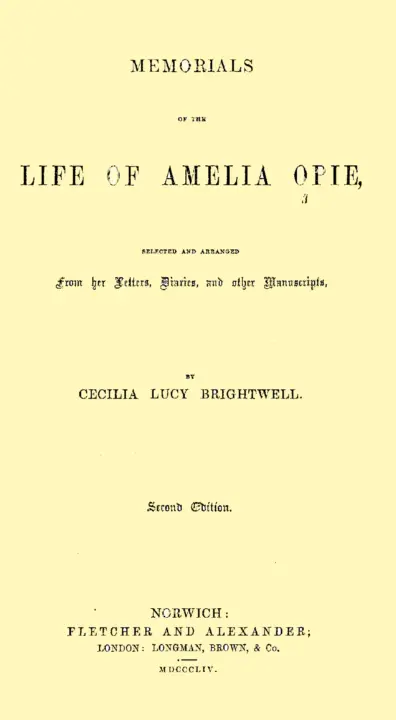
THE CLASSIC COLLECTION · 1854
"Memorials of the Life of Amelia Opie" by Amelia Opie is a biographical memoir written in the mid-19th century. The work compiles the life and experiences of Amelia Opie, detailing her upbringing, family influences, and significant events that shaped her character and artistic pursuits. Through this memoir, readers gain insight into her personal reflections, relationships, and the social context of her time. The opening of the memoir introduces the reader to Opie's early life, focusing on her birth, parentage, and formative years in Norwich. It emphasizes her close bond with her father, Dr. James Alderson, following the death of her mother when Amelia was a child. As she recounts her childhood experiences, including her early fears and her mother's methods of nurturing her, the foundation for Opie's lifelong values of compassion and benevolence emerges. The narrative sets the stage for exploring her interests in literature and social issues, as well as her eventual prominence as a writer and artist. This opening portion memorably blends personal narrative with broader themes of family, loss, and the shaping of one's character through early experiences.
Introduction adapted from the source catalogue; source summaries may be automatically generated.
Free to read · English · 139,153 words · No account needed
MAKE TIME FOR A GOOD BOOK
On by default. Untick to stop anonymous reading totals. Each page counts after 10 seconds in view. How this works.
Anonymous counting is on unless you have switched it off.
Tuesday, 1794.
MY DEAR MRS. T.
At length I have found an opportunity of writing to you at my leisure, but now, though I have begun with the resolution of being very grave and very sentimental, I feel such an inclination to run into plain matters of fact and narration, that I shall beg leave to content myself with a recital of the events of my journey to town yesterday, requesting at the same time a recital of the events of your life, since I saw you, in return. We will leave gravity and sentiment to be the order of the evening when we resume our Wednesday tête à têtes, and rejoice in the absence of husband and father.
Mr. J. Boddington and I set off for town yesterday by way of Islington, that we might pay our first visit to Godwin, at Somers’ Town. After a most delightful ride through some of the richest country I ever beheld, we arrived at about one o’clock at the philosopher’s house, whom we found with his hair bien poudré, and in a pair of new, sharp-toed, red morocco slippers, not to mention his green coat and crimson under-waistcoat. He received me very kindly, but wondered I should think of being out of London;—could I be either amused or instructed at Southgate? How did I pass my time? What were my pursuits? and a great deal more, which frightened my protector, and tired me, till at last I told him I had not yet outlived my affections, and that they bound me to the family at Southgate. But was I to acknowledge any other dominion than that of reason?—“but are you sure that my affections in this case are not the result of reason?” He shrugged disbelief, and after debating some time, he told me I was more of the woman than when he saw me last. Rarely did we agree, and little did he gain on me by his mode of attack; but he seemed alarmed lest he should have offended me, and apologised several times, with much feeling, for the harshness of his expressions. In short, he convinced me that his theory has not yet gotten entire ascendancy over his practice. He has promised to come over to spend a day at Southgate, when I shall pit rational belief in Mr. M., against atheism in Mr. Godwin. Mr. B. was disgusted with his manner; though charmed with that of Barry, whom we called on last week. Godwin told me he had talked of me to Mrs. Inchbald, that she recollected me, and wished to see me; so I determined to call on her after I had paid my visit to Mrs. Siddons. From Godwin’s, we went to Ives Hurry’s in the City, where we left our chair and horses, and proceeded in a coach to Mrs. Betham’s, to have my profile taken, and thence we drove to Marlborough Street. I found Mrs. Siddons engaged in nursing her little baby, and as handsome and charming as ever. She played last Wednesday before her month was up, and is now confined to her room with the cold she caught behind the scenes. There too, I saw Charles Kemble, as I passed through his sister’s dressing room, and thought him so like Kemble, Mrs. Twiss, and Mrs. Siddons, that it was some time before I could recollect myself enough to know whether he was a man or a woman. Sally and Maria, tell my father, are quite well, and inquired much concerning him. The baby is all a baby can be, but Mrs. S. laughs, and says it is a wit and a beauty already in her eyes; she leaves town to-day, or she would have invited me for a longer visit. From Marlborough Street, we drove to Mrs. Inchbald’s, who is as pretty as ever, and much more easy and unreserved in her manner, than when I last saw her. With her we passed an hour, and when I took my leave, she begged I would call on her again. She is in charming lodgings, and has just received two hundred pounds from Sheridan, for a farce containing sixty pages only. From her house we drove into the city. You will wonder, perhaps, where we dined. Be it known unto you, that we never dine when we visit London. Ives Hurry, as soon as we arrive at his house, always treats us with as much ice and biscuits as we can eat; we then sally forth, and eat ice again when we want it; so we did yesterday, and Mrs. Siddons’ roast beef had no temptations for us. As we returned to I. H.’s, we went to Daniel Isaac Eaton’s shop; we had scarcely entered it, when a very genteel-looking young man came in. He examined us, and we him; and suspicion being the order of the day, I dared not talk to Mrs. Eaton till the stranger was engaged in conversation with Boddington. I then told her that curiosity led me to her shop, and that I came from that city of sedition, Norwich. Her eyes sparkled, and she asked me if I knew Charles Marsh? “You come from Norwich, (cried the stranger,) allow me to ask you some questions,” &c., &c. He put questions, I answered them, and in a short time Mr. J. B. and myself were both so charmed with his manners and conversation, that we almost fancied we had known him before. We saw that he was intimate with Mrs. E. and her sweet girl, and seemed to be as much at home in the shop as the counter itself. So we had no fears of him; at last we became so fraternized, that Mrs. E. shut the shop door and gave us chairs. I will not relate the information I heard, but I could have talked with him all night. “Well, but who was he?” Have patience and you shall hear. Finding that he was just returned from Scotland, and was au fait of all the proceedings there, and that his connexions were those of high life; I asked where Lord Daer was, and lamented that he was not one of the arrested members. He smiled, and said that Lord D. wanted nerve then, and fortitude to resist the anxieties of his mother, and sisters, the most accomplished women in England; that the very day of the arrest he had received a letter from Lord Daer, promising to be with them if possible; and in the evening another note to say Lady Selkirk was ill, and that he could not leave her. “Indeed! I thought he bailed you,” said Mrs. Eaton. “Oh! no,” replied the other. Mr. B. and I looked at each other, wondering who “you,” was; but I began to suspect, and went on questioning him. He said they dared not hurt Lord D.; that they dared not attack any man of connexions and estate in Scotland: that had he himself been condemned, or sent to Botany Bay, his connexions would have risen to a man. I ventured to say, that however amiable Lord D.’s family might be, he ought to have disregarded their influence. He replied that I was quite right, and that he himself had disregarded them;—that democratic women were rare, and that he heartily wished he could introduce me to two charming patriots at Edinburgh, who were, though women, up to circumstances—and a great deal more, that raised my curiosity to a most painful height; at last, having said that he had laid it down as a rule for his conduct, that a patriot should be without the hope of living, or the fear of dying, he took his leave, leaving our minds elevated and delighted. Mrs. E. told us it was Mr. Sinclair, Sir John’s nephew, he who was tried, and acquitted. He says Lord D. is supposed to be dying, and he himself looks in bad health, but his countenance is fine, and his manners elegant.—“What think you of Mr. Windham?” said I, “Oh! the poor creature is out of his element; he might have done very well for a college disputant or a Greek professor, perhaps, but that’s all.” “Why do the Norwich patriots espouse Mingay? what can they expect? (said he,) he might be a very good implement of resentment against Windham, but, though the friend of their necessity, not of their choice.” Is he not right? * * * *
Your reading position is saved on this browser. Take it to another device with a library code. Reading pages adapt to text, rather than matching a printed edition.
BEHIND THE BOOK
This eBook is for the use of anyone anywhere in the United States and most other parts of the world at no cost and with almost no restrictions whatsoever. You may copy it, give it away or re-use it under the terms of the Project Gutenberg License included with this eBook or online at www.gutenberg.org. If you are not located in the United States, you will have to check the laws of the country where you are located before using this eBook. Read the source licence.
The original source file, including credits and licence, is retained by this library. Request an original-format copy at no charge. Please include the book title and Project Gutenberg identifier #47595.
KEEP YOUR CURIOSITY GOING
John L. Ransom

Herman W. Mudgett

Harriet Monroe
Daniel Dulany Addison
Charles Lanman

Harold Rosher