THE CLASSIC COLLECTION✦Andersonville diaryCLASSIC FREE BOOKS
Andersonville diary
John L. Ransom
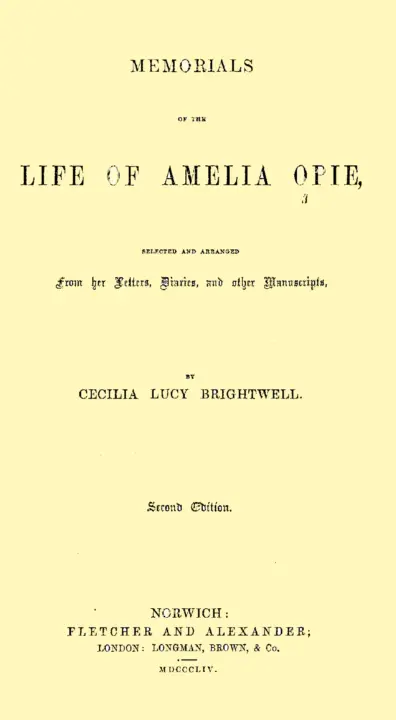
THE CLASSIC COLLECTION · 1854
"Memorials of the Life of Amelia Opie" by Amelia Opie is a biographical memoir written in the mid-19th century. The work compiles the life and experiences of Amelia Opie, detailing her upbringing, family influences, and significant events that shaped her character and artistic pursuits. Through this memoir, readers gain insight into her personal reflections, relationships, and the social context of her time. The opening of the memoir introduces the reader to Opie's early life, focusing on her birth, parentage, and formative years in Norwich. It emphasizes her close bond with her father, Dr. James Alderson, following the death of her mother when Amelia was a child. As she recounts her childhood experiences, including her early fears and her mother's methods of nurturing her, the foundation for Opie's lifelong values of compassion and benevolence emerges. The narrative sets the stage for exploring her interests in literature and social issues, as well as her eventual prominence as a writer and artist. This opening portion memorably blends personal narrative with broader themes of family, loss, and the shaping of one's character through early experiences.
Introduction adapted from the source catalogue; source summaries may be automatically generated.
Free to read · English · 139,153 words · No account needed
MAKE TIME FOR A GOOD BOOK
On by default. Untick to stop anonymous reading totals. Each page counts after 10 seconds in view. How this works.
Anonymous counting is on unless you have switched it off.
On the whole, we came away disappointed, from having formed false ideas of the nature of the infliction which we had gone to contemplate. I have since then seen madness in many different asylums, but I was never disappointed again.
Faithful to the views with which I began this little sketch of my childhood and my early youth, I will here relate a circumstance which was romantic enough to add fresh fuel to whatever I had already of romance in my composition; and therefore is another proof that, from the earliest circumstances with which human beings are surrounded, the character takes its colouring through life. Phrenologists watch certain bumps on the head, indicative, they say, of certain propensities, and assert that parents have a power to counteract, by cultivation, the bad propensities, and to increase the good. This may be a surer way of going to work; but, as yet, the truth of their theory is not generally acknowledged. In the meanwhile, I would impress on others what I am fully sensible of myself; namely, that the attention of parents and instructors should be incessantly directed to watching over the very earliest dispositions and tastes of their children or pupils, because, as far as depends on mere human teaching, whatever they are in disposition and pursuit in the earliest dawn of existence, they will probably be in its meridian and its decline.
When I was scarcely yet in my teens, a highly respected friend of mine, a member of the Society of Friends, informed me that she had a curious story to relate to me and her niece, my favourite friend and companion; she told us that her husband had received a letter from a friend at Lynn, recommending to his kindness a young man, named William Henry Renny, who was a sailor, just come on shore from a distant part, and wanted some assistance on his way (I think) to London. My friend, who was ever ready to lend his aid when needed, and was sure his correspondent would not have required it for one unworthy, received the young man kindly, and ordered him refreshments in the servants’ hall; and, as I believe, prepared for him a bed in his own house. But before the evening came, my friend had observed something in the young man’s manner which he did not like; he was too familiar towards the servants, and certainly did not seem a proper inmate for the family of a Friend. At length, in consequence of hints given him by some one in the family, he called the stranger into his study, and expressed his vexation at learning that his conduct had not been quite correct. The young man listened respectfully to the deserved rebuke, but with great agitation and considerable excitement, occasioned perhaps, as my candid friend thought, by better meals than he had been used to, and which was therefore a sort of excuse for his behaviour; but little was my friend prepared for the disclosure that awaited him. Falling on his knees, the young man, with clasped hands, conjured his hearer to forgive him the imposition he had practised. “Oh, sir,” cried he, “I am an impostor, my name is not William Henry R. but Anna Maria Real, I am not a man, but a woman!” Such a confession would have astounded any one; judge then how it must have affected the correct man whom she addressed! who certainly did not let the woman remain in her abject position, but desired immediately to hear a true account of who and what she was. She said, that her lover, when very young, had left her to go to sea, and that she resolved to follow him to Russia, whither he was bound; that she did follow him, disguised as a sailor, and had worked out her passage undetected. She found her lover dead, but she liked a sailor’s life so well, that she had continued in the service up to that time, when (for some reason which I have forgotten) she left the ship, and came ashore at Lynn, not meaning to return to it, but to resume the garb of her sex. On this latter condition, my friend and his wife were willing to assist her, and endeavour to effect a reformation in her. The first step was to procure her a lodging that evening, and to prevent her being seen, as much as they could, before she had put on woman’s clothes. Accordingly, she was sent to lodgings, and inquiries into the truth of her story were instituted at Lynn and elsewhere.
Your reading position is saved on this browser. Take it to another device with a library code. Reading pages adapt to text, rather than matching a printed edition.
BEHIND THE BOOK
This eBook is for the use of anyone anywhere in the United States and most other parts of the world at no cost and with almost no restrictions whatsoever. You may copy it, give it away or re-use it under the terms of the Project Gutenberg License included with this eBook or online at www.gutenberg.org. If you are not located in the United States, you will have to check the laws of the country where you are located before using this eBook. Read the source licence.
The original source file, including credits and licence, is retained by this library. Request an original-format copy at no charge. Please include the book title and Project Gutenberg identifier #47595.
KEEP YOUR CURIOSITY GOING
John L. Ransom

Herman W. Mudgett

Harriet Monroe
Daniel Dulany Addison
Charles Lanman

Harold Rosher