THE CLASSIC COLLECTION✦Andersonville diaryCLASSIC FREE BOOKS
Andersonville diary
John L. Ransom
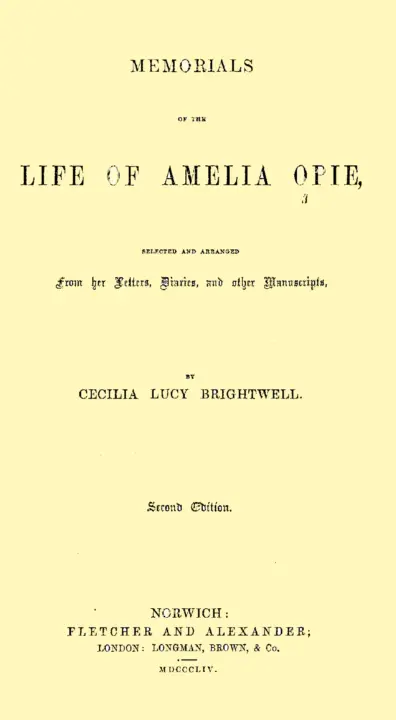
THE CLASSIC COLLECTION · 1854
"Memorials of the Life of Amelia Opie" by Amelia Opie is a biographical memoir written in the mid-19th century. The work compiles the life and experiences of Amelia Opie, detailing her upbringing, family influences, and significant events that shaped her character and artistic pursuits. Through this memoir, readers gain insight into her personal reflections, relationships, and the social context of her time. The opening of the memoir introduces the reader to Opie's early life, focusing on her birth, parentage, and formative years in Norwich. It emphasizes her close bond with her father, Dr. James Alderson, following the death of her mother when Amelia was a child. As she recounts her childhood experiences, including her early fears and her mother's methods of nurturing her, the foundation for Opie's lifelong values of compassion and benevolence emerges. The narrative sets the stage for exploring her interests in literature and social issues, as well as her eventual prominence as a writer and artist. This opening portion memorably blends personal narrative with broader themes of family, loss, and the shaping of one's character through early experiences.
Introduction adapted from the source catalogue; source summaries may be automatically generated.
Free to read · English · 139,153 words · No account needed
MAKE TIME FOR A GOOD BOOK
On by default. Untick to stop anonymous reading totals. Each page counts after 10 seconds in view. How this works.
Anonymous counting is on unless you have switched it off.
The poor man entered; he was a short, thick, middle-aged, ruddy looking man, clad in a very handsome slop of unbleached linen, very handsomely worked round the neck and at the wrists; and I received him very kindly, and seated him by me. Perry, of the Morning Chronicle, was one of my visitors, and some half dozen ladies and one or two gentlemen, who seemed inclined to laugh. Perry and Hogg nodded at each other, and P. said, “I have just been seeing Mr. Hogg at Lady Cork’s; and Mr. H., I find has a kind of divining power—he knows who persons are, by their countenances. On the Countess of Mornington’s (Duke of W.’s mother) asking him what he thought she was, he said she was, he saw, a woman of great courage. ‘I am the mother of a Hero,’ was her reply.” Still I saw Hogg did not like Perry, and he soon interrupted him, saying to me, “I am come to read you a poem of mine, for I hear you are a poet—a poem on Hop.” (I ought to say his dialect was quite new to me.) “Oh! by all means,” I replied, “ah! a poem on hops; you are a Kentish man perhaps.” “No,” he thundered out, “on Hop, Hop.”—and I had then wit enough to understand he meant Hope. “Better and better, (said I,) where is your poem?” “I will go fetch it—it is outside the door;” and he went for it. When he was gone, Perry took his seat, by me, and we were talking of this strange visitant, when he returned, and instantly exclaimed to P. “that’s my place;—what do you mean by taking it? get up!” and really, had P. resisted, it seemed likely that a blow would have followed the words; but Perry obeyed, and while Hogg was reading his manuscript, I went to the chimney-piece and took down a large bottle of lavender water, which, as it was a hot day, I carried round to the company, and then offered it to him also, to smell at. “No, no,” said he, “if I took any it would be in a glass;” evidently taking it for a dram: and I had difficulty in keeping my guests from indecorous mirth; at last the poor man (in whose bright eye I thought I read more than incipient insanity) began to read; but with such difficulty, (for it was not in his own hand-writing,) that I humbly requested to be allowed to read it for him, and he consented; and I did read it, and really was surprised to find how good many of the lines were; and I own, I did improve some of them, when the measure halted, by adding words. He seemed much pleased, poor man, and we got through the whole. Some of the guests who were there at the first, stole away, ’ere I had done; and others coming in, I pointed them to a chair, while they listened, and looked, in utter astonishment! It was a scene indeed! When the MS. was returned, my servant came up to tell Mr. H. that Lady Cork had sent her servant to see him back to her house; “tell the fellow I will not go yet, and I can go alone;” and he re-seated himself. Not long after, came in my cousin T. A. The servant had told him Lady C. had sent a poor crazy man to me, and I could not get rid of him; so he hastened up, to rid me of the guest he supposed to be forced on me, by the Countess; but when I met him smiling, and told him Mr. H. had come to read me a pretty poem, he with difficulty suppressed a laugh, and sat down meekly. But soon after came up another message, “Madam, Lady C. has sent another servant for Mr. H.; and says he must come directly!” “Must! I won’t come; I know my way,” was Hogg’s reply; and the bard of Hope had almost thrown me into Despair—the despair of getting rid of him,—when I bethought me to try to convince him civility obliged him to go to Lady C., as I was sure she wished much to introduce him and his poem to others of her friends; and, at last, I prevailed on him to go, my cousin most politely seeing him downstairs. I saw him no more; and, I think, two days afterwards, the poor man, sick to death of London, and of being made a show of, took French leave, one morning early; and I believe he took with him both Lady C.’s gifts, the blanket and the blouse.
Your reading position is saved on this browser. Take it to another device with a library code. Reading pages adapt to text, rather than matching a printed edition.
BEHIND THE BOOK
This eBook is for the use of anyone anywhere in the United States and most other parts of the world at no cost and with almost no restrictions whatsoever. You may copy it, give it away or re-use it under the terms of the Project Gutenberg License included with this eBook or online at www.gutenberg.org. If you are not located in the United States, you will have to check the laws of the country where you are located before using this eBook. Read the source licence.
The original source file, including credits and licence, is retained by this library. Request an original-format copy at no charge. Please include the book title and Project Gutenberg identifier #47595.
KEEP YOUR CURIOSITY GOING
John L. Ransom

Herman W. Mudgett

Harriet Monroe
Daniel Dulany Addison
Charles Lanman

Harold Rosher