THE CLASSIC COLLECTION✦Andersonville diaryCLASSIC FREE BOOKS
Andersonville diary
John L. Ransom
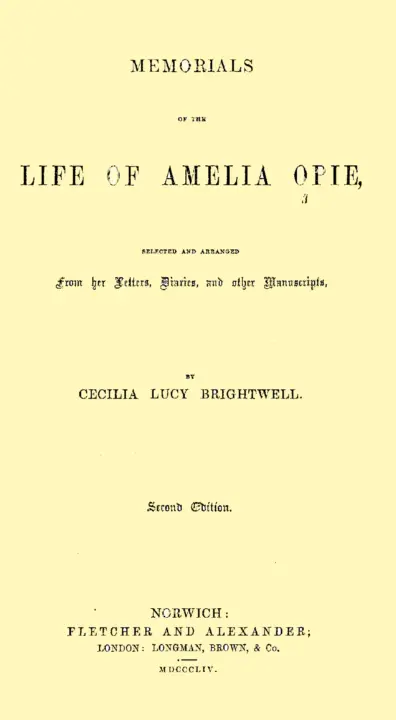
THE CLASSIC COLLECTION · 1854
"Memorials of the Life of Amelia Opie" by Amelia Opie is a biographical memoir written in the mid-19th century. The work compiles the life and experiences of Amelia Opie, detailing her upbringing, family influences, and significant events that shaped her character and artistic pursuits. Through this memoir, readers gain insight into her personal reflections, relationships, and the social context of her time. The opening of the memoir introduces the reader to Opie's early life, focusing on her birth, parentage, and formative years in Norwich. It emphasizes her close bond with her father, Dr. James Alderson, following the death of her mother when Amelia was a child. As she recounts her childhood experiences, including her early fears and her mother's methods of nurturing her, the foundation for Opie's lifelong values of compassion and benevolence emerges. The narrative sets the stage for exploring her interests in literature and social issues, as well as her eventual prominence as a writer and artist. This opening portion memorably blends personal narrative with broader themes of family, loss, and the shaping of one's character through early experiences.
Introduction adapted from the source catalogue; source summaries may be automatically generated.
Free to read · English · 139,153 words · No account needed
MAKE TIME FOR A GOOD BOOK
On by default. Untick to stop anonymous reading totals. Each page counts after 10 seconds in view. How this works.
Anonymous counting is on unless you have switched it off.
On the 30th the travellers left Baden, in company with friends, (and friends and acquaintances they met at every turn,) and on the 1st of October reached Friburg; with the interior of the cathedral they were much struck, and its “windows, all of painted glass, such as I never saw before;” the Journal proceeds;—
From thence we set off for Boldbach, en route to the Falls, and soon turning into a valley, went up, on foot, a very steep, narrow, rocky defile, the river rolling and talking beneath, the rocks and mountains so high, that in the carriage it was difficult to see to the top, the vale was so narrow! It was sublimely grand to look back, and so repeatedly did the road wind, that it seemed we were blocked in by rocks! this was the Black Forest, and the famous gorge d’enfer. The next thing, worthy of equal admiration, was the Black Forest itself, through which we passed, and the latter part of it we had the moon to light us through. Before we reached the forest, we saw the Alps, and, for some time, some nearer and plainer than others. Oh! it was glorious!
(3rd of 10th mo.) Rose at five, but not off till past seven; and I was going to the Falls of the Rhine! At length I heard them roar, and saw them smoke! and as soon as the voiture stopped at the inn, I ran off to the Falls.
TO THOMAS BRIGHTWELL. Hotel of the Rhine Falls, 10th mo., 3rd, 1835.
I think, my dear friend, thou wilt not be sorry to hear a little of my goings on. * * Thou didst not come as far as this spot, and my journey has been extended much beyond my original plan; but I am so delighted with the Rhine, that I could not resist the temptation and opportunity—one which cannot occur again—of seeing it in its wondrous beauty here. Three times have I visited the Falls to-day, and, if the moon rises bright, I am to visit them again. We came yesterday from Friburg, and to that place we went from Baden Baden—a beautiful spot, but there is no water except in the environs, and I admire no place where water is not. Friburg Cathedral is most beautiful; they say Strasburg is finer—nous verrons. From F. our route lay through a very steep mountainous country, and through the Black Forest, that haunt of banditti in former times, and the scene of so many tales and romances. It is sublime in its dark-browed beauty still, and a fine moon added to the solemn calm of the scene. But the Alps! long before we saw the Forest the snow mountains were in sight—and also long before we were in Switzerland, Swiss cottages, Swiss chalets, and Swiss costumes, met our eyes at every turn. We went, just after we left Friburg, up a steep rocky defile, and up mountains, and through forests, to the top of which our eyes could scarcely reach, and in which the exquisite beauty of foliage and colouring went de pair with sublimity—and from the top of these passes the snow mountains first met my eager gaze. This morning we set off at six precisely; we are at present travelling in a returned carriage—which holds us and our luggage, and we find such modes of conveyance the cheapest and best. It was half-past twelve when we reached this hotel: chemin faisant I heard the roar of the Falls, and saw them smoke, and while my friend staid to eat her breakfast, I (who had had coffee before starting) could not delay my visit to this long-desired scene, and I hurried down a steep path to it, which, if under less powerful influences, I should have cautiously trodden—but I arrived safe at a railing near the fall, and was awhile satisfied! but I soon changed my place, and walked till I came in front of the mighty torrent. Oh! those busy restless waters—no one can fancy what they are! they must be seen to be conceived of! Some persons are disappointed when they see them, and, in one respect, so should I have been, had not prints prepared me for what I was to expect. I am used to see and admire cascades that fall from a height, over one narrow rock, and then over another—and perhaps over another still; but this is, I may say, like Niagara, a table or flat fall. It is a wide river, coming to an edge or wall of rocks, and leaping over them—then gracefully rolling on, like liquified aqua marine—that beautiful green stone of such exquisite tint and clearness. The chute itself is like the purest snow; but, ever and anon, as the sun shone on it, some of the tumbling masses, falling over the rocks below the great fall, were like liquid sapphires and of the palest purest blue. Still the Rhine here is, as a river, unlike its usual self, of the full green blue, like the precious stone named above. In its best dress, where the boats go, thou mayst remember, it is of that undefinable light, pale-blueish green, the colour of Dresden china. When it flows smoothly on at this place, it turns up a narrow channel, and glides along through richly wooded rocks, and is seen no more! Oh! it is a glorious river! and had it no banks, I should love it for itself alone! There is something awful in the constant roar and eternal motion of these waters! The sea is sometimes calm, and its roar becomes a gentle murmuring, but these rolling waterfalls seem to know no change, but fall and roar for ever, exempt from the common doom of created things, which is to alter and to end. There is an inhabited castle on a rock beside the Rhine-falls; I should like to know whether its inhabitants have, of necessity, acquired the habit of speaking so loud as to break the drum of the ears of their acquaintances!
Your reading position is saved on this browser. Take it to another device with a library code. Reading pages adapt to text, rather than matching a printed edition.
BEHIND THE BOOK
This eBook is for the use of anyone anywhere in the United States and most other parts of the world at no cost and with almost no restrictions whatsoever. You may copy it, give it away or re-use it under the terms of the Project Gutenberg License included with this eBook or online at www.gutenberg.org. If you are not located in the United States, you will have to check the laws of the country where you are located before using this eBook. Read the source licence.
The original source file, including credits and licence, is retained by this library. Request an original-format copy at no charge. Please include the book title and Project Gutenberg identifier #47595.
KEEP YOUR CURIOSITY GOING
John L. Ransom

Herman W. Mudgett

Harriet Monroe
Daniel Dulany Addison
Charles Lanman

Harold Rosher